
[論文レビュー] Reliability of lattice gauge theories in the thermodynamic limit
本稿は、スピン-S表現が大きい場合でさえも、格子規範理論におけるエネルギー罰則保護が熱力学的極限においても規範不変性を保つことを示している。解析的に、2つの出現する有効理論——調整された規範理論と再正則化された規範理論——を同定し、それぞれの系の力学を $\sqrt{V/V_0^3}$ および $\exp(V/V_0)/V_0$ のスケールに比例する時間スケールまで正確に記述している。保護強度 $V$ は $S^2$ に比例し、体積に依存しない。
Although gauge invariance is a postulate in fundamental theories of nature such as quantum electrodynamics, in quantum-simulation implementations of gauge theories it is compromised by experimental imperfections. In a recent work [Halimeh and Hauke, \href{https://journals.aps.org/prl/abstract/10.1103/PhysRevLett.125.030503}{Phys. Rev. Lett. extbf{125}, 030503 (2020)}], it has been shown in finite-size spin-$1/2$ quantum link lattice gauge theories that upon introducing an energy-penalty term of sufficiently large strength $V$, unitary gauge-breaking errors at strength $λ$ are suppressed $\proptoλ^2/V^2$ up to all accessible evolution times. Here, we show numerically that this result extends to quantum link models in the thermodynamic limit and with larger spin-$S$. As we show analytically, the dynamics at short times is described by an extit{adjusted} gauge theory up to a timescale that is at earliest $τ_ ext{adj}\propto\sqrt{V/V_0^3}$, with $V_0$ an energy factor. Moreover, our analytics predicts that a renormalized gauge theory dominates at intermediate times up to a timescale $τ_ ext{ren}\propto\exp(V/V_0)/V_0$. In both emergent gauge theories, $V$ is volume-independent and scales at worst $\sim S^2$. Furthermore, we numerically demonstrate that robust gauge invariance is also retained through a single-body gauge-protection term, which is experimentally straightforward to implement in ultracold-atom setups and NISQ devices.
研究の動機と目的
- 実験的不備により規範不変性が破れる状況下でも、格子規範理論が熱力学的極限において信頼できるかを確立すること。
- 有限サイズ系で示されたエネルギー罰則保護が、熱力学的極限およびより大きなスピン-S表現に対しても有効であるかを調査すること。
- 保護下での規範破壊誤差に起因する有効力学を解析的に導出し、調整されたおよび再正則化された規範理論によって支配される別々の時間スケールを同定すること。
- 保護強度 $V$ が体積に依存せず、最悪でも $S^2$ に比例することを検証し、量子シミュレータにおけるスケーラビリティを可能にすること。
- 超冷却原子系およびNISQデバイス実装における単体的規範保護項のロバスト性を示すこと。
提案手法
- 無限大マトリックス積状態(iMPS)を用いた数値シミュレーションにより、熱力学的極限におけるスピン-S量子リンク模型のクイエンチダイナミクスを研究する。
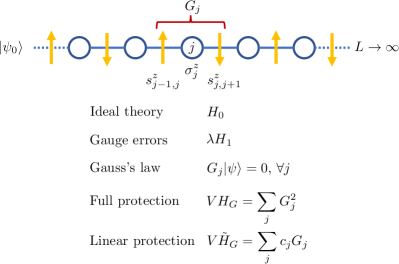
- 全エネルギー罰則 $V H_G = V \sum_j G_j^2$ と線形保護項 $V \tilde{H}_G = V \sum_j c_j G_j$ の適用。$c_j$ は量子ゼノ効果を誘発するために選択される。
- アバニン=ドロエック=ホー=フーヴェネルズ(ARHH)法を拡張し、局所的・フラストレーションフリーでギャップを持つ保護ハミルトニアン下での制約付き量子ダイナミクスに対する普遍的上限を導出する。
- 調整された規範理論ハミルトニアン $H_{\text{adj}} = H_0 + \lambda \mathcal{P}_0 H_1 \mathcal{P}_0$ の解析的導出。これは時間スケール $\tau_{\text{adj}} \propto \sqrt{V/V_0^3}$ まで有効であり、$\mathcal{P}_0$ は物理部分空間への射影である。
- 保護強度の非摂動的効果に起因し、非摂動的安定化を示す、中間時間スケールで支配的となる再正則化された規範理論の同定。時間スケールは $\tau_{\text{ren}} \propto \exp(V/V_0)/V_0$ に比例する。
- 量子ゼノ効果を用いて線形保護の妥当性を正当化し、誤差境界は $\sim t V_0^2 L^2 / V$ に比例し、時間スケールは $\propto V/(V_0 L)^2$ に比例する。
実験結果
リサーチクエスチョン
- RQ1エネルギー罰則保護は、より大きなスピン-S表現を有する格子規範理論の熱力学的極限においても規範不変性を維持できるか?
- RQ2強い保護下で、規範破壊誤差に起因する有効力学は何か?また、保護強度 $V$ にどのように依存するか?
- RQ3有効力学が有効である時間スケールは、体積に依存せず、$S$ にスケーリング可能か?
- RQ4量子ゼノ効果は線形保護方式における規範保護にどのように寄与するか?また、その結果得られる誤差境界は何か?
- RQ5単体的規範保護項は、超冷却原子系やNISQデバイスのような実験的に実現可能な設定において、強固な保護を提供できるか?
主な発見
- 系のダイナミクスは、時間スケール $\tau_{\text{adj}} \propto \sqrt{V/V_0^3}$ まで、調整された規範理論 $H_{\text{adj}} = H_0 + \lambda \mathcal{P}_0 H_1 \mathcal{P}_0$ によって正確に記述され、誤差は $\sim t^2 V_0^3 / V$ で有界である。
- 物理的誤差項 $\lambda H_1$ に対して、$\mathcal{P}_0 H_1 \mathcal{P}_0 = 0$ であるため、この順序では有効補正が存在しない。
- 中間時間スケールでは再正則化された規範理論が支配的であり、時間スケール $\tau_{\text{ren}} \propto \exp(V/V_0)/V_0$ に比例する。これは、規範不変性の非摂動的安定化を示している。
- 保護強度 $V$ は体積に依存せず、$S$ が大きい極限では最悪でも $S^2$ に比例する。これは、量子シミュレーションにおけるスケーラビリティを保証する。
- 単体的規範保護項——特に非適合シーケンス $c_j = (-1)^{j+1}$ を用いた線形保護——は、量子ゼノ効果により強固な規範不変性を達成し、誤差境界は $\sim t V_0^2 L^2 / V$ に比例する。
- 数値結果により、全保護および線形保護の両方のスキームが、iMPSシミュレーションにおける結合次元の変化に対しても収束し、強固な規範不変性を維持することが確認された。
![Figure 2: (Color online). Gauge violation as given in Eq. ( 6 ) as function of gauge-spin length $S$ [(a) $S=1/2$ , (b) $S=1$ , (c) $S=3/2$ , and (d) $S=2$ ], computed in the thermodynamic limit using iMPS. The initial state, outlined in Fig. 1 , is quenched with Hamiltonian $H_{0}+\lambda H_{1}+VH_](https://ar5iv.labs.arxiv.org/html/2104.07040/assets/x2.png)
より良い研究を、今すぐ始めましょう
論文の読解から最終レビューまで、研究時間を劇的に削減しましょう。
クレジットカード登録不要
このレビューはAIが作成し、人間の編集者が確認しました。