
[論文レビュー] Resolving the nature and putative nebular emission of GS9422: an obscured AGN without exotic stars
本研究は z=5.943 にある GS9422 を JWST の imaging と spectroscopy を用いて、nebular emission が連続体を支配していないこと、そして銀河がダムド Ly-α 雲を伴う隠れ型2AGNをホストしていることを示す。
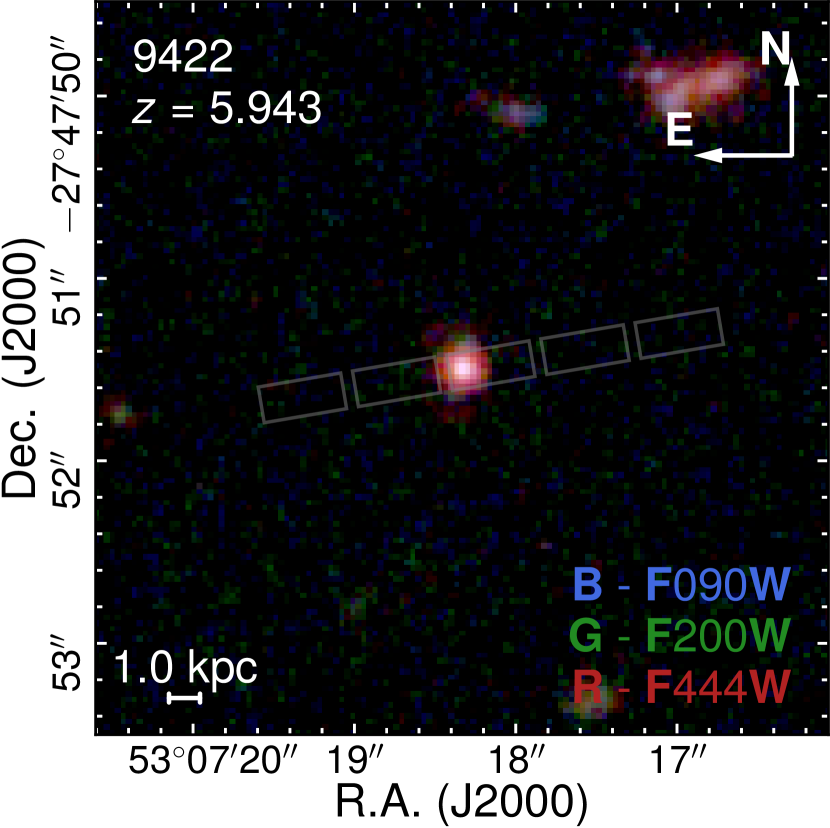
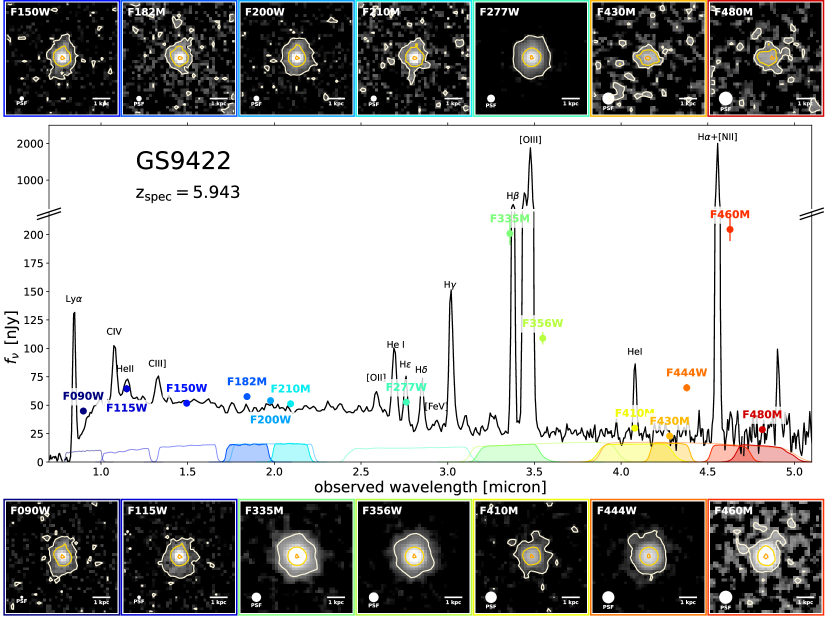
Understanding the sources that power nebular emission in high-redshift galaxies is fundamentally important not only for shedding light onto the drivers of reionisation, but to constrain stellar populations and the growth of black holes. Here we focus on an individual object, GS9422, a galaxy at $z_{ m spec}=5.943$ with exquisite data from the JADES, JEMS and FRESCO surveys, including 14-band JWST/NIRCam photometry and deep NIRSpec prism and grating spectroscopy. We map the continuum emission and nebular emission lines across the galaxy on 0.2-kpc scales. GS9422 has been claimed to have nebular-dominated continuum and an extreme stellar population with top-heavy initial mass function. We find clear evidence for different morphologies in the emission lines, the rest-UV and rest-optical continuum emission, demonstrating that the full continuum cannot be dominated by nebular emission. While multiple models reproduce the spectrum reasonably well, our preferred model with a type-2 active galactic nucleus (AGN) and local damped Ly-$α$ (DLA) clouds can explain both the spectrum and the wavelength-dependent morphology. The AGN powers the off-planar nebular emission, giving rise to the Balmer jump and the emission lines, including Ly-$α$, which therefore does not suffer DLA absorption. A central, young stellar component dominates the rest-UV emission and -- together with the DLA clouds -- leads to a spectral turn-over. A disc-like, older stellar component explains the flattened morphology in the rest-optical continuum. We conclude that GS9422 is consistent with being a normal galaxy with an obscured, type-2 AGN -- a simple scenario, without the need for exotic stellar populations.
研究の動機と目的
- GS9422 における nebular emission の起源を調査し、連続体が nebular-dominated かどうかを評価する。
- スペクトルと形態を説明する競合する仮説(stellar、AGN、または混合)を検証する。
- 発光線、rest-UV、rest-optical 連続体の空間分布を決定し、エネルギー源を推定する。
- 14-band NIRCam photometry と深い NIRSpec spectroscopy を用いて恒星および ISM の性質を制約する。
- 観測を説明するためにエキゾチックな星集団(例:トップヘビーな IMF)が必要か評価する。
提案手法
- 14-band JWST/NIRCam photometry と深い NIRSpec prism および grating spectroscopy を用いて、約0.2 kpc スケールで連続体と nebular lines をマップする。
- rest-UV 連続体、rest-optical 連続体、発光線を横断する非パラメトリック(等光度輪郭)およびパラメトリック(Sérsic)形態解析を行う。
- トレーサー(Ly-α、rest-UV、発光線、rest-optical 連続体)ごとに画像をスタックして形態を比較する。
- PSF で畳み込んだ光プロファイルを PySersic(および ForcePho)で前方モデル化し、各トレーサーの半光度半径、Sérsic 指数、離心率、位置角を導出する。
- 中間帯画像から EW マップと Balmer ジャンプの評価を用いて nebular- continuum 支配と AGN 寄与を検証する。
- スペクトルと波長依存の形態を fit するために、stellar only、AGN only、DLAs を含む AGN+stellar の複数の物理モデルを検討する。
実験結果
リサーチクエスチョン
- RQ1rest-frame 連続体は GS9422 全体で nebular emission により支配されているか、それとも恒星成分が著しく寄与しているのか。
- RQ2観測された波長依存の形態を、エキゾチックな星集団ではなく隠れた AGN のような単一のエネルギー源で説明できるか。
- RQ3AGN 活動、DLAs、恒星成分の組み合わせが、スペクトルと発光線・連続体の空間分布を最もよく説明するか。
- RQ4NIRCam の中間帯測定は Balmer ジャンプの存在と nebular continuum の強さを裏付けるか。
- RQ5GS9422 のスペクトルエネルギー分布と線比を説明するにはトップヘビー IMF のシナリオが必要か。
主な発見
- GS9422 では発光線、rest-UV 連続体、rest-optical 連続体でそれぞれ異なる形態を示し、連続体が nebular-dominated ではないことを示唆している。
- 最も適切なモデルは、スペクトルと波長依存の形態を説明する、局所的なダムド Ly-α 雲を伴う隠れ型2AGN の存在である。
- 中心部の若い恒星成分が rest-UV 発光を支配し、DLA 雲とともにスペクトルが短波長へと転じる要因となっている。
- 円盤状の古い恒星成分が rest-optical 連続体の扁平な形態を説明する。
- Ly-α、rest-UV 連続体、発光線は空間的に異なる広がりをもち、Ly-α が最も広く、rest-UV が最もコンパクトで、rest-optical 連続体は円盤状で rest-UV/線発光とほぼ90度異なる向きに配置される。
- GS9422 は exot ic な星集団や極端な IMF を必要とせず、隠れ型2AGN を伴う普通の銀河として解釈できる。
より良い研究を、今すぐ始めましょう
論文設計から論文執筆まで、研究時間を劇的に削減しましょう。
クレジットカード登録不要
このレビューはAIが作成し、人間の編集者が確認しました。