
[論文レビュー] Rethinking Medical Report Generation: Disease Revealing Enhancement with Knowledge Graph
本論文は、チークX線レポートにおける疾患の長尾分布に対処するために、知識グラフ(KG)を活用した二段階型の医療レポート生成フレームワークを提案する。137種類の疾患タイプを含む包括的なKGを構築し、KGガイドドのデータ拡張を適用することで、新規の指標「多様性感受性(DS)」を用いて臨床的妥当性を向上させ、ベースラインモデル比でDSに25%の相対的改善(0.1902)を達成し、希少疾患の記載が顕著に向上した。
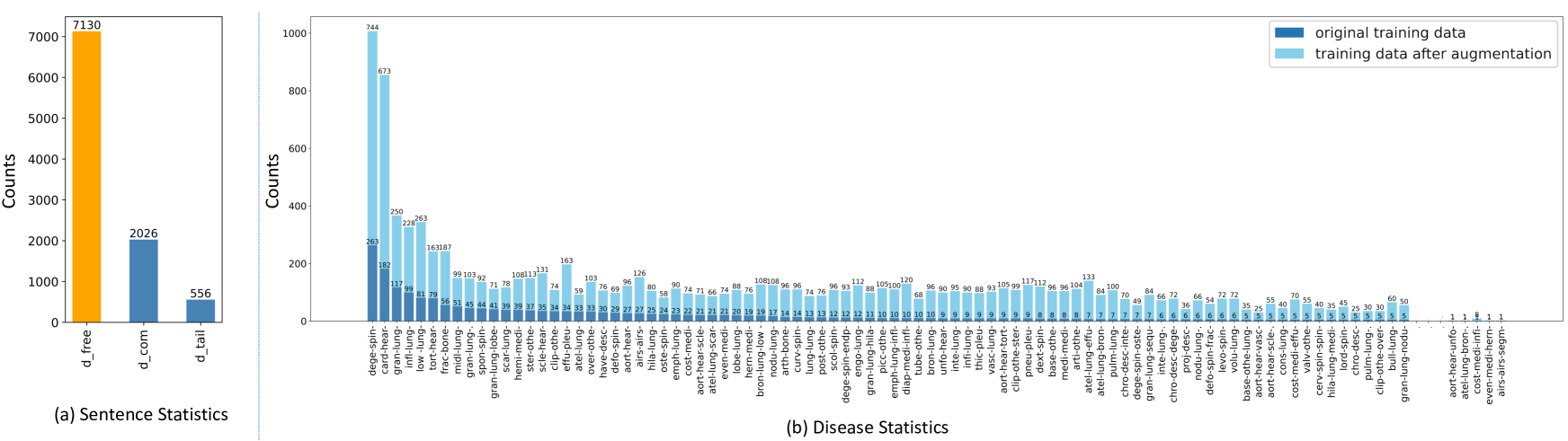
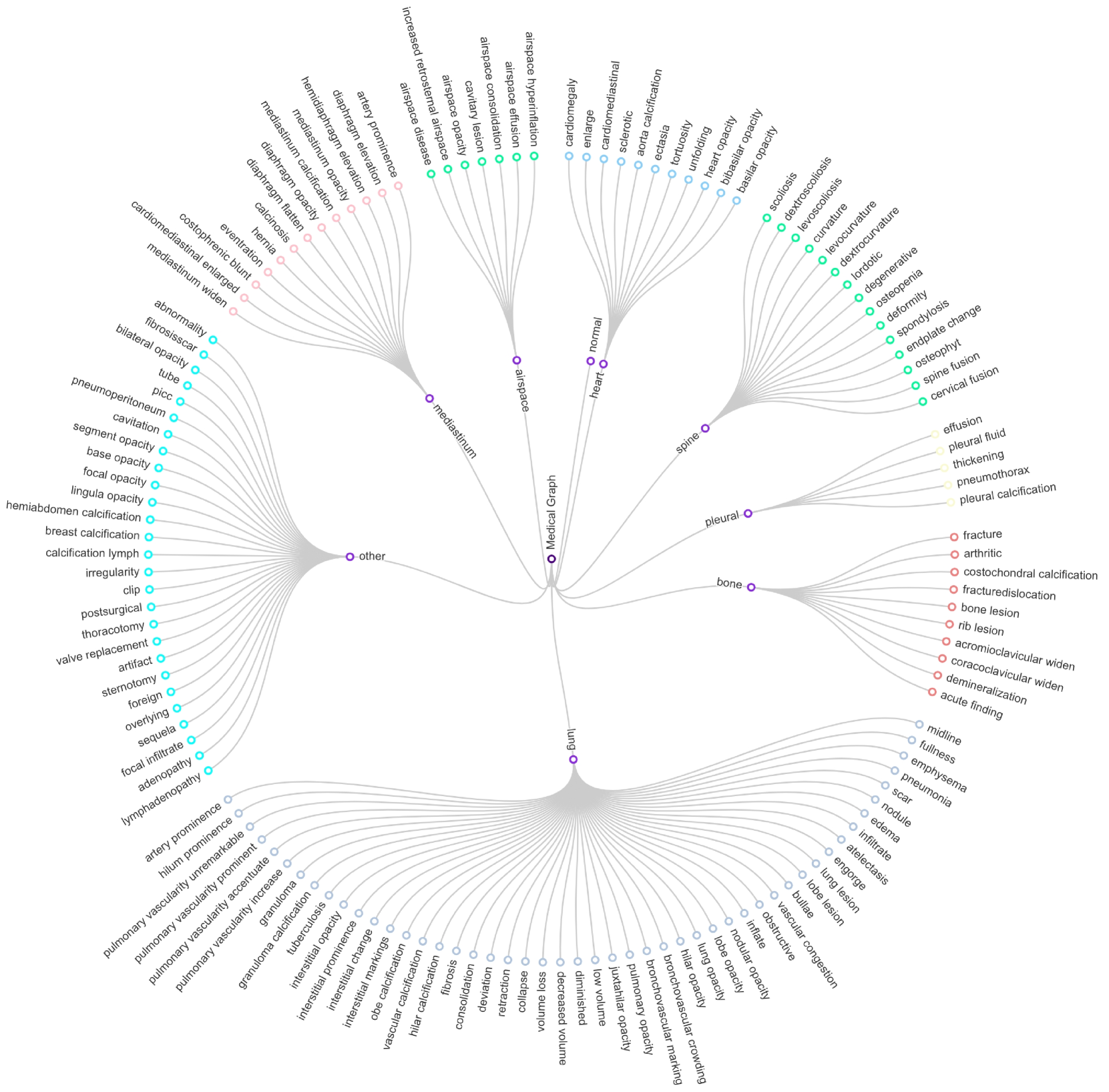
Knowledge Graph (KG) plays a crucial role in Medical Report Generation (MRG) because it reveals the relations among diseases and thus can be utilized to guide the generation process. However, constructing a comprehensive KG is labor-intensive and its applications on the MRG process are under-explored. In this study, we establish a complete KG on chest X-ray imaging that includes 137 types of diseases and abnormalities. Based on this KG, we find that the current MRG data sets exhibit a long-tailed problem in disease distribution. To mitigate this problem, we introduce a novel augmentation strategy that enhances the representation of disease types in the tail-end of the distribution. We further design a two-stage MRG approach, where a classifier is first trained to detect whether the input images exhibit any abnormalities. The classified images are then independently fed into two transformer-based generators, namely, ``disease-specific generator" and ``disease-free generator" to generate the corresponding reports. To enhance the clinical evaluation of whether the generated reports correctly describe the diseases appearing in the input image, we propose diverse sensitivity (DS), a new metric that checks whether generated diseases match ground truth and measures the diversity of all generated diseases. Results show that the proposed two-stage generation framework and augmentation strategies improve DS by a considerable margin, indicating a notable reduction in the long-tailed problem associated with under-represented diseases.
研究の動機と目的
- 医療レポート生成データセットにおける疾患の長尾分布、特に希少疾患の不足を是正すること。
- 特に希少疾患に対して正確かつ多様な疾患キーワードの記載を保証することで、生成レポートの臨床的妥当性を向上させること。
- 胸部X線疾患137種類を含む知識グラフ(KG)を構築し、疾患の関係性をモデル化するとともに、データ拡張と評価の支援を行うこと。
- 生成レポートにおける疾患キーワードの正確性と多様性を測る指標として、新規の評価指標「多様性感受性(DS)」を提案すること。
- KGに従った臨床的妥当性に基づく学習と評価が、BLEUなどの標準的N-gram指標よりも実世界での有用性を顕著に向上させることを示すこと。
提案手法
- 2つの公開データセット(IU-XrayとMIMIC-CXR)から、8つのカテゴリにまたがる137種類の疾患タイプを統合し、疾患の関係性をモデル化する包括的な知識グラフ(KG)を構築した。
- 二段階型の生成フレームワークを設計した:第一段階では、画像に異常が存在するかを分類器が検出する。第二段階では、分類結果に基づき、二つの別個のトランスフォーマベースの生成器が「疾患特異的」または「疾患非存在」のレポートを生成する。
- KGを用いて希少疾患クラスのための合成トレーニングサンプルを生成する新規なデータ拡張戦略を導入し、長尾分布のバランスを改善した。
- 多様性感受性(DS)指標を提案し、正解の疾患キーワードのリCALLと生成された疾患キーワードの多様性の両方を測定することで、モデルの性能を評価した。
- BLEUではなくDSスコアに基づいて学習とモデル選択を最適化し、N-gram一致よりも臨床的正確性を優先した。
- フレームワークはIU-Xrayデータセットで評価され、公平な比較のためR2Genベースラインと同一のハイパーパrameterと設定を採用した。
実験結果
リサーチクエスチョン
- RQ1既存の医療レポートデータセットにおける疾患頻度の長尾分布が、特に希少疾患の文脈でモデル性能に与える影響は何か?
- RQ2知識グラフを用いてデータ拡張をガイドし、医療レポート生成における低頻度疾患クラスの表現を改善することは可能か?
- RQ3疾患特異的と疾患非存在レポート生成を分離する二段階型生成フレームワークは、エンドツーエンドモデルに比べて、臨床的妥当性が向上するか?
- RQ4新規の評価指標である多様性感受性(DS)は、BLEUなどの標準的N-gram指標に比べ、医療レポート生成における臨床的有用性をよりよく反映できるか?
- RQ5DSに基づく学習は、BLEUに基づく学習に比べて、希少疾患の記載にどの程度向上をもたらすか?
主な発見
- KGベースの拡張を施した二段階型生成フレームワークは、DSスコア0.1902を達成し、R2Genの0.1523を顕著に上回り、疾患記載の検出と多様性の両面で優れた性能を示した。
- 本手法のDORスコアは0.5138であり、R2Genの0.2911を上回り、疾患検出とレポート品質のバランスが優れていることを示した。
- 拡張戦略を除去した場合、DSスコアは0.1634に低下し、データのバランス調整が希少疾患生成の向上に果たす重要性を裏付けた。
- 疾患特異的のみの生成器は高いDS(0.1955)を達成したが、DORが0であった。これは正常レポートを生成できないという臨床的限界を示している。
- BLEU最適化のR2Genモデルは高いBLEUスコアを達成したが、DS(0.0324)と感受性(0.0186)はほぼ0に近く、標準的指標が臨床的正確性を反映できないことを示した。
- 定性的分析により、本手法が「間質性透明度」や「浮腫」などの希少異常を、KGアノテーションキーワードと整合する臨床的妥当な記述として効果的に生成できていることが確認された。
より良い研究を、今すぐ始めましょう
論文の読解から最終レビューまで、研究時間を劇的に削減しましょう。
クレジットカード登録不要
このレビューはAIが作成し、人間の編集者が確認しました。