
[論文レビュー] Revisiting oldest stars as cosmological probes: new constraints on the Hubble constant
本研究は、最も古い星——球状銀河団、白色矮星、超微弱銀河——を独立した宇宙論的プローブとして再評価し、ハッブル定数 $H_0$ を制約する。形成赤方偏移 ($11 \leq z_f \leq 30$) と $\Omega_{\rm M} = 0.30 \pm 0.02$ に対して保守的な事前分布を用いたベイズ推論により、最も正確な個々の年齢推定から $H_0 < 70.6$ km/s/Mpc を導出し、部分群の平均をとった際には90.3%信用区間で $H_0 < 73.0$ km/s/Mpc を得た。これは、SH0ESの値よりもプランク2020の値を支持する。
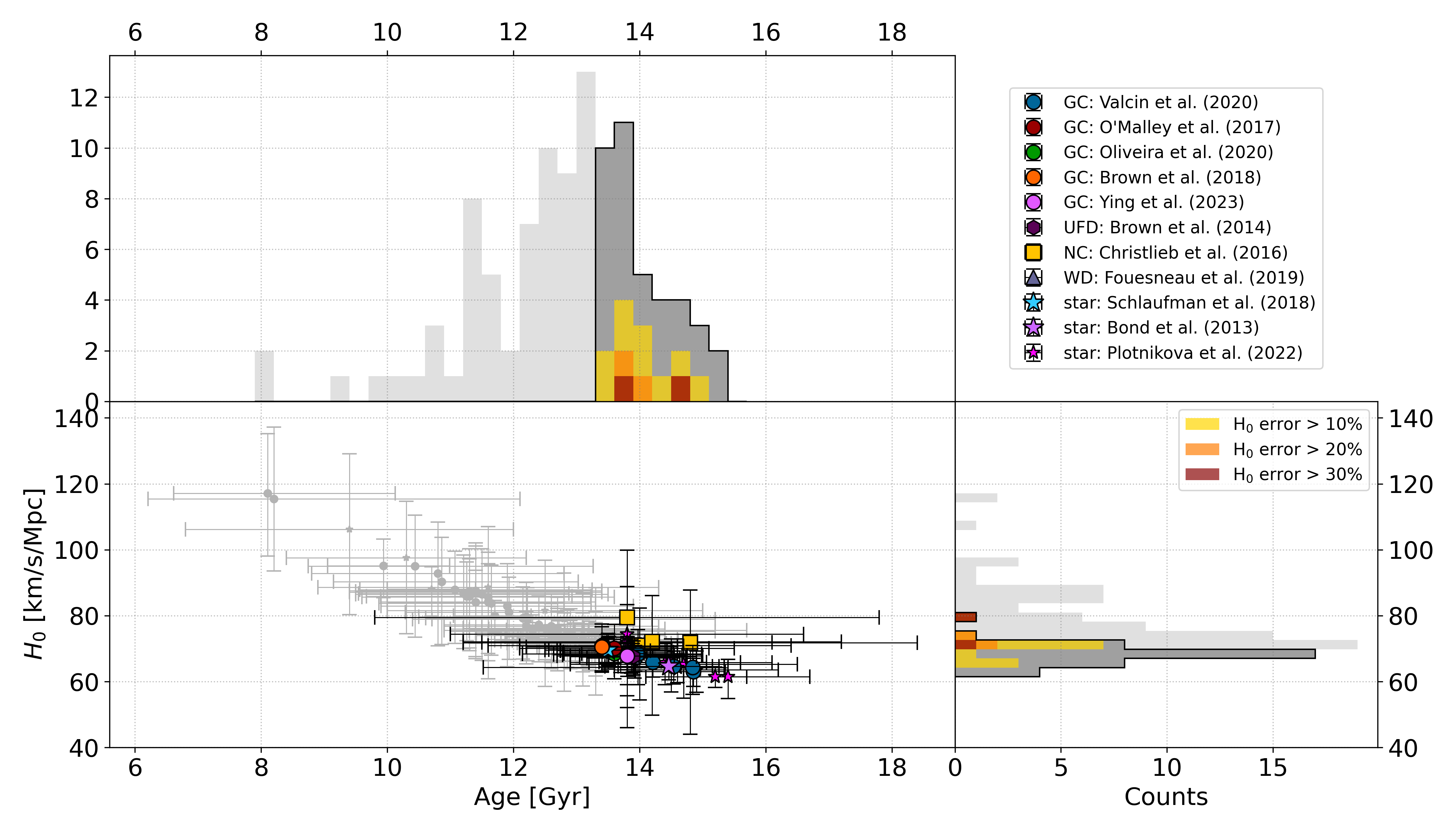
Despite the tremendous advance of observational cosmology, the value of the Hubble constant ($H_0$) is still controversial (the so called ``Hubble tension'') because of the inconsistency between local/late-time measurements and those derived from the cosmic microwave background. As the age of the Universe is very sensitive to $H_0$, we explored whether the present-day oldest stars could place independent constraints on the Hubble constant. To this purpose, we selected from the literature the oldest objects (globular clusters, stars, white dwarfs, ultra-faint and dwarf spheroidal galaxies) with accurate age estimates. Adopting a conservative prior on their formation redshifts ($11 \leq z_{ m f} \leq 30$) and assuming $Ω_{ m M} = 0.3 \pm 0.02$, we developed a method based on Bayesian statistics to estimate the Hubble constant. We selected the oldest objects ($>13.3$ Gyr) and estimated $H_0$ both for each of them individually and for the average ages of homogeneous subsamples. Statistical and systematic uncertainties were properly taken into account. The constraints based on individual ages indicate that $H_0<70.6$ km/s/Mpc when selecting the most accurate estimates. If the ages are averaged and analyzed independently for each subsample, the most stringent constraints imply $H_0<73.0$ with a probability of 90.3% and errors around 2.5 km/s/Mpc. We also constructed an ``accuracy matrix'' to assess how the constraints on $H_0$ become more stringent with further improvements in the accuracy of stellar ages and $Ω_{ m M}$. The results show the high potential of the oldest stars as independent and competitive cosmological probes not only limited to the Hubble constant.
研究の動機と目的
- 最も古い星がハッブル定数 $H_0$ を制約する独立した宇宙論的プローブとしての可能性を評価すること。
- 最も観測可能な物体の年齢が宇宙の年齢より若い必要があることから、ハッブル緊張問題を解消するための年齢の利用。
- 星の年齢推定と宇宙論的パラメータにおける統計的・系統的不確実性を考慮するベイズフレームワークの構築。
- 年齢と $\Omega_{\rm M}$ の精度向上が $H_0$ の制約をどの程度強化できるかを定量化すること。
- 観測された星の年齢が、晩期宇宙($H_0$)と初期宇宙($H_0$)の測定値(特にプランク2020対SH0ES)とどの程度整合するかを評価すること。
提案手法
- 平坦な $\Lambda$CDMモデル下で、最も古い星の年齢を用いて $H_0$ を推定するベイズ推論を適用する。
- モデル依存性を最小限に抑えるために、形成赤方偏移 $z_f \in [11, 30]$ に対して保守的な一様事前分布を課す。
- CMBデータとは独立した晩期宇宙プローブに基づき、$\Omega_{\rm M} = 0.30 \pm 0.02$ に対してガウス事前分布を用いる。
- 年齢 $t$ と $H_0$ を結ぶ積分関係式 $H_0 = A / t \int_0^{z_f} [\Omega_{\rm M}(1+z)^3 + (1 - \Omega_{\rm M})]^{-1/2} dz$ を使用する。
- 年齢が 13.3 Gyr 以上の 39 個の対象を分析し、個々の $H_0$ 値と同質な部分群(例:球状銀河団、白色矮星)での平均値を計算する。
- 将来の星の年齢と $\Omega_{\rm M}$ の不確実性の向上が $H_0$ の制約をどの程度強化するかを予測するための「精度行列」を構築する。

実験結果
リサーチクエスチョン
- RQ1現在の宇宙における最も古い星の年齢は、ハッブル定数 $H_0$ を独立して制約できるか?
- RQ2星の年齢推定における系統的不確実性が導かれる $H_0$ 値に与える影響は何か?また、それらは軽減可能か?
- RQ3観測された最も古い星の年齢は、CMBのプランク2020と局所測定のSH0ESによる $H_0$ 値とどの程度整合するか?
- RQ4星の年齢精度の向上が $H_0$ の不確実性をどの程度低減できるか?
- RQ5最も古い星は、ハッブル緊張問題を解消する試みとしての初期ダークエネルギーモデルと標準 $\Lambda$CDM モデルを区別するのに役立つだろうか?
主な発見
- 最も正確な個々の年齢推定から、高い信頼性で $H_0 < 70.6$ km/s/Mpc を得た。これは $H_0$ の低い値を支持する。
- 同質な部分群内での年齢の平均をとった場合、90.3%信用区間の $H_0$ 上限は $73.0$ km/s/Mpc であり、これは SH0ES の値 $73.04 \pm 1.04$ km/s/Mpc よりも低い。
- 結果は、プランク2020の $H_0$ 値($67.4 \pm 0.5$ km/s/Mpc)が、SH0ES の値よりも最も古い星の年齢に基づく観点から強く支持されていることを示している。
- 系統的不確実性としての $\Omega_{\rm M}$ 事前分布の寄与は最大で $\sigma_{\rm syst} = 2.37$ km/s/Mpc であり、この手法が事前分布の仮定に対して頑健であることを示している。
- 精度行列の結果、星の年齢不確実性を $\lesssim 0.3-0.4$ Gyr まで低下させれば、$H_0$ の制約が $\sim 1-2$ km/s/Mpc まで tightened され、他の宇宙論的プローブと同等の精度に達する可能性がある。
- 本研究は、最も古い星が宇宙論的プローブとして実用的であるだけでなく、非常に有望であることを示しており、$H_0$ の制約や初期ダークエネルギーモデルの検証に貢献できる可能性を秘めている。
この論文を読む
Nubintのビューアで原文を開き、読みながら気になる箇所をすぐに質問できます。
Nubintでこの論文を読むこのレビューはAIが論文の原文をもとに作成しました。引用する前に原文をご確認ください。