
[論文レビュー] Role of left-hand cut contributions on pole extractions from lattice data: Case study for $T_{cc}(3875)^+$
本稿は、一パイオン交換(OPE)に起因する左側カット(LHC)が、$T_{cc}^+(3875)^+$ などの近閾値状態のハドロン分子における格子QCDデータからの極の抽出に顕著な影響を及ぼすことを示している。パイオン質量が $D^* - D$ 質量差を上回る場合、LHC は $DD^*$ 閾値に近づき、有効範囲展開の有効性を失わせる。このため、信頼できる極の決定には散乱振幅にOPEを明示的に含める必要がある。これは、Exotic状態の格子解析においてこれまでに無視されがちな重要な系貫的誤差要因を浮き彫りにしている。
We discuss recent lattice data for the $T_{cc}(3875)^+$ state to stress, for the first time, a potentially strong impact of left-hand cuts from the one-pion exchange on the pole extraction for near-threshold exotic states. In particular, if the left-hand cut is located close to the two-particle threshold, which happens naturally in the $DD^*$ system for the pion mass exceeding its physical value, the effective-range expansion is valid only in a very limited energy range up to the cut and as such is of little use to reliably extract the poles. Then, an accurate extraction of the pole locations requires the one-pion exchange to be implemented explicitly into the scattering amplitudes. Our findings are general and potentially relevant for a wide class of hadronic near-threshold states.
研究の動機と目的
- 近閾値ハドロン分子、特に $T_{cc}^+(3875)^+$ の格子QCDデータから共鳴極を抽出する際、一パイオン交換(OPE)に起因する左側カット(LHC)の影響を調査すること。
- LHC が2粒子閾値に近接している場合、特に物理的でないパイオン質量領域において、有効範囲展開(ERE)が有効であるかどうかを評価すること。
- LHC が閾値に近接する状況では、OPE相互作用の明示的取り扱いが極の信頼性ある決定に不可欠であることを示し、標準的なEREに基づくフィッティング手順の妥当性に疑問を呈すること。
- 同様のLHC効果が極の抽出を歪める可能性がある他の近閾値Exoticハドロン状態に対しても適用可能な一般枠組みを提供すること。
提案手法
- 著者らは、$T_{cc}^+(3875)^+$ 状態の格子QCDデータを用い、$S$-波チャンネルにおける $DD^*$ 散乱振幅に注目する。
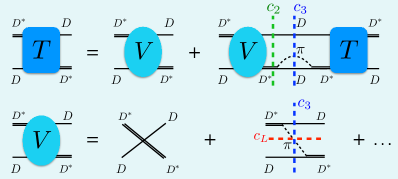
- 散乱振幅を、一パイオン交換(OPE)を明示的に含む相互作用ポテンシャルを用いたLippmann-Schwinger方程式でモデル化する。
- $L\text{üscher}$ 法を用いて格子データから $p\cot\delta(p^2)$ 関数を抽出し、非ガウス的不確実性を考慮するため1000個の準データセットを用いたベイズ的手法でフィッティングを行う。
- フィッティング手順では、モデル予測と準データとの間の $\chi^2$ を最小化する。パラメータ $c_0$ と $c_2$ はポテンシャルの低エネルギー定数を表す。
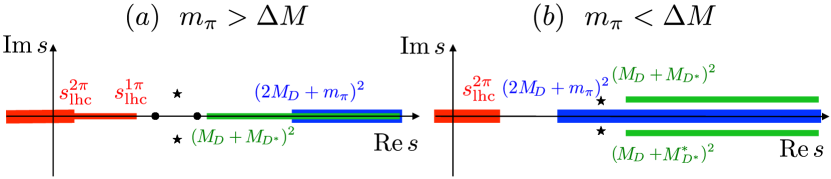
- 左側カットの分岐点の位置をパイオン質量の関数として計算し、$m_\pi > \Delta M$ の場合に $DD^*$ 閾値に近いかどうかを分析する。
- OPE強度を1/10および5倍に変化させることで、その強度変動が極および $p\cot\delta(p^2)$ の残差に与える影響を分離して分析する。
実験結果
リサーチクエスチョン
- RQ1一パイオン交換に起因する左側カットが、格子QCDデータからの共鳴極抽出における有効範囲展開の信頼性にどのように影響を与えるか?
- RQ2パイオン質量 $m_\pi > \Delta M$ の場合に、左側カットが $DD^*$ 閾値に近接する状況で、$p\cot\delta(p^2)$ 関数の極構造はどのように変化するか?
- RQ3OPE相互作用が、特にOPE強度を変化させた場合に、散乱振幅における極の存在と位置にどの程度の影響を与えるか?
- RQ4左側カットが物理的閾値に近接している場合、有効範囲展開に基づく標準的なフィッティング手順は、信頼できる極位置を提供できるか?
主な発見
- パイオン質量が $D^* - D$ 質量差を上回る場合($m_\pi > \Delta M$)、左側カットの分岐点は $DD^*$ 閾値に近づき、有限なエネルギー範囲において有効範囲展開が無効化される。
- 一パイオン交換に起因する左側カットは、カットが閾値に近い場合、散乱振幅における非正則性の主要因となり、極抽出を歪める。
- OPE強度を低下させると、$p\cot\delta(p^2)$ の極は左側カットに近づき、OPEを無効化すると極が消滅する。これはOPEが極形成に不可欠であることを証明している。
- 物理的パイオン結合定数の下では、極と左側カットがほぼ一致するため、明示的なモデル化が行われない限り、極抽出が誤解を招く可能性がある。
- $m_\pi = 280$ MeV およびより小さい charm クォーク質量での格子データへのフィッティング結果は一貫しており、LHC効果が顕著で無視できないことが示された。
- 本研究は、近閾値Exotic状態の極抽出において、一パイオン交換の明示的取り扱いが必要不可欠であると結論づけた。特に、物理的でないパイオン質量領域ではその重要性が顕著である。
より良い研究を、今すぐ始めましょう
論文の読解から最終レビューまで、研究時間を劇的に削減しましょう。
クレジットカード登録不要
このレビューはAIが作成し、人間の編集者が確認しました。