
[論文レビュー] Rumor Detection with Hierarchical Representation on Bipartite Adhoc Event Trees
本論文はBAETを提案する。投稿とそれに応答する者から成る二部のアドホックイベントツリーを構築して噂を検出するBAETというモデルを紹介し、著者と投稿のシグナルを用いた階層表現を用いて検出性能を向上させる。
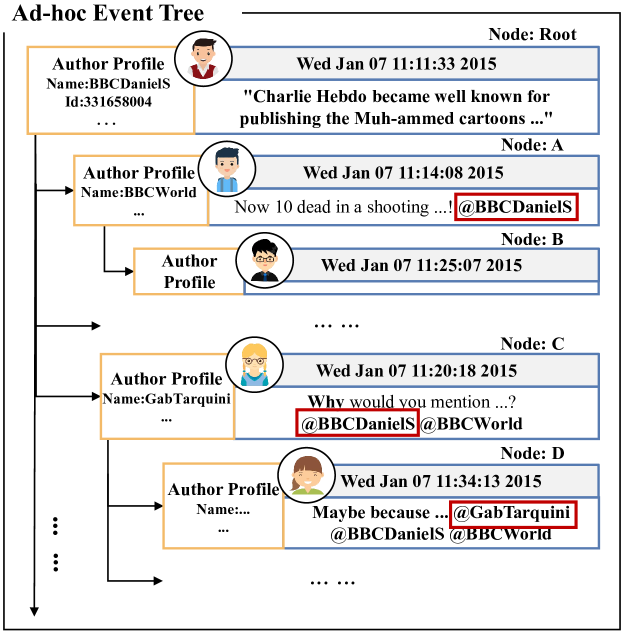
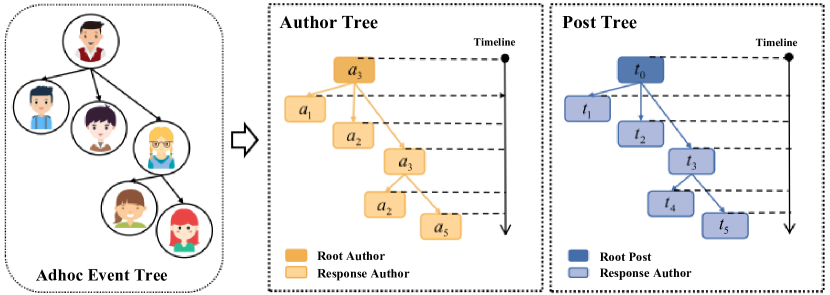
The rapid growth of social media has caused tremendous effects on information propagation, raising extreme challenges in detecting rumors. Existing rumor detection methods typically exploit the reposting propagation of a rumor candidate for detection by regarding all reposts to a rumor candidate as a temporal sequence and learning semantics representations of the repost sequence. However, extracting informative support from the topological structure of propagation and the influence of reposting authors for debunking rumors is crucial, which generally has not been well addressed by existing methods. In this paper, we organize a claim post in circulation as an adhoc event tree, extract event elements, and convert it to bipartite adhoc event trees in terms of both posts and authors, i.e., author tree and post tree. Accordingly, we propose a novel rumor detection model with hierarchical representation on the bipartite adhoc event trees called BAET. Specifically, we introduce word embedding and feature encoder for the author and post tree, respectively, and design a root-aware attention module to perform node representation. Then we adopt the tree-like RNN model to capture the structural correlations and propose a tree-aware attention module to learn tree representation for the author tree and post tree, respectively. Extensive experimental results on two public Twitter datasets demonstrate the effectiveness of BAET in exploring and exploiting the rumor propagation structure and the superior detection performance of BAET over state-of-the-art baseline methods.
研究の動機と目的
- 投稿内容と時間を超えた著者情報を噂伝播モデリングに組み込むことを動機づける。
- 投稿と著者の両方を噂カスケードとして捉える二部のアドホックイベントツリー表現を提案する。
- 頑健な噂検証のためにノードレベルとツリーレベルの表現を学習する階層型ニューラルフレームワークを開発する。
提案手法
- 主張投稿周辺のクーポン化されたアドホックイベントから投稿ツリーと著者ツリーを構築する。
- 投稿と著者特徴を埋め込み、根に意識的な注意機構を用いてノード表現を学習する。
- 構造的伝播パターンを捉えるためにツリー変種RNN(TRvNN)を適用する。
- TRvNNの出力から構造表現を統合するためにツリー認識型の注意機構を用いる。
- 最終的な噂分類のために投稿ツリーと著者ツリーの表現を結合する。
実験結果
リサーチクエスチョン
- RQ1著者情報を投稿内容と効果的に統合して噂検出を改善するにはどうすればよいか?
- RQ2二部のアドホックイベントツリーは伝播トポロジーと著者の影響を噂検証のためにより良く捉えられるのか?
- RQ3ノードレベルと構造レベルのどのような階層表現が噂と非噂を最も効果的に識別するか?
- RQ4根ノードと葉ノードに注意を払う注意機構は検出性能を改善するか?
主な発見
- BAETは公開データセットPHEMEとRumorEvalにおいて最先端の噂検出モデルより顕著な改善を達成する。
- 著者情報は投稿内容だけではなく噂検出に意味のある寄与をする。
- ノードレベル表現と構造レベル表現の組み合わせは堅牢な伝播モデリングを生み出す。
- 根に意識的な注意とツリー認識型注意は、ノード内意味論とノード間伝播ダイナミクスを効果的に捉える。
より良い研究を、今すぐ始めましょう
論文設計から論文執筆まで、研究時間を劇的に削減しましょう。
クレジットカード登録不要
このレビューはAIが作成し、人間の編集者が確認しました。