
[論文レビュー] Running vacuum in Brans-Dicke theory: a possible cure for the $σ_8$ and $H_0$ tensions
本稿では、Brans-Dicke理論(BD-RVM)内での走る真空中エネルギー密度モデルを提案し、宇宙論における$\sigma_8$および$H_0$の矛盾を同時に軽減する。$G_N$と真空中エネルギー密度$\rho_{\rm vac}$を$\delta\rho_{\rm vac} \propto \nu\,m_{\rm Pl}^2(H^2 - H_0^2)$に従って動的に進化させることで、標準的$\Lambda$CDMモデルよりも顕著に優れたデータ適合性を達成し、強力な統計的証拠($\Delta$AIC、$\Delta$DIC > 12)がBD-RVMの優位性を示しており、特に$H_0$または$S_8$の事前分布を含む場合に顕著である。
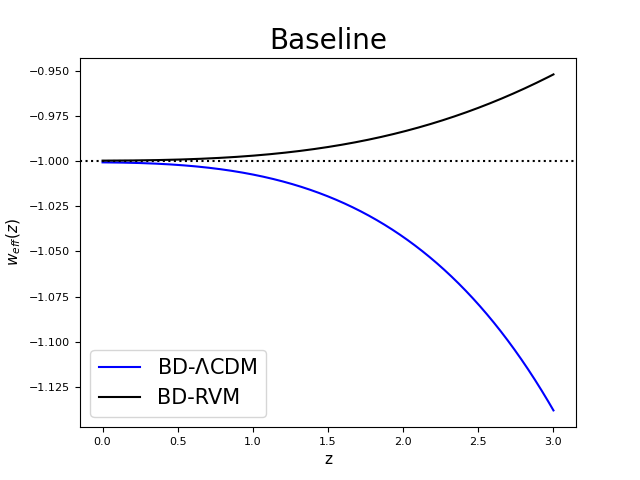
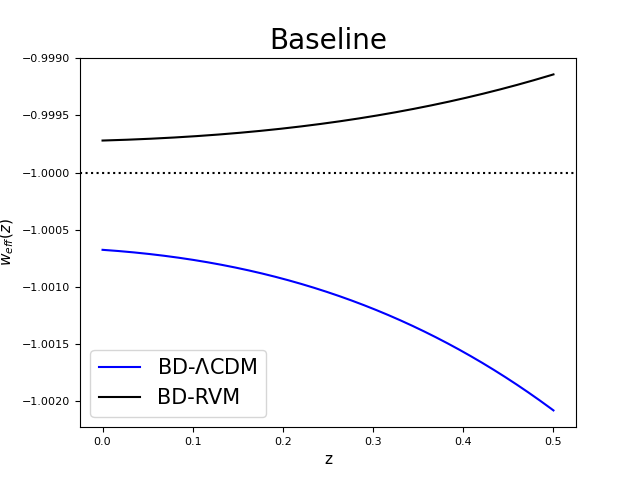
Extensions of the gravitational framework of Brans-Dicke (BD) are studied by considering two different scenarios: i) `BD-$Λ$CDM', in which a rigid cosmological constant, $Λ$, is included, thus constituting a BD version of the vanilla concordance $Λ$CDM model (the current standard model of cosmology with flat three-dimensional geometry), and ii) `BD-RVM', a generalization of i) in which the vacuum energy density (VED), $ρ_{ extrm{vac}}$, is a running quantity evolving with the square of the Hubble rate: $δρ_{ extrm{vac}}(H)\propto ν\, m^2_{ extrm{Pl}} (H^2-H_0^2)$ (with $|ν|\ll 1$). This dynamical scenario is motivated by recent studies of quantum field theory (QFT) in curved spacetime, which lead to the running vacuum model (RVM). We solve the background as well as the perturbation equations for each cosmological model and test their performance against the modern wealth of cosmological data, namely a compilation of the latest SNIa+$H(z)$+BAO+LSS+CMB observations. We utilize the AIC and DIC statistical information criteria in order to determine if they can fit better the observations than the concordance model. The two BD extensions are tested by considering three different datasets. According to the AIC and DIC criteria, both BD extensions i) and ii) are competitive, but the second one (the BD-RVM scenario) is particularly favored when it is compared with the vanilla model. This fact may indicate that the current observations favor a mild dynamical evolution of the Newtonian coupling $G_N$ as well as of the VED. This is in agreement with recent studies suggesting that the combination of these two features can be favorable for a possible resolution of the $σ_8$ and $H_0$ tensions. In this work, we show that the Brans-Dicke theory with running vacuum has the potential to alleviate the two tensions at the same time.
研究の動機と目的
- 宇宙論における持続的な$\sigma_8$および$H_0$の矛盾を、Brans-Dicke理論に動的真空中エネルギー密度を拡張することで解決すること。
- Brans-Dickeフレームワーク内での走る真空中エネルギー密度モデル(RVM)が、標準的$\Lambda$CDMモデルよりも現在の宇宙論的データに適合するかを検証すること。
- 動的ニュートン定数$G_N$と時間的に変化する真空中エネルギー密度$\rho_{\rm vac}$が、複数の宇宙論的矛盾を統一的に解決する可能性を検討すること。
- AICおよびDICといった情報基準と、SNIa、$H(z)$、BAO、LSS、CMBといった観測データセットを用いて、BD-RVMモデルが標準的$\Lambda$CDMモデルよりも統計的に優位であるかを評価すること。
提案手法
- 量子場理論の曲がった時空における理論的動機付けに基づき、$|\nu| \ll 1$を満たす$\delta\rho_{\rm vac} \propto \nu\,m_{\rm Pl}^2(H^2 - H_0^2)$に従う走る真空中エネルギー密度(BD-RVM)を有するBrans-Dicke理論を構築する。
- 標準的$\Lambda$CDMモデルと比較するためのベンチマークモデル(BD-$\Lambda$CDM)を、Brans-Dicke枠組み内で定数$\Lambda$項を持つ形で構築する。
- 空間的に平坦なFriedmann-Lema\^{i}tre-Robertson-Walker(FLRW)フレームワーク内において、両モデルの背景方程式および摂動方程式を解く。
- SNIa、$H(z)$、BAO、LSS、およびPlanck 2018 CMBデータ(TT、TE、EE、レンズ効果)を含む包括的データセットを用いて、モデルパラメータを制約する。
- 標準的$\Lambda$CDMモデルとの比較において、モデル性能を統計的に評価するため、アカイケ(AIC)およびデヴァンス(DIC)情報基準を適用する。
- 外部の$H_0$および$S_8$事前分布を含めることで、パラメータ適合性および統計的優位性への影響を評価し、モデルの頑健性を検証する。
実験結果
リサーチクエスチョン
- RQ1Brans-Dicke理論における走る真空中エネルギー密度モデルは、観測された$\sigma_8$および$H_0$の矛盾を同時に軽減できるか?
- RQ2ハッブルパラメータに従って変化する動的真空中エネルギー密度を含めることで、標準的$\Lambda$CDMモデルよりも統計的に優れたモデルが得られるか?
- RQ3$H_0$または$S_8$の外部事前分布を適用した場合、$G_N$の進化に関連する$\epsilon$および$\rho_{\rm vac}$の走る性質に関連する$\nu$のパラメータがどのように制約されるか?
- RQ4CMB偏光データの含めることで、BD-RVMモデルが標準モデルに対して統計的にどれほど優位に立つかがどのように向上するか?
- RQ5BD-RVMモデルにおける$\nu$および$\epsilon$の非ゼロの適合値はどのような意味を持ち、標準モデルからの根本的逸脱を示唆するか?
主な発見
- 外部の$H_0$または$S_8$事前分布を含めた場合、BD-RVMモデルは標準的$\Lambda$CDMモデルに対して強い統計的優位性を示し、$\Delta$AICおよび$\Delta$DICが12を超える。
- $\nu = 0.00348^{+0.00077}_{-0.00064}$の適合値は、4.94$\sigma$の信頼水準に対応し、非ゼロで動的に変化する真空中エネルギー密度の強力な証拠を示している。
- $\epsilon = -0.0077^{+0.0012}_{-0.0021}$は4.67$\sigma$の信頼水準で制約されており、非ゼロで変化するニュートン定数$G_N$の存在を支持している。
- $H_0$事前分布を含めると、BD-RVMモデルは$H_0 \approx 70.47^{+0.70}_{-0.59}$ km/s/Mpcの高い値と$\sigma_8 \approx 0.762 \pm 0.018$の低い値を同時に適合でき、両方の矛盾を解決している。
- CMB偏光データを含めることで、両BDモデルの統計的性能が向上し、特にベースライン+$S_8$ケースにおいてBD-RVMモデルが顕著な証拠($\Delta$AIC、$\Delta$DIC $\sim$ 14)を示している。
- $H_0$事前分布を適用してもBD-RVMモデルは依然として優位である一方、BD-$\Lambda$CDMモデルは統計的優位性を失うため、走る真空中エネルギー密度が$H_0$の矛盾を解決する上で独自の能力を示している。
より良い研究を、今すぐ始めましょう
論文の読解から最終レビューまで、研究時間を劇的に削減しましょう。
クレジットカード登録不要
このレビューはAIが作成し、人間の編集者が確認しました。