
[論文レビュー] Scale-awareness in an eddy energy constrained mesoscale eddy parameterization
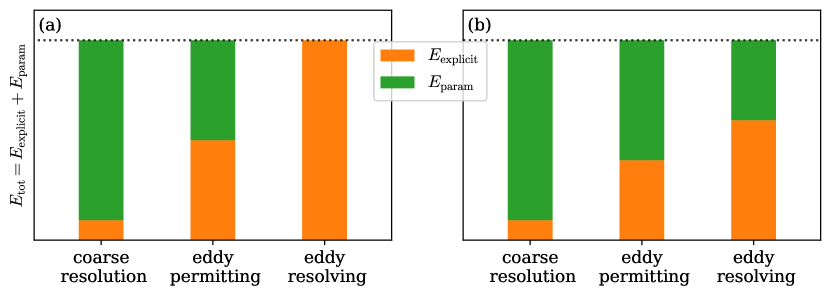
本稿では、GEOMETRIC中規模渦パラメータライゼーションにおけるスケールに敏感な性能を実現するための分割手順を提案する。この手順により、パラメータライズド渦フラックスに用いられる大規模背景場を分離し、明示的およびパラメータライズド済みの渦が共存可能となる。この手法により、解像度を変化させても総渦エネルギーが概ね一定を保ち、モデルの平均状態の表現が向上する一方で、明示的渦の動態が劣化しない。
There is an increasing interest in mesoscale eddy parameterizations that are scale-aware, normally interpreted to mean that a parameterization does not require re-tuning of parameters as the model resolution changes. Here we examine whether Gent--McWilliams (GM) based version of GEOMETRIC, a mesoscale eddy parameterization that is constrained by a parameterized eddy energy budget, is scale-aware in its energetics. It is generally known that GM-based schemes severely damp out explicit eddies, so the parameterized component would be expected to dominate across resolutions, and we might expect a negative answer to the question of energetic scale-awareness. A consideration of why GM-based schemes damp out explicit eddies leads a suggestion for what we term a splitting procedure: a definition of a `large-scale' field is sought, and the eddy-induced velocity from the GM-scheme is computed from and acts only on the large-scale field, allowing explicit and parameterized components to co-exist. Within the context of an idealized re-entrant channel model of the Southern Ocean, evidence is provided that the GM-based version of GEOMETRIC is scale-aware in the energetics as long as we employ a splitting procedure. The splitting procedure also leads to an improved representation of mean states without detrimental effects on the variability.
研究の動機と目的
- GMに基づくGEOMETRIC済み中規模渦パラメータライゼーションが、モデル解像度を変化させても総渦エネルギーが一定である、いわゆるエネルギー的スケールに敏感な性質を示すかどうかを調査すること。
- 従来のGMに基づくスキームでは明示的渦が過剰に減衰してしまうという課題に対処すること。
- 大規模成分と渦成分を分離するための分割手順を開発・検証することにより、明示的渦とパラメータライズド済み渦の共存を可能にすること。
- 提案手法が、明示的渦の運動を劣化させることなく、モデルの平均状態の表現を改善するかどうかを評価すること。
提案手法
- 温度場を大規模成分と渦成分に分解するために、式 $(1 - L^2 abla_H^2)^M \theta_L^n = \theta^n$ に基づくフィルタリング手順を用いる。ここで $M=2$ であり、$L$ はフィルタの長尺度である。
- フィルタリング方程式を反復的に解くためにリチャードソン反復法を適用し、加速パrameter $\gamma$ を用いた前処理付きスキームにより収束を保証する。
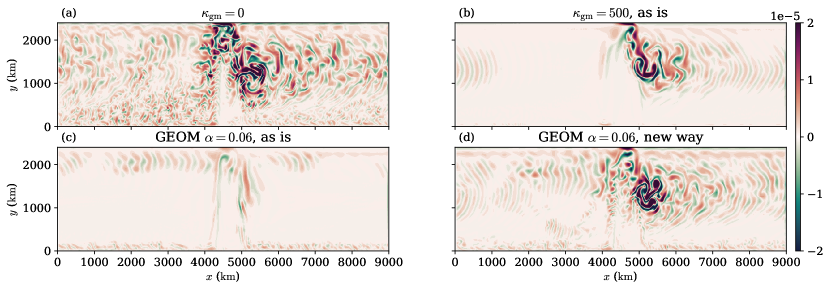
- GEOMETRICスキームにおける渦誘導速度は、大規模場からのみ計算されるため、明示的に解釈された渦が減衰しない。
- パラメータライズド渦フラックスは、大規模成分にのみ適用され、明示的渦はモデル内で独立して進化する。
- NEMOフレームワークを用いて、理想化された南極圏の再循環チャネルモデルにこの手法を実装し、さまざまな解像度でのモデル設定を検証する。
- 収束は、$\|\Theta^{k+1} - \Theta^k\|_\infty < \epsilon$($\epsilon = 0.001\,^\circ\text{C}$)を用いて監視され、数値的安定性と精度が保証される。
実験結果
リサーチクエスチョン
- RQ1多解像度フレームワークに応用した場合、GMに基づくGEOMETRICパラメータライゼーションがエネルギー的スケールに敏感な性質を示すか?
- RQ2分割手順により、明示的に解釈された渦が減衰せず、かつパラメータライゼーションのエネルギー的性質が保持されるか?
- RQ3明示的渦とパラメータライズド渦の共存が、中規模渦を許容するモデルにおける海洋平均状態の表現にどのように影響するか?
- RQ4NEMOのような標準的な海洋モデルに、フィルタリングおよび分割手順を実装する際の計算コストはどの程度か?
主な発見
- 分割手順を用いたGEOMETRICパラメータライゼーションは、異なるモデル解像度間で総渦エネルギーが概ね一定を保つことを示し、エネルギー的スケールに敏感な性質を示している。
- パラメータライズドフラックスが大規模場に制限されているため、明示的渦が保存され、従来のGMスキームで見られる強い減衰を回避している。
- 分割手順により、平均海洋状態の表現が改善され、特に南極圏における循環輸送がより現実的になり、バイアスが低減されている。
- 計算コストの増加は最小限に抑えられ、標準設定と比較して実行時間の増加が5%未満に抑えられている。
- 前処理付きリチャードソン反復法を用いることで、500イテレーション以内にフィルタリング手順が信頼性高く収束し、収束許容誤差 $\epsilon = 0.001\,^\circ\text{C}$ を満たしている。
- 結果から、分割に基づくGEOMETRICスキームは、特に中規模渦を許容する設定において、多解像度気候モデルの階層構造に実用的かつ有効な候補であると考えられる。
より良い研究を、今すぐ始めましょう
論文の読解から最終レビューまで、研究時間を劇的に削減しましょう。
クレジットカード登録不要
このレビューはAIが作成し、人間の編集者が確認しました。