
[論文レビュー] SEEDS: Emulation of Weather Forecast Ensembles with Diffusion Models
SEEDS は拡散モデルを用いて、少数の運用予報に条件付けられた大規模な天気予報系を生成し、計算資源を大幅に削減しつつ、同等またはそれ以上の予測精度を実現します。
Uncertainty quantification is crucial to decision-making. A prominent example is probabilistic forecasting in numerical weather prediction. The dominant approach to representing uncertainty in weather forecasting is to generate an ensemble of forecasts. This is done by running many physics-based simulations under different conditions, which is a computationally costly process. We propose to amortize the computational cost by emulating these forecasts with deep generative diffusion models learned from historical data. The learned models are highly scalable with respect to high-performance computing accelerators and can sample hundreds to tens of thousands of realistic weather forecasts at low cost. When designed to emulate operational ensemble forecasts, the generated ones are similar to physics-based ensembles in important statistical properties and predictive skill. When designed to correct biases present in the operational forecasting system, the generated ensembles show improved probabilistic forecast metrics. They are more reliable and forecast probabilities of extreme weather events more accurately. While this work demonstrates the utility of the methodology by focusing on weather forecasting, the generative artificial intelligence methodology can be extended for uncertainty quantification in climate modeling, where we believe the generation of very large ensembles of climate projections will play an increasingly important role in climate risk assessment.
研究の動機と目的
- Numerical weather prediction における予報不確実性を大規模な ensemble で定量化する。
- 限定された種から物理ベースの ensemble 分布をエミュレートするスケーラブルな生成法を開発する。
- 別のデータソースと混合して ensemble の偏りを後処理で是正できるようにする。
- 生成された ensemble が主要なスキル指標で物理ベースの ensemble と同等以上であることを示す。
- 生成された ensemble の信頼性と極端イベントの表現を評価する。
提案手法
- K 個の seed forecasts を条件として拡散ベースの生成モデルを訓練し、N>K の天気状態サンプルを生成する。
- 大気データをキューブスフィア格子上の標準化異常として表現し、軸方向注意機構を持つ ViT 風のスコアネットワークを用いる。
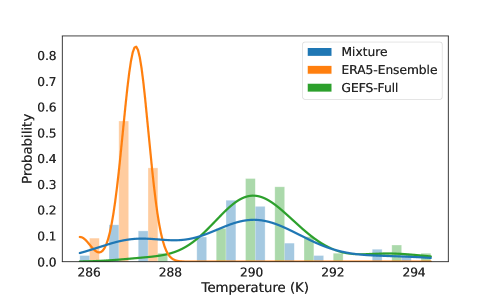
- 2 つの学習タスク:生成的 ensemble エミュレーション( Seeds から p(v) をエミュレート)と生成的後処理(α p(v) + (1−α) p′(v) を近似)。
- 訓練・評価には GEFS 復元予報の 20 年分と ERA5 復元データを使用。
- 評価指標として順位ヒストグラム、RMSE、ACC、CRPS、極端事象(±2σ)スキルを ERA5-HRES の真値と比較。
実験結果
リサーチクエスチョン
- RQ1拡散ベースのエミュレータは、少数の seed 予報から物理ベース GEFS 系の統計特性を再現する大規模な ensemble を生成できるか。
- RQ2生成的後処理(ERA5 データとの混合)は、物理ベースの ensemble のみと比較して信頼性と極端イベント予測を改善するか。
- RQ3生成された ensemble は、空間的一貫性、多変量相関、スペクトル特性の点で真値とどう比較されるか。
- RQ4SEEDS を用いて何百~千件規模の ensemble メンバーを生成する際の計算効率の向上はどれほどか。
主な発見
- 生成された ensemble( Seeds-gee と Seeds-gpp)は、GEFS-full および ERA5 と同様の共分散構造とエネルギースペクトルを持つ天気類似サンプルを実現し、現実的な空間パターンを含む。
- Seeds-gee は RMSE、ACC、CRPS の各指標で gefs-full に対して同等のスキルを達成し、Seeds-gpp は近傍地表温度と極端イベントカバレッジでしばしば gefs-full を上回る。
- 生成的後処理(Seeds-gpp)は、物理ベースの全体 ensemble よりも信頼性が高く(順位ヒストグラムの不確実性 δ が低い)、極端イベントの分類(Brier スコア)にも優れている。
- モデルは 512 メンバーを、 seed forecast 2 個のみで追加計算をほとんど必要とせずに TPUv3 上でバッチあたり 3 分で生成でき、非常に大規模な ensemble を実現できる。
- 生成された ensemble は tail event をより適切に捕捉し、 seeds を超える包絡線を拡大し、希少イベントの不確実性量化を促進する。
- リードタイムが最大 16 日までで、生成的 ensemble は完全な GEFS 系列と強い相関を示し、単なる気候統計を超えるダイナミクスを学習していることを示唆している。

より良い研究を、今すぐ始めましょう
論文設計から論文執筆まで、研究時間を劇的に削減しましょう。
クレジットカード登録不要
このレビューはAIが作成し、人間の編集者が確認しました。