
[論文レビュー] Self-Interference Channel Characterization in Underwater Acoustic In-Band Full-Duplex Communications Using OFDM
この論文は湖上実験を通じて、水中音響帯域内全二重通信(UWA-IBFD)システムにおける自己干渉チャネルインパルス応答(SCIR)をOFDMを用いて特徴づけている。直接パスは強く安定しており、表面反射パスはSIパワーの16%を占め、コherenct timeが約70 msと短く、時間的に急変するため、キャンセレーションが困難であることが明らかになった。
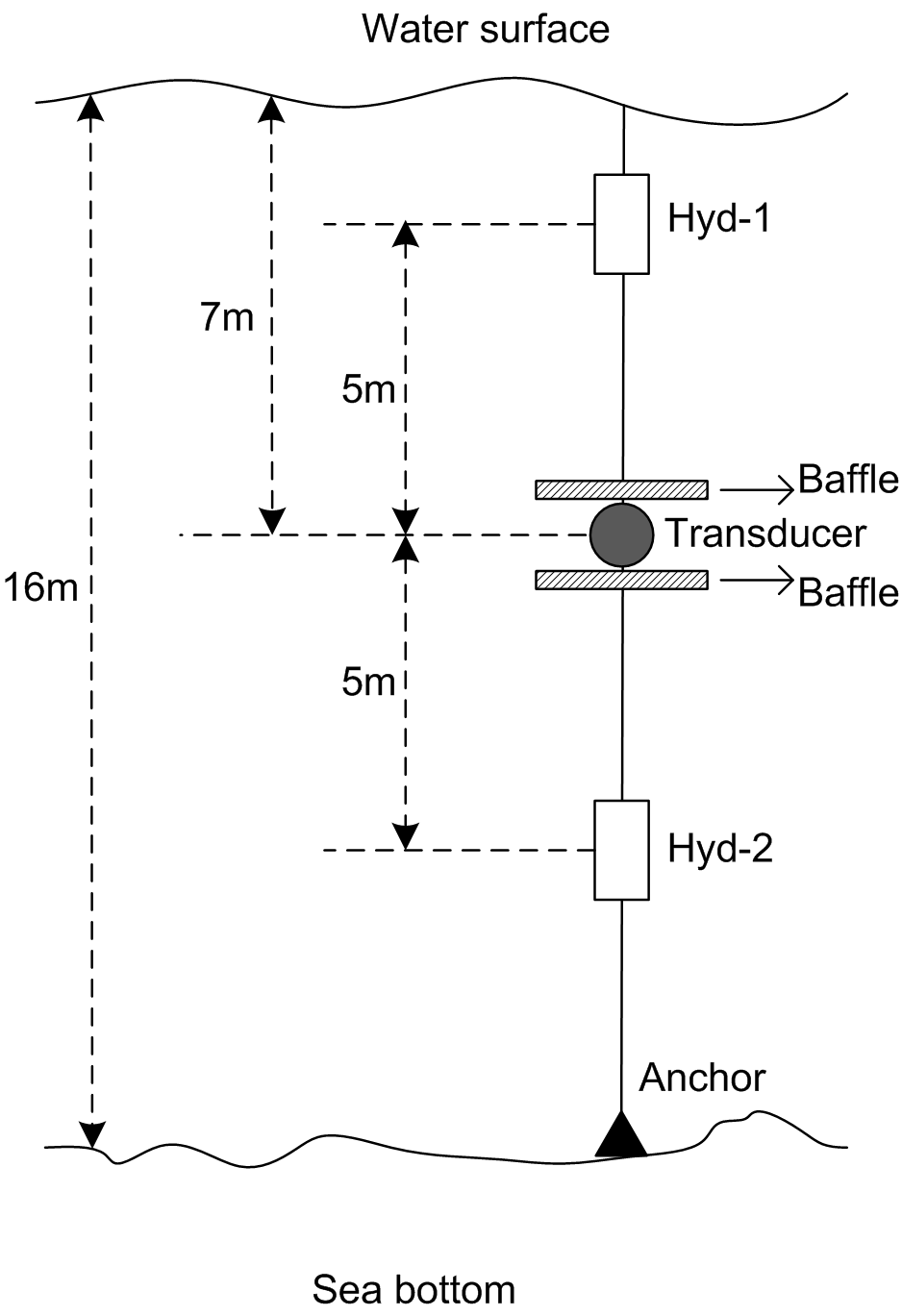
Due to the limited available bandwidth and dynamic channel, data rates are extremely limited in underwater acoustic (UWA) communications. Addressing this concern, in-band fullduplex (IBFD) has the potential to double the efficiency in a given bandwidth. In an IBFD scheme, transmission and reception are performed simultaneously in the same frequency band. However, in UWA-IBFD, because of reflections from the surface and bottom and the inhomogeneity of the water, a significant part of the transmitted signal returns back to the IBFD receiver. This signal contaminates the desired signal from the remote end and is known as the self-interference (SI). With an estimate of the self-interference channel impulse response (SCIR), a receiver can estimate and eliminate the SI. A better understanding of the statistical characteristics of the SCIR is necessary for an accurate SI cancellation. In this article, we use an orthogonal frequency division multiplexing (OFDM) signal to characterize the SCIR in a lake water experiment. To verify the results, SCIR estimation is performed using estimators in both the frequency and time domains. We show that, in our experiment, regardless of the depth of the hydrophone, the direct path of SCIR is strong, stable and easily tracked; however, the reflection paths are weaker and rapidly time-varying making SI cancellation challenging. Among the reflections, the first bounce from the water surface is the prevalent path with a short coherence time around 70 ms.
研究の動機と目的
- 水中音響帯域内全二重通信(UWA-IBFD)システムにおける自己干渉チャネルインパルス応答(SCIR)の統計的特性を理解すること。
- パワー遅延プロファイル(PDP)、自己相関関数(ACF)、コherenct time(COT)を分析することで、SIキャンセレーションの可能性を評価すること。
- 動的な水中環境におけるロバスト性を比較するため、周波数領域と時間領域のSCIR推定手法を比較すること。
- どのマルチパス成分がSIパワーを支配しているか、およびその時間変動特性がキャンセレーション性能に与える影響を特定すること。
- 従来のOFDMチャネル推定仮定(ブロック内一定)が、UWA-IBFD SCIRに適用可能かどうかを評価すること。
提案手法
- 湖上環境でOFDM信号を送信し、周波数領域(FD)および時間領域(TD)の両手法を用いてSCIRを推定する。
- SCIRの大きさからパワー遅延プロファイル(PDP)を推定し、支配的マルチパス成分を特定する。
- SCIRの自己相関関数(ACF)を計算し、時間相関を分析し、コherenct time(COT)を導出する。
- コherenct timeは、ACFが最大値の半分に低下するラグとして推定され、チャネルがおおよそ一定に保たれる timescale を示す。
- 短い時間窓(36 ms)を用いたウィンドウ化時間領域アプローチを用い、短時間におけるチャネル安定性が達成可能であることを検証する。
- 理論的分析では、$ P_s = \frac{1}{M} \sum_{m=0}^{M-1} p[m] $ を用いてPDPから全SIパワーを計算し、$ p_{\text{acc}}[j] = \frac{1}{M} \sum_{m=0}^{j-1} p[m] $ を用いて初期パスの累積的パワー寄与度を評価する。
![Figure 1 : UWA-IBFD system using OFDM for SCIR estimation, where $x[n]$ is the transmitted signal, $y[n]$ is the received signal, ${\hat{s}}[n]$ is the anticipated SI signal, and $e[n]$ denotes the residual.](https://ar5iv.labs.arxiv.org/html/2005.10933/assets/images/fig1.png)
実験結果
リサーチクエスチョン
- RQ1UWA-IBFDシステムの自己干渉チャネルインパルス応答(SCIR)における支配的マルチパス成分は何か?
- RQ2特に直接パスと表面反射パスに関して、SCIRのコherenct timeはどのように変動するか?
- RQ3SCIRの時間変動特性、特に表面反射パスの影響により、OFDMブロック内でのチャネル一定性という仮定がどの程度破られるか?
- RQ4周波数領域と時間領域のSCIR推定手法は、実際の水中環境において一貫したSCIRの統計的特徴をもたらすか?
- RQ5直接パスと表面反射パスは、全自己干渉パワーのそれぞれどの程度を占めているか?
主な発見
- SCIRの直接パスは強く、安定しており、全自己干渉パワーのおよそ72%を占め、キャンセレーションが比較的容易である。
- 表面反射パスは支配的反射パスであり、全SIパワーの約16%を占め、時間的に急変する特徴を示す。
- 表面反射パスのコherenct timeは約70 msであり、これは通常のOFDMブロック長よりも短く、ブロック内でのチャネルスローネス仮定を無効にしている。
- 36 msの窓サイズを用いた時間領域推定により、コherenct timeの推定値が妥当であることが確認され、表面反射パスが短時間にわたりおおよそ一定に保たれることを裏付けた。
- 直接パスと表面反射パスを合わせると、全自己干渉パワーのおよそ88%を占めるため、これらの2つのパスを正確に追跡できれば、SIの大部分をキャンセレーション可能である。
- UWA-IBFDにおいて、チャネルがブロック内一定であるという標準的なOFDMチャネル推定仮定は、SCIRの著しい時間変動性、特に表面反射パスの影響により不適切である。
より良い研究を、今すぐ始めましょう
論文の読解から最終レビューまで、研究時間を劇的に削減しましょう。
クレジットカード登録不要
このレビューはAIが作成し、人間の編集者が確認しました。