
[論文レビュー] Simultaneously probing the sound speed and equation of state of the early Universe with pulsar timing arrays
本稿は、NANOGrav、PPTA、EPTAのパulsar timing array (PTA) データを用い、検出されたナノヘルツ帯の重力波背景がスカラー誘発重力波由来であると仮定して、初期宇宙の状態方程式(w)と音速(cₛ)を同時に制約する。得られた結果は w = 0.60⁺⁰.³²₋₀.³⁹、cₛ ≳ 0.09、T_rh ≲ 0.2 GeV であり、放射支配でない初期宇宙を支持し、圧力のない流体モデルを除外する。
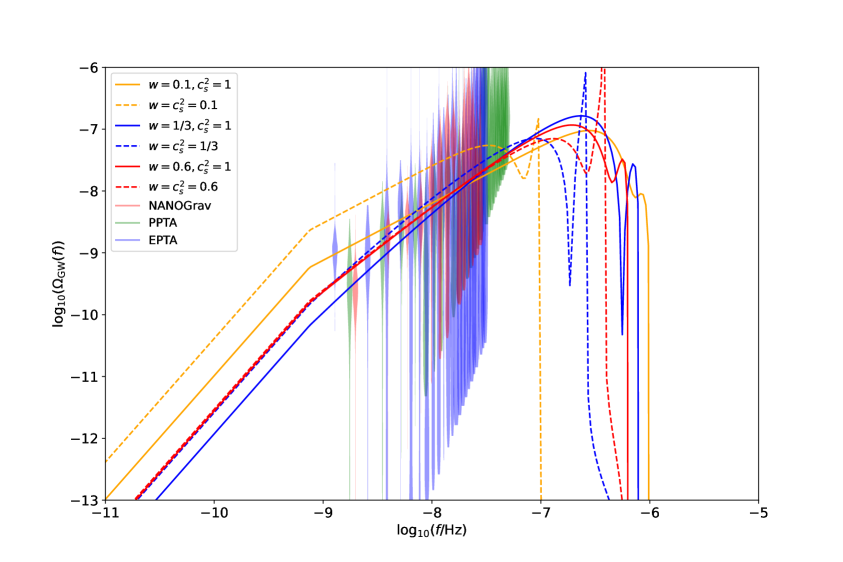
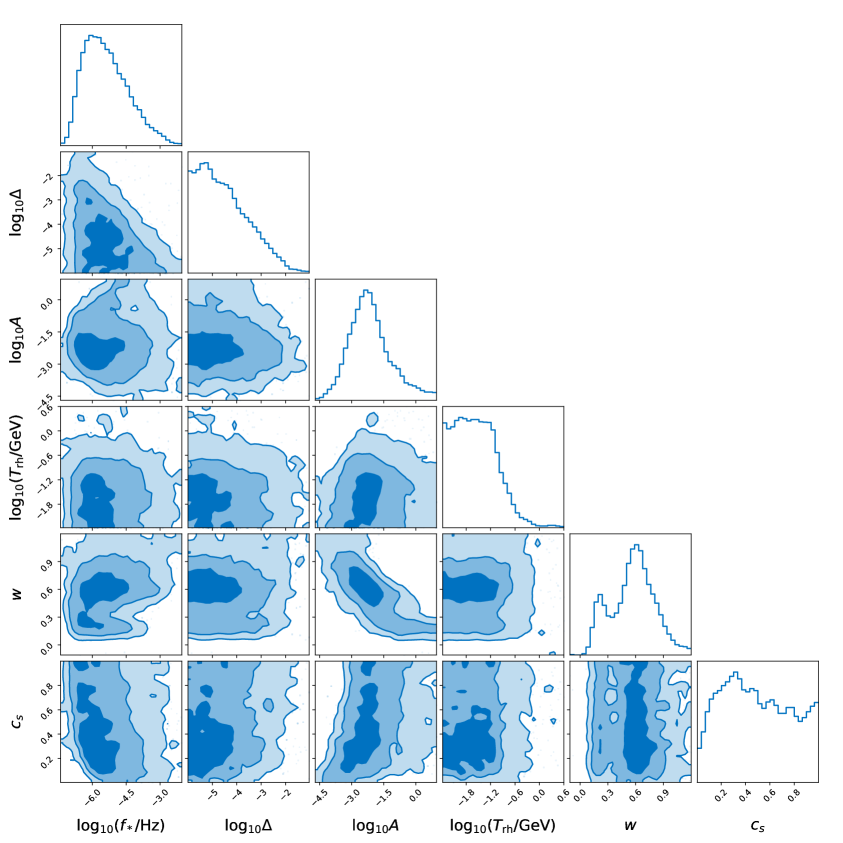
Recently, several major pulsar timing array (PTA) collaborations have assembled strong evidence for the existence of a gravitational-wave background at frequencies around the nanohertz regime. Assuming that the PTA signal is attributed to scalar-induced gravitational waves, we jointly employ the PTA data from the NANOGrav 15-year data set, PPTA DR3, and EPTA DR2 to probe the conditions of the early Universe. Specifically, we explore the equation of state parameter ($w$), the reheating temperature ($T_\mathrm{rh}$), and the sound speed ($c_s$), finding $w = 0.59^{+0.36}_{-0.40}$ (median + $90\%$ credible interval), and $T_\mathrm{rh}\lesssim 0.2\,\mathrm{GeV}$ at the $95\%$ credible interval for a lognormal power spectrum of the curvature perturbation. Furthermore, we compute Bayes factors to compare different models against the power-law spectrum model, effectively excluding the pressure-less fluid domination model. Our study underscores the significance of scalar-induced gravitational waves as a powerful tool to explore the nature of the early Universe.
研究の動機と目的
- 重力波データを用いて、初期宇宙の状態方程式(w)と音速(cₛ)を同時に制約すること。
- 観測されたパルサー計時アレイ(PTA)信号が、天体的要因(例:超大質量黒丸二重星)ではなく、スカラー誘発重力波(SIGWs)由来であるかどうかを検証すること。
- ベイズ的モデル比較を用いて、標準的な放射支配的宇宙論モデル(w = 1/3、cₛ² = 1/3)と比較して、代替的宇宙論モデルを評価すること。
- SIGWsが初期ブラックホール(PBH)形成および再熱温度(T_rh)に与える影響を検討すること。
- 複数の機器で得られたPTAデータを統合し、任意のwとcₛをもつ非標準的初期宇宙モデルの妥当性を評価すること。
提案手法
- 初期密度ゆらぎをモデル化するため、曲率ゆらぎにログノーマルスペクトルを採用する。
- 一般のwとcₛをもつ宇宙におけるスカラー誘発重力波(SIGWs)のエネルギー密度を、2次摂動論を用いて計算する。
- NANOGrav 15年、PPTA DR3、EPTA DR2のPTAデータを、ベイズ推論とネストド・サンプリング・ツールである dynesty を用いて分析する。
- 異なるwとcₛをもつモデルを、放射支配的基準モデル(w = 1/3、cₛ² = 1/3)と比較するためのベイズ因子を計算する。
- 大きな曲率ゆらぎによる初期ブラックホール(PBH)生成に関する制約を組み込み、パラメータ空間をさらに精緻化する。
- BILBY ベイズ推論ライブラリを用いて、統合されたPTAデータセット上で完全な事後分布サンプリングとモデル比較を実施する。
実験結果
リサーチクエスチョン
- RQ1PTA観測から、初期宇宙の状態方程式(w)と音速(cₛ)の連続的制約は何か?
- RQ2観測されたPTA信号は、超大質量黒丸二重星などの天体的要因よりも、スカラー誘発重力波(SIGW)由来であると支持されるか?
- RQ3推定されたwとcₛの値は、標準的な放射支配的モデル(w = 1/3、cₛ² = 1/3)とどのように比較されるか?
- RQ4データは圧力のない流体モデル(w = 0)やcₛ² = 1のモデルを除外できるか?
- RQ5最良のフィットSIGWシナリオ下で、再熱温度(T_rh)と初期ブラックホール(PBH)形成にどのような意味があるか?
主な発見
- 分析により、68%信用区間で w = 0.60⁺⁰.³²₋₀.³⁹ が得られ、これは放射支配的状態からの逸脱を示している。
- 音速は cₛ ≳ 0.09 に制約され、初期宇宙における非理想流体的挙動を示唆している。
- 再熱温度は T_rh ≲ 0.2 GeV と推定され、低スケール再熱のシナリオと整合的である。
- 放射支配的モデル(w = 1/3、cₛ² = 1/3)はベイズ因子によって除外され、代替的な初期宇宙のダイナミクスが支持される。
- 圧力のない流体モデル(w = 0)は、著しく低い証拠を示すため、データによって実質的に除外される。
- 結果は、PTA信号のスカラー誘発重力波説明がベイズ的根拠をもって強く支持され、他のモデルよりも優位であることを示している。
より良い研究を、今すぐ始めましょう
論文の読解から最終レビューまで、研究時間を劇的に削減しましょう。
クレジットカード登録不要
このレビューはAIが作成し、人間の編集者が確認しました。