
[論文レビュー] Small amplitude red giants elucidate the nature of the Tip of the Red Giant Branch as a standard candle
本論文はほぼすべてのTRGB星がOSARG変数であることを示している。OSARGを用いることで精密なTRGB較正とH0 = 71.8 ± 1.5 km/s/Mpcを得て、TRGBとCepheid距離スケールを一致させる。
The tip of the red giant branch (TRGB) is an important standard candle for determining luminosity distances. Although several $10^5$ small amplitude red giant stars (SARGs) have been discovered, variability was previously considered irrelevant for the TRGB as a standard candle. Here, we show that all stars near the TRGB are SARGs that follow several period-luminosity sequences, of which sequence A is younger than sequence B as predicted by stellar evolution. We measure apparent TRGB magnitudes, m$_{\mathrm{TRGB}}$, in the Large Magellanic Cloud (LMC), using Sobel filters applied to photometry from the Optical Gravitational Lensing Experiment and the ESA Gaia mission, and we identify several weaknesses in a recent LMC-based TRGB calibration used to measure the Hubble constant. We consider four samples: all Red Giants (RGs), SARGs, and sequences A & B. The B-sequence is best suited for measuring distances to old RG populations, with M$_{\mathrm{F814W,0}}$ = -4.025 $\pm$ 0.014(stat.) $\pm$ 0.033(syst.) mag assuming the LMC's geometric distance. Control of systematics is demonstrated using detailed simulations. Population diversity affects m$_{\mathrm{TRGB}}$ at a level exceeding the stated precision: the SARG and A-sequence samples yield 0.039 mag and 0.085 mag fainter (at 5σ significance) m$_{\mathrm{TRGB}}$ values, respectively. Ensuring equivalent RG populations is crucial to measuring accurate TRGB distances. Additionally, luminosity function smoothing ($\sim$ 0.02 mag) and edge detection response weighting (as much as -0.06 mag) can further bias TRGB measurements, with the latter introducing a tip-contrast relation. We are optimistic that variable red giants will enable further improvements to the TRGB as a standard candle.
研究の動機と目的
- Calibrate the TRGB absolute magnitude using variable red giants (OSARGs) in the LMC.
- Investigate whether variability properties improve TRGB detection and reduce smoothing biases.
- Quantify the TRGB luminosity in multiple photometric systems and compare with existing calibrations.
- Derive H0 from the TRGB calibration and assess agreement with Cepheid-based and CMB-based measurements.
提案手法
- Cross-match OGLE-III OSARGs with cleaned RGB samples in the LMC.
- Classify OSARGs into A-sequence and B-sequence subgroups based on dominant periods.
- Measure the TRGB with Sobel edge detection on GLOESS-smoothed luminosity functions.
- Use Gaia DR3 synthetic photometry to obtain I-band and F814W magnitudes and apply reddening corrections.
- Calibrate M_F814W,syn and M_I,syn using the LMC distance from detached eclipsing binaries.
- Estimate uncertainties with Monte Carlo resampling and quantify smoothing bias effects.
実験結果
リサーチクエスチョン
- RQ1Does selecting OSARGs near the TRGB yield more precise TRGB magnitudes than using all RGB stars?
- RQ2What is the absolute TRGB magnitude in different photometric systems when anchored to the LMC distance?
- RQ3How does the new TRGB calibration affect the inferred H0 compared to Cepheid- and CMB-based values?
- RQ4Do astro-physical sample selections (A/B OSARG sequences) introduce systematic differences in TRGB calibrations?
主な発見
| V-I)_0 | I_OGLE (mag) | I_syn (mag) | F814W_syn (mag) | G_Rp (mag) | G_0 (mag) |
|---|---|---|---|---|---|
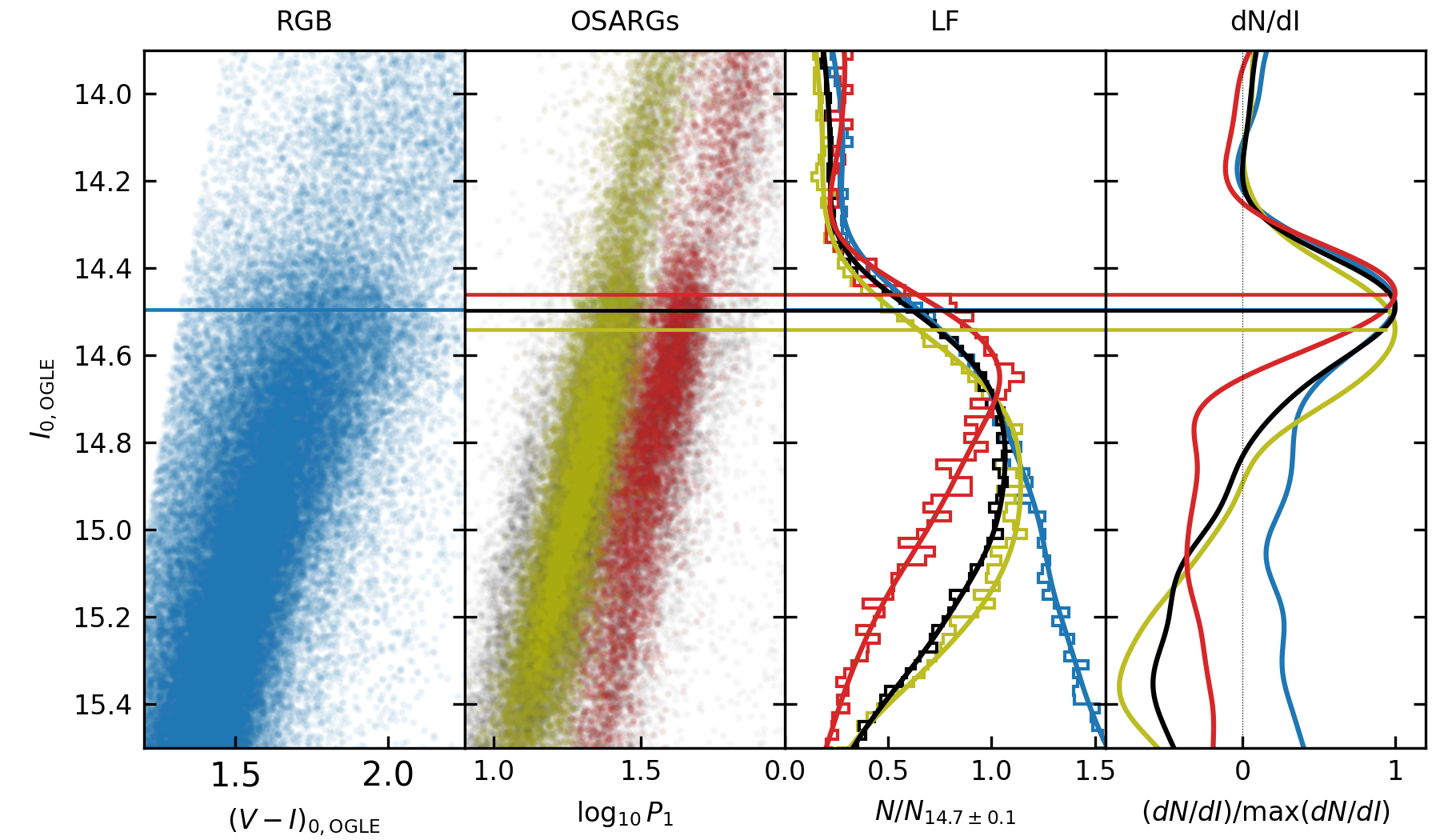
| 1.82±0.19 | 14.501±0.010 | 14.497±0.011 | 14.491±0.010 | 14.640±0.009 | 15.621±0.015 |
| 1.78±0.21 | 14.495±0.021 | 14.478±0.029 | 14.473±0.027 | 14.635±0.024 | 15.618±0.014 |
| 1.76±0.11 | 14.527±0.027 | 14.506±0.035 | 14.499±0.032 | 14.648±0.039 | 15.626±0.036 |
| 1.79±0.15 | 14.545±0.013 | 14.543±0.012 | 14.537±0.012 | 14.690±0.009 | 15.655±0.016 |
| 1.82±0.19 | 14.459±0.014 | 14.457±0.015 | 14.452±0.013 | 14.607±0.013 | 15.566±0.030 |
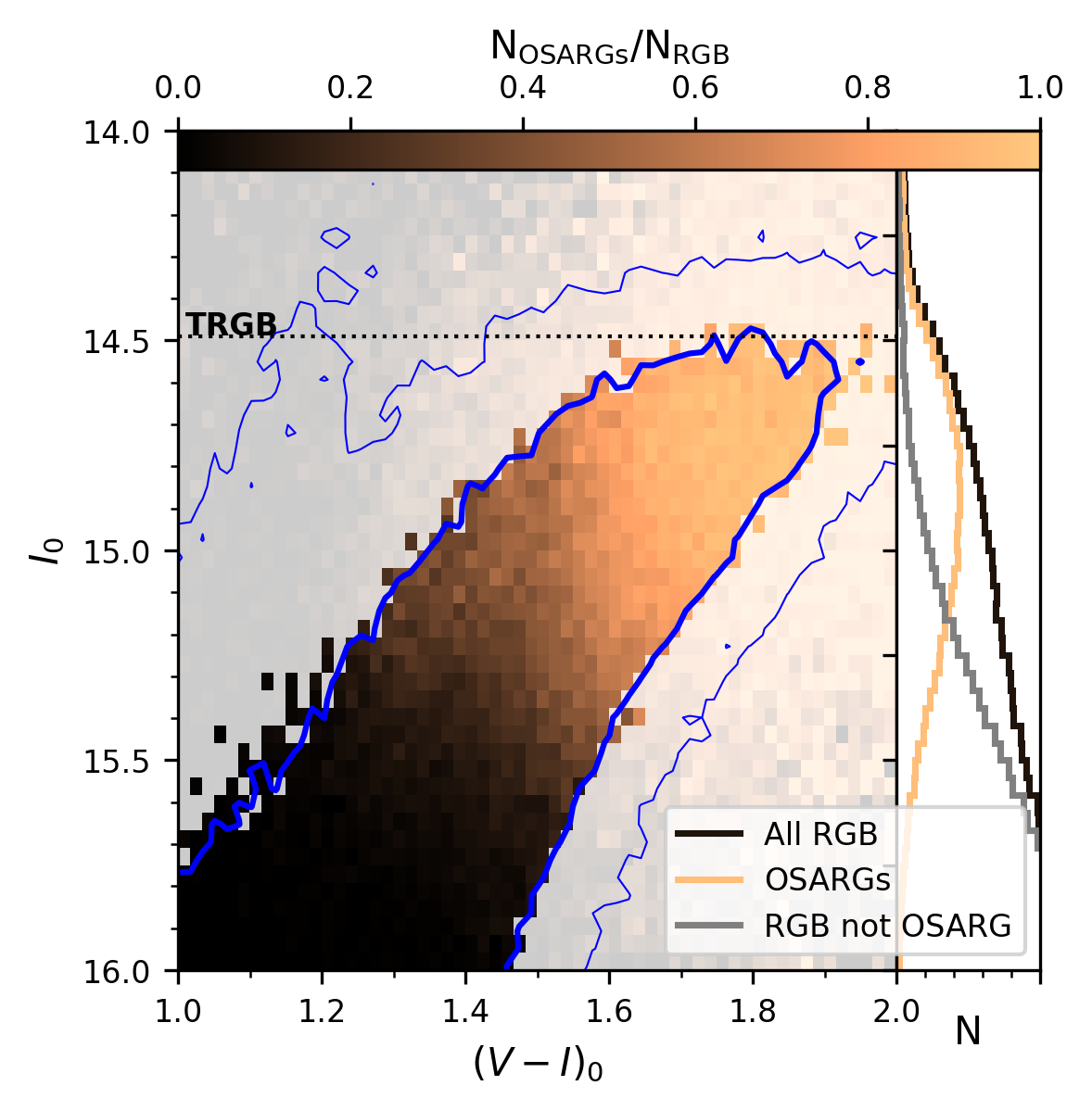
- OSARGs give the most precise TRGB measurement with m_F814W,syn = 14.491 ± 0.010 (stat) ± 0.010 (syst) mag.
- TRGB absolute magnitudes calibrated to the LMC distance yield M_F814W,syn = -3.986 ± 0.011 (stat) ± 0.028 (syst) mag and M_I,syn = -3.979 ± 0.011 (stat) mag.
- Using the LMC distance, the TRGB calibration implies H0 = 71.8 ± 1.5 km s^-1 Mpc^-1, in close agreement with Cepheid-based measurements and in tension with Planck’s early-Universe value by 2.8σ.
- Differences of up to ~0.041 mag between OSARG A/B sequences and ~0.087 mag between the A and B OSARG sequences show the impact of variability-based homogeneity on TRGB estimates.
- The results align with Gaia-based and EDD (Rizzi) calibrations, while differing from some Hoyt (CCHP) calibrations due to choices of R_I and sample selection.
- Calibrated M_I,OGLE and M_I,syn values are consistent with external calibrations within quoted uncertainties.
より良い研究を、今すぐ始めましょう
論文設計から論文執筆まで、研究時間を劇的に削減しましょう。
クレジットカード登録不要
このレビューはAIが作成し、人間の編集者が確認しました。