
[論文レビュー] SoftMatch: Addressing the Quantity-Quality Trade-off in Semi-supervised Learning
SoftMatch は、SSL における擬似ラベルの量と質を高い状態に保つための、トランケーションされた Gaussian weighting と Uniform Alignment を導入し、未ラベルデータをより適切に活用することで学習を改善します。
The critical challenge of Semi-Supervised Learning (SSL) is how to effectively leverage the limited labeled data and massive unlabeled data to improve the model's generalization performance. In this paper, we first revisit the popular pseudo-labeling methods via a unified sample weighting formulation and demonstrate the inherent quantity-quality trade-off problem of pseudo-labeling with thresholding, which may prohibit learning. To this end, we propose SoftMatch to overcome the trade-off by maintaining both high quantity and high quality of pseudo-labels during training, effectively exploiting the unlabeled data. We derive a truncated Gaussian function to weight samples based on their confidence, which can be viewed as a soft version of the confidence threshold. We further enhance the utilization of weakly-learned classes by proposing a uniform alignment approach. In experiments, SoftMatch shows substantial improvements across a wide variety of benchmarks, including image, text, and imbalanced classification.
研究の動機と目的
- Formally define the quantity and quality of pseudo-labels in SSL within a unified sample weighting framework.
- Identify the limitations of hard-thresholded pseudo-labeling that cause a quantity-quality trade-off.
- Propose SoftMatch with adaptive, truncated Gaussian weighting to improve pseudo-label utilization while maintaining quality.
- Introduce Uniform Alignment to address class-imbalance in pseudo-labels and stabilize learning.
- Demonstrate state-of-the-art or competitive results on image, text, and long-tailed SSL benchmarks.
提案手法
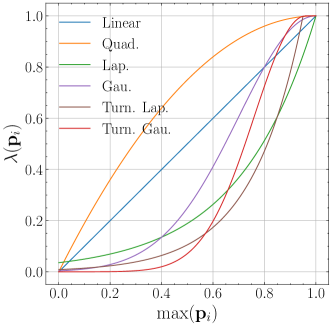
- Reframe SSL unsupervised loss as a weighted cross-entropy where weights lambda(p) depend on the model’s confidence.
- Derive a truncated Gaussian weighting function for lambda(p) based on the current training iteration mean mu_t and variance sigma_t of the max-class confidence.
- Estimate mu_t and sigma_t via EMA from historical predictions and adapt weights during training.
- Introduce Uniform Alignment to normalize predictions by a uniform target distribution and compute per-sample weights from the normalized predictions.
- Combine the Gaussian weighting with Uniform Alignment to form the final lambda(p) used in the unsupervised loss.
- Provide an algorithmic overview and empirical validation across image and text tasks.
実験結果
リサーチクエスチョン
- RQ1How can pseudo-labels be weighted to balance their quantity and quality during SSL training?
- RQ2Can a data-driven, adaptive weighting scheme outperform fixed or threshold-based pseudo-labeling in diverse domains?
- RQ3Does aligning pseudo-label distributions toward uniform class usage improve robustness under long-tailed or imbalanced data?
- RQ4What is the impact of updating weighting parameters from historical predictions on SSL performance?
- RQ5How does SoftMatch perform relative to state-of-the-art SSL methods on image and text benchmarks?
主な発見
- SoftMatch achieves strong improvements across image and text classification benchmarks compared to prior SSL methods.
- SoftMatch surpasses FixMatch by 1.48% on SVHN with 40 labels.
- SoftMatch outperforms FlexMatch on CIFAR-100 with 400 labels, STL-10 with 40 labels, and ImageNet with 10% labels by margins of 7.73%, 2.84%, and 1.33%, respectively.
- SoftMatch demonstrates robustness to long-tailed distributions in imbalanced SSL settings, showing best test error across all long-tailed configurations examined.
- Uniform Alignment helps balance pseudo-labels across classes, benefiting learning in imbalanced SSL scenarios.
- Ablation studies indicate Gaussian-based weighting with adaptive mu_t, sigma_t and Uniform Alignment yield the most consistent gains over alternatives.

より良い研究を、今すぐ始めましょう
論文設計から論文執筆まで、研究時間を劇的に削減しましょう。
クレジットカード登録不要
このレビューはAIが作成し、人間の編集者が確認しました。