
[論文レビュー] Space Group Constrained Crystal Generation
DiffCSP++は、空間群制約を組み込むことで拡散ベースの結晶生成を拡張し、対称性の下で格子、Wyckoff位置、および原子種の生成を可能にします。実験は、空間群認識による制御を用いた構造予測とab initio生成の改善を示します。
Crystals are the foundation of numerous scientific and industrial applications. While various learning-based approaches have been proposed for crystal generation, existing methods seldom consider the space group constraint which is crucial in describing the geometry of crystals and closely relevant to many desirable properties. However, considering space group constraint is challenging owing to its diverse and nontrivial forms. In this paper, we reduce the space group constraint into an equivalent formulation that is more tractable to be handcrafted into the generation process. In particular, we translate the space group constraint into two parts: the basis constraint of the invariant logarithmic space of the lattice matrix and the Wyckoff position constraint of the fractional coordinates. Upon the derived constraints, we then propose DiffCSP++, a novel diffusion model that has enhanced a previous work DiffCSP by further taking space group constraint into account. Experiments on several popular datasets verify the benefit of the involvement of the space group constraint, and show that our DiffCSP++ achieves promising performance on crystal structure prediction, ab initio crystal generation and controllable generation with customized space groups.
研究の動機と目的
- 空間群対称性を拡散ベースの結晶生成に組み込み、精度と制御性を向上させることを動機づける。
- 格子(基底)とWyckoff(分数座標)制約を実現可能な形に翻訳する。
- これらの制約の下で格子行列、分数座標、および原子種を同時生成する拡散モデルを開発する。
- 複数データセットにわたって結晶構造予測およびab initio結晶生成の性能を改善を示す。
提案手法
- 空間群制約を二部として解釈する:不変ログ空間の格子基底制約とWyckoff位置の分数座標制約。
- 不変成分Sを決定する極分解L = Q exp(S)を用いて格子Lを表現し、対称な行列であるSが格子形状をO(3)回転に依存せず決定する。
- 格子を6つの結晶族に分類して、格子制約を対称基底係数_k_i_ (i=1..6)へ写像する。
- Wyckoff位置を、サイト対称性とWyckoff重複度で分の座標を制約し、ノイズ除去後の座標をWyckoff制約部分空間へ射影するために擬似逆を必要に応じて用いる。
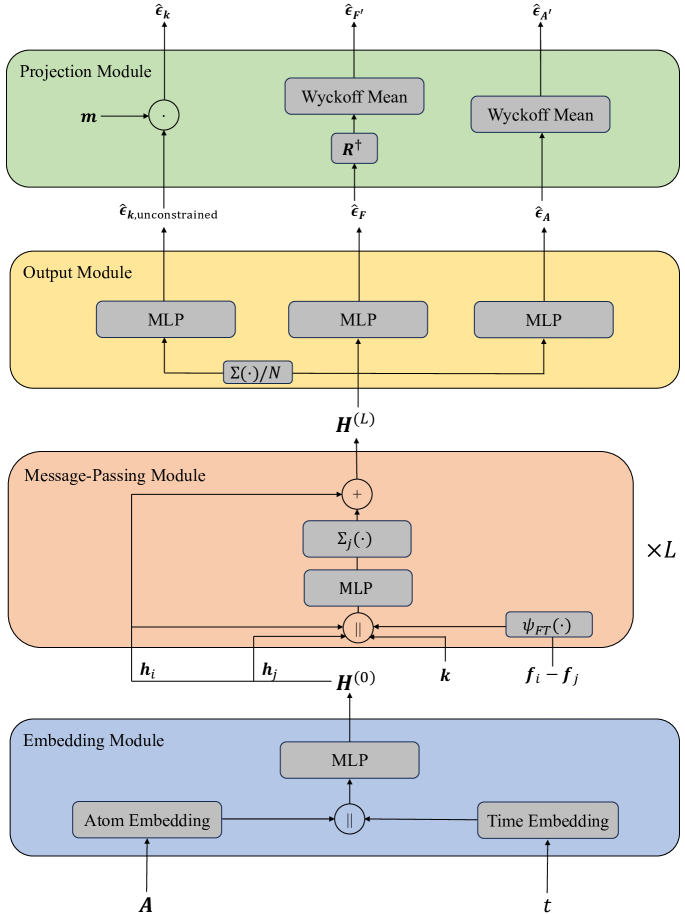
- Lの不変kベクトル、Wyckoff制約付き分数座標F′、基本原子種A′に対して拡散過程を適用し、結合学習目的L_M = λ_k L_k + λ_F′ L_F′ + λ_A′ L_A′を用いる。
- 拡散モデルに不変グラフニューラルネットワークの特徴量、時間埋め込み、およびフーリエ基底の相対位置符号化を導入して空間群対称性をエンコードし、適切な場所でE(3)不変性を保証する。

実験結果
リサーチクエスチョン
- RQ1空間群対称性を拡散ベースの結晶生成へ効果的に統合し、格子制約とWyckoff制約を分離することは可能か。
- RQ2指定条件下でDiffCSP++は結晶構造予測とab initio生成の性能を改善するか。
- RQ3GT空間群入力とテンプレートベースの空間群入力を用いた場合の生成品質への影響はどうなるか。
- RQ4不変格子表現は従来の DiffCSP アプローチと比較してモデル性能にどのような影響を与えるか。
主な発見
- DiffCSP++ with space group constraints achieves strong performance on crystal structure prediction across Perov-5, MP-20, and MPTS-52 datasets.
- Under GT space-group conditions, DiffCSP++ surpasses baseline methods in match rate and RMSE.
- Using CSPML templates with DiffCSP++ improves prediction when GT space groups are unavailable, though gaps remain versus GT conditions (70.58% vs 80.27% MR on MP-20).
- In ab initio generation, DiffCSP++ matches or exceeds baselines on validity and coverage, and shows improved property statistics (e.g., density, formation energy) indicating more realistic crystals.
- Ablation shows the invariant lattice representation and pre/post-average strategies influence MR and RMSE, with DiffCSP++ (Post) achieving higher MR (80.27%) and lower RMSE than variants.
- The method demonstrates that incorporating space group symmetry benefits diffusion-based crystal generation for complex structures.
より良い研究を、今すぐ始めましょう
論文設計から論文執筆まで、研究時間を劇的に削減しましょう。
クレジットカード登録不要
このレビューはAIが作成し、人間の編集者が確認しました。