
[論文レビュー] Sparse Blossom: correcting a million errors per core second with minimum-weight matching
疎結晶法(sparse blossom)を導入する。これは、全探索を回避した高速なMWPMベースの量子誤り訂正符号用デコーダであり、表面コードの大規模化においてリアルタイムデコードを実現する。
In this work, we introduce a fast implementation of the minimum-weight perfect matching (MWPM) decoder, the most widely used decoder for several important families of quantum error correcting codes, including surface codes. Our algorithm, which we call sparse blossom, is a variant of the blossom algorithm which directly solves the decoding problem relevant to quantum error correction. Sparse blossom avoids the need for all-to-all Dijkstra searches, common amongst MWPM decoder implementations. For 0.1% circuit-level depolarising noise, sparse blossom processes syndrome data in both $X$ and $Z$ bases of distance-17 surface code circuits in less than one microsecond per round of syndrome extraction on a single core, which matches the rate at which syndrome data is generated by superconducting quantum computers. Our implementation is open-source, and has been released in version 2 of the PyMatching library.
研究の動機と目的
- 大規模表面コード量子コンピュータのためのリアルタイムでスケーラブルなデコードの必要性を動機づける。
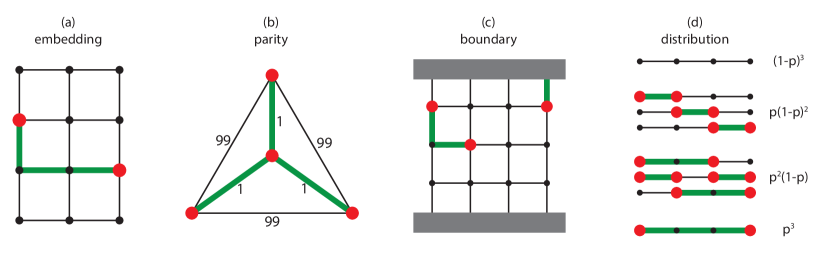
- 検出器グラフ上で埋め込みMWPM問題を直接解く、グラフ状の誤りモデルに対する高速デコーダの開発。
- コストの高い全探索を回避し、リアルタイム動作を可能にすることで、従来のMWPM実装を改善する。
- 迅速なシミュレーションとハードウェア対応デコードワークフローを促進するため、オープンソースソフトウェア(PyMatching v2)を提供する。
提案手法
- graphlike誤りモデルから検出器グラフを定義し、辺の重み w(e)=log((1-p)/p) とする。
- 従来のMWPMではなく、検出器グラフ上で最小重み埋め込みマッチング(MWEM)としてデコードを定式化する。
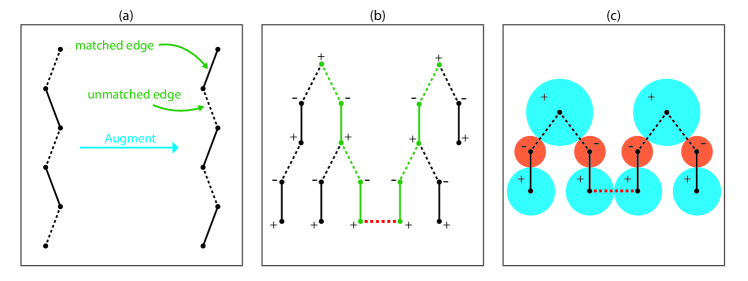
- Edmondsの blossom アルゴリズムの一変更版である sparse blossom を開発し、グローバル優先度キューの下で領域を成長させてMWEMを効率的に見つける。
- 負の辺の重みを、最小歪み調整を行い非負重みに前処理して扱う。PyMatchingで実装されているとおり。
- パスグラフ構築と3段階の還元(パスグラフを構築、MWPMを解く、MWEMを再構築)を通じてMWEMとMWPMの関係を証明する。
- distance-17およびdistance-29の表面コード回路を0.1%のサーキットレベル脱偏 polarノイズ下でベンチマークし、単一コアでマイクロ秒スケールのデコードを報告する。
実験結果
リサーチクエスチョン
- RQ1量子誤り訂正のために、検出器グラフ上で直接実用的に最小重み埋め込みマッチングの定式化を解決できるか。
- RQ2全探索なしに大規模表面コードのための高速・リアルタイムデコードを提供するように、blossomアルゴリズムをどのように適応できるか。
- RQ3従来のMWPMアプローチと比較して、MWEMベースのデコーダで達成可能な性能向上(速度とスケーラビリティ)はどの程度か。
主な発見
- Sparse blossomは distance-17 表面コード回路のX基底およびZ基底を、0.1%ノイズで単一コアあたり1マイクロ秒未満の1ラウンドでデコードする。
- 同じノイズモデルで distance 29 では、単一コアで1ラウンドあたり3.5マイクロ秒で動作する。
- この実装は従来のツールを大幅に上回り、リアルタイムデコードとスケーラブルなシミュレーションを可能にする。
- デコーダは PyMatching version 2 に実装され、オープンソースソフトウェアとして提供されており(GitHubリンクを提供)、Stim を用いた迅速なシミュレーションに利用できる。
より良い研究を、今すぐ始めましょう
論文設計から論文執筆まで、研究時間を劇的に削減しましょう。
クレジットカード登録不要
このレビューはAIが作成し、人間の編集者が確認しました。