
[論文レビュー] Stable Neural Stochastic Differential Equations in Analyzing Irregular Time Series Data
tldr: 本論文は three stable classes of Neural SDEs (Langevin-type SDE, Linear Noise SDE, and Geometric SDE) による不規則時系列データの取り扱いを制御パスで実現し、存在性/一意性を証明し、分布シフトと欠測データへの頑健性を広範な実験で示す。
Irregular sampling intervals and missing values in real-world time series data present challenges for conventional methods that assume consistent intervals and complete data. Neural Ordinary Differential Equations (Neural ODEs) offer an alternative approach, utilizing neural networks combined with ODE solvers to learn continuous latent representations through parameterized vector fields. Neural Stochastic Differential Equations (Neural SDEs) extend Neural ODEs by incorporating a diffusion term, although this addition is not trivial, particularly when addressing irregular intervals and missing values. Consequently, careful design of drift and diffusion functions is crucial for maintaining stability and enhancing performance, while incautious choices can result in adverse properties such as the absence of strong solutions, stochastic destabilization, or unstable Euler discretizations, significantly affecting Neural SDEs' performance. In this study, we propose three stable classes of Neural SDEs: Langevin-type SDE, Linear Noise SDE, and Geometric SDE. Then, we rigorously demonstrate their robustness in maintaining excellent performance under distribution shift, while effectively preventing overfitting. To assess the effectiveness of our approach, we conduct extensive experiments on four benchmark datasets for interpolation, forecasting, and classification tasks, and analyze the robustness of our methods with 30 public datasets under different missing rates. Our results demonstrate the efficacy of the proposed method in handling real-world irregular time series data.
研究の動機と目的
- 不規則時系列データを欠測データとともに Neural SDEs で頑健に扱う動機づけ。
- well-posedness と stability を保証するための three stable Neural SDE クラスの提案。
- drift に controlled path を組み込み、逐次観測モデリングを改善。
- 分布シフトと欠測データに対する頑健性を理論的に分析。
- 複数データセットを跨ぐ interpolation、forecasting、classification タスクで実証的に検証。
提案手法
- Langevin-type Neural LSDE を drift γ と diffusion σ を用いて定義し、 Lipschitz 条件と成長条件の下で existence/uniqueness を証明。
- Linear Noise Neural LNSDE を線形乗法的 diffusion で定義し、安定性を解析。
- Geometric Neural GSDE を幾何形状 form で定義し、非負性と absorbing state properties を示す。
- Neural コンポーネントに対して Assumptions 3.1–3.3 を課し、SDE 解の良い定義を保証。
- drift に z̄(t)=zeta(t,z(t),X(t);θζ) を組み込み、z(t) を drift 項での z̄(t) に置換。
- robustness results(Theorems 3.5 and 3.6)を提供し、入力摂動下での出力分布の非漸近的な差を境界付ける。
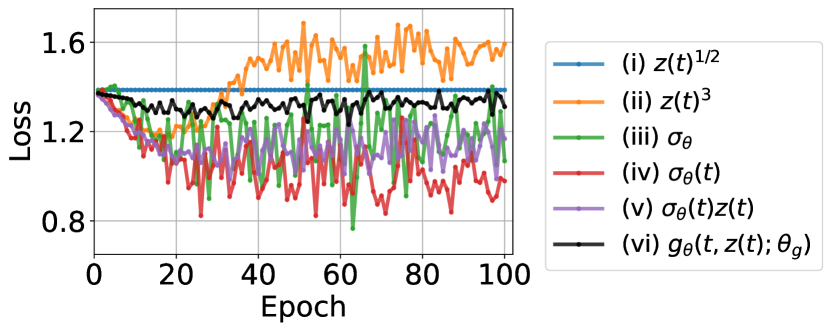
- ablation 研究を行い、diffusion nonlinearities と controlled paths(ζ および diffusion σ)を比較。
実験結果
リサーチクエスチョン
- RQ1分布シフトと欠測データの下でも安定な Neural SDE を設計して性能を維持できるか?
- RQ2Langevin-type、Linear Noise、Geometric SDE 形式が existence、uniqueness、頑健性の理論的保証を提供するか?
- RQ3drift に controlled path を組み込むことで irregular time series に対する経験的性能が改善されるか?
- RQ4異なる diffusion アーキテクチャ(affine vs nonlinear)が安定性と精度にどう影響するか?
- RQ5欠測を伴う interpolation、forecasting、classification タスクで提案モデルの実証的有効性はどうか?
主な発見
- Three stable Neural SDE classes (LSDE, LNSDE, GSDE) are proposed and shown to have unique strong solutions under reasonable assumptions.
- Neural GSDE exhibits nonnegativity and absorbing state properties linking to deep ReLU networks.
- Theoretical results show robustness to distribution shift and missing data, with non-asymptotic bounds on output distribution changes that decay with depth T.
- Empirical results across four benchmarks for interpolation, forecasting, and classification show the proposed methods outperform baselines under various missing rates.
- Ablation studies confirm the benefit of incorporating a controlled path and a nonlinear diffusion function for performance.
- Across 30 public datasets with varying missing rates, the proposed Neural LSDE, LNSDE, and GSDE achieve top-tier accuracy and robustness compared to traditional RNNs, Neural CDEs, and other Neural SDE variants.
より良い研究を、今すぐ始めましょう
論文設計から論文執筆まで、研究時間を劇的に削減しましょう。
クレジットカード登録不要
このレビューはAIが作成し、人間の編集者が確認しました。