
[論文レビュー] Standard Siren Cosmology with Gravitational Waves from Binary Black Hole Mergers in Active Galaxy Nuclei
本論文は、活動銀河核(AGN)における二重ブラックホール合体からの重力波を用いた、重力波標準サインとしての新規な宇宙論的手法を提案する。特記事項として、特徴的な宿主銀河の特定を必要とせず、AGNの増光またはカタログを赤方偏移の指標として用いる。LIGO/Virgo/KAGRAが設計感度(A+)に達した状態で1〜2年間の観測により、増光検出効率や宇宙論的事前分布の違いに応じて、H₀の制約が2〜7%の精度で達成可能である。
The detection of gravitational waves (GW) with an electromagnetic counterpart enabled the first Hubble Constant $H_0$ measurement through the standard siren method. Current constraints suggest that $\sim 20-30\%$ of LIGO/Virgo/KAGRA (LVK) Binary Black Hole (BBH) mergers might occur in Active Galactic Nuclei (AGN) disks. The claim for a possible association of several BBH mergers with flaring AGNs suggests that cosmological analyses using BBH and AGNs might be promising. We explore standard siren analyses through a method that takes into account the presence of background flaring AGNs, without requiring a unique host galaxy identification, and apply it to realistic GW simulations. Depending on the fraction of LVK BBHs that induce flares, we expect to constrain $H_0$ at the $\sim 6-7\%$ ($\sim 4-5\%$) precision with $\sim 2-3$ years or $\sim 160-240$ events ($\sim 1$ year or $500$ events) of LVK at design (A+) sensitivity, assuming that systematic BBH follow-up searches are performed. %Assuming a more restrictive $Ω_{ m m}$ prior and that at least $20\%$ of BBHs produces detectable flares, we may reach a $3\%$ ($2\%$) precision in $H_0$ after 2 (1) year of LVK at design (A+) sensitivity. We also show that in a scenario where only $\sim 1\%$ of the BBHs induce detectable flares it is possible to achieve an $H_0$ precision from $7.5\%$ to $15\%$ with $\sim 240$ events. In addition, a $\sim 5-27\%$ precision is achievable with complete AGN catalogs and 1 year of LVK run, without the need of any flare identification.
研究の動機と目的
- 重力波を用いた独立した宇宙論的測定を可能にすることで、持続的なH₀の不一致を解消すること。
- 大多数の二重ブラックホール(BBH)合体に電磁的対応物が存在しないという課題を、AGNの増光を赤方偏移の指標として用いることで克服すること。
- 時間的に迅速なフォローアップや特徴的な宿主銀河の特定を必要とせず、GWイベントとAGNまたは増光を統計的に関連付ける手法を開発すること。
- 現実的なAGN密度と増光確率を考慮した上で、AGN内のBBH合体を用いた宇宙論的精度を定量化すること。
- 宇宙論的事前分布(例:Ω_m)とAGN増光検出効率の影響が、H₀測定精度に与える影響を評価すること。
提案手法
- AGNと増光の空間的・時間的分布を考慮し、非一様ポアソン過程を用いてGW-AGN関連をモデル化する。
- ベイズの定理を適用し、BBHが増光を引き起こす割合(λ)と天球上の位置を周辺化することで、宇宙論的パラメータの事後分布を計算する。
- GWイベントがAGNの天球位置と赤方偏移と一致する確率と、偶然一致の背景レートを組み合わせた尤度関数(式3)を用いる。
- AGNおよび増光の検出確率(P_det^AGN)を組み込み、天球および赤方偏移にわたる統合(式4)により、背景関連の期待数(μ_i)を計算する。
- emcee MCMCパッケージを用いて事後分布をサンプリングし、wCDM宇宙論モデルにおける宇宙論的パラメータとλを推定する。
- 実際のGWシミュレーションを用いて、AGN密度(n_AGN = 10^{-4.75} から 10^{-4.5} Mpc⁻³)および増光確率(α_flare = 10^{-4} から 10^{-3})を変化させた条件で手法をテストする。
実験結果
リサーチクエスチョン
- RQ1特徴的な宿主銀河の特定を要せず、AGNの増光またはカタログを赤方偏移の指標として用いることは、標準サイン宇宙論において可能か?
- RQ2現在および将来の重力波検出器の感度を考慮した場合、AGN内のBBH合体を用いてどの程度のH₀精度が達成可能か?
- RQ3Ω_mなどの宇宙論的事前分布の取り入れが、この枠組みにおけるH₀測定精度にどのように影響するか?
- RQ4BBHが検出可能なAGN増光を引き起こす割合(λ)をどの程度の精度で測定できるか?また、その精度はイベント数とAGN密度にどのように依存するか?
- RQ5時間的に迅速なフォローアップ観測を要せず、AGNカタログのみを用いても、5%未満のH₀精度を達成できるか?
主な発見
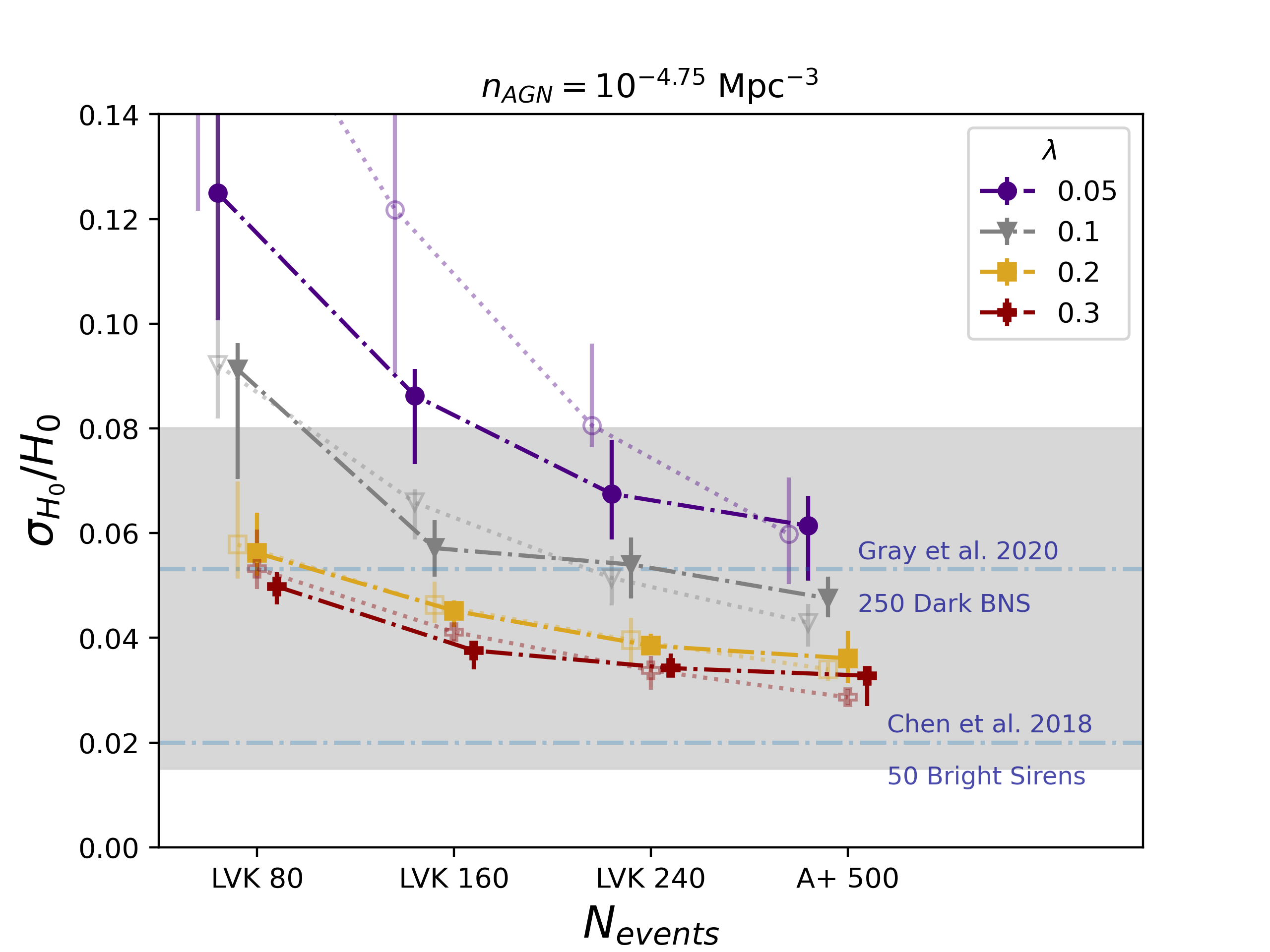
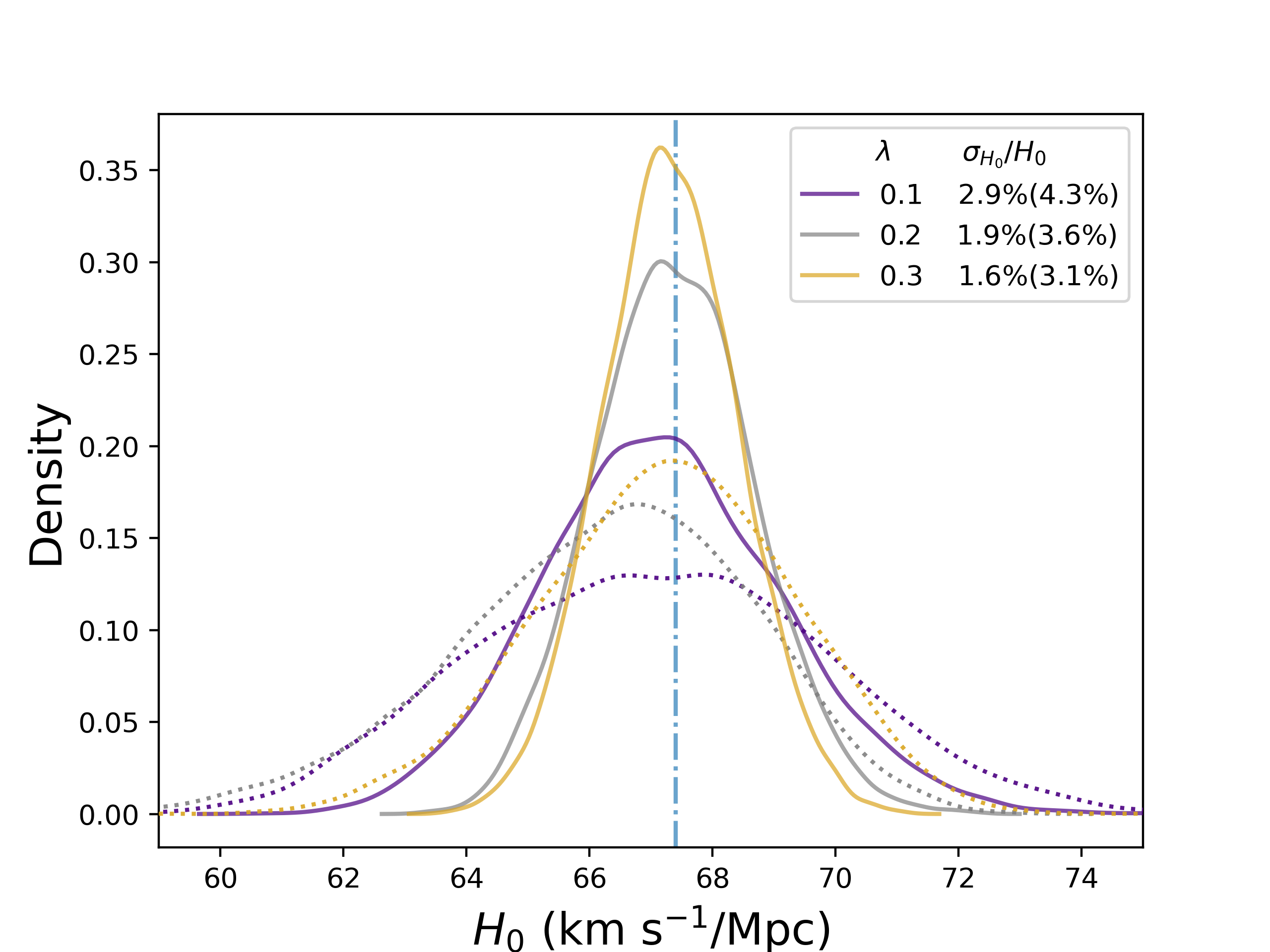
- LIGO/Virgo/KAGRAが設計感度(A+)に達した状態で約2年間の観測で160件のBBHイベントを取得した場合、BBHの20〜80%がAGN内で発生すると仮定すると、H₀の制約精度が3.5〜7%に達する。
- A+感度で約1年間の観測で500件のイベントを取得した場合、同様の仮定のもとでH₀の精度は2.5〜5%に向上する。
- BBH増光割合が20%で、Ω_mに制限的な事前分布を適用した場合、A+感度で2年間(1年間)の観測でH₀精度が3%(2%)に達する。
- 完全なAGNカタログと1年間のLVKデータのみを用いても、H₀精度5〜10%を達成可能であり、時間的に迅速なフォローアップ観測を要しない。
- 本手法により、BBHが増光を引き起こす割合(λ)を約10〜30%の精度で制約可能であり、AGN内でのBBH形成メカニズムに関する知見が得られる。
- 事後分布の等高線は、標準サイン宇宙論に特徴的なバナナ型のデゲネラシーを示しており、本手法が標準サイン宇宙論の原則と整合していることを確認した。
より良い研究を、今すぐ始めましょう
論文の読解から最終レビューまで、研究時間を劇的に削減しましょう。
クレジットカード登録不要
このレビューはAIが作成し、人間の編集者が確認しました。