
[論文レビュー] Star-Planet Interaction at radio wavelengths in YZ Ceti: Inferring planetary magnetic field
本研究では、改良された巨大メートル波電波望遠鏡(uGMRT)を用いて、YZ Ceti系における星-惑星相互作用(SPI)の最初の確認された検出が、電波波長におけるオーロラ電波放射(ARE)によってなされた。研究者たちは、YZ Cet bの軌道位相と相関する円偏光電波パルスを検出し、惑星磁場の下限が0.4 G以上であると推定した。これは、系外惑星の磁気圏を間接的に測定した初の例である。
In exoplanetary systems, the interaction between the central star and the planet can trigger Auroral Radio Emission (ARE), due to the Electron Cyclotron Maser mechanism. The high brightness temperature of this emission makes it visible at large distances, opening new opportunities to study exoplanets and to search for favourable conditions for the development of extra-terrestrial life, as magnetic fields act as a shield that protects life against external particles and influences the evolution of the planetary atmospheres. In the last few years, we started an observational campaign to observe a sample of nearby M-type stars known to host exoplanets with the aim to detect ARE. We observed YZ Ceti with the upgraded Giant Metrewave Radio Telescope (uGMRT) in band 4 (550-900 MHz) nine times over a period of five months. We detected radio emission four times, two of which with high degree of circular polarization. With statistical considerations we exclude the possibility of flares due to stellar magnetic activity. Instead, when folding the detections to the orbital phase of the closest planet YZ Cet b, they are at positions where we would expect ARE due to star-planet interaction (SPI) in sub-Alfvenic regime. With a degree of confidence higher than 4.37 sigma, YZ Cet is the first extrasolar systems with confirmed SPI at radio wavelengths. Modelling the ARE, we estimate a magnetic field for the star of about 2.4 kG and we find that the planet must have a magnetosphere. The lower limit for the polar magnetic field of the planet is 0.4 G.
研究の動機と目的
- 電波波長を用いて、系外惑星系における星-惑星相互作用(SPI)に起因するオーロラ電波放射(ARE)を検出すること。
- M型矮星系における電波放射がSPI由来であるか、星のフレア由来であるかを区別すること。
- 電波放射モデルを用いて、惑星磁場の存在と強度を推定すること。
- 系外惑星系におけるAREのためのハロー・コーンビームモデルを検証すること。
- 電波放射を間接的指標として用いて、系外惑星の磁気圏を検出する手法を確立すること。
提案手法
- 5か月間にわたり、YZ Cetiを550–900 MHzで9回のuGMRT観測を実施し、電波放射を検出すること。
- 円偏光および時間的変動性の分析により、AREと星のフレアを区別すること。
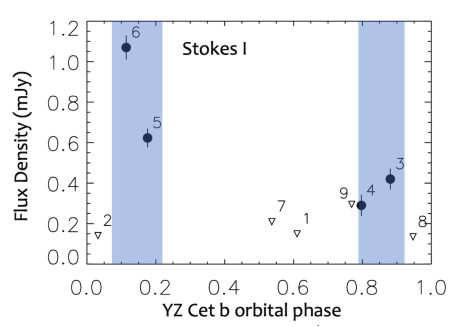
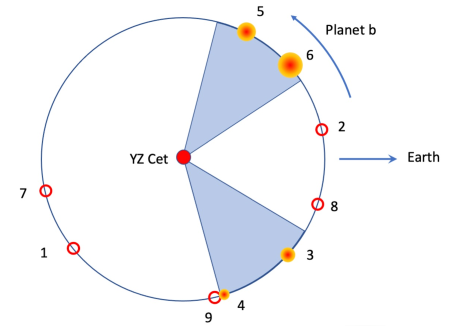
- YZ Cet bの軌道位相に合わせて検出結果を折りたたみ、予想されるSPI領域と相関を確認すること。
- 観測された電波放射を電子サイクロトロンメーザー放射(ECME)機構を用いてモデル化すること。
- 入射磁気エネルギーと観測された電波放射のエネルギー収支を用いて、惑星磁気圏断面積を推定すること。
- 一般化された電波-磁気ボーデの法則および双極子磁場スケーリングを適用し、惑星磁場の下限を推定すること。
実験結果
リサーチクエスチョン
- RQ1電波波長において、系外惑星系における星-惑星相互作用に起因するオーロラ電波放射(ARE)を検出できるか?
- RQ2YZ Cetiで検出された電波放射は、星のフレアではなくSPIに起因するAREと整合的か?
- RQ3電波放射モデルに基づき、YZ Cet bにおける惑星磁場の下限は何か?
- RQ4観測された放射パターンは、AREのためのハロー・コーンビームモデルを支持するか?
- RQ5電波放射を用いて、間接的に系外惑星の磁気圏を検出できるか?
主な発見
- 9回のuGMRT観測のうち4回で電波放射が検出され、そのうち2回は高い円偏光を示しており、コherent放射を示唆している。
- 電波放射はYZ Cet bの軌道位相と強く相関しており、対称的な2つの領域でピークを示しており、AREのハロー・コーンビームモデルと整合的である。
- 統計的解析により、電波放射の原因が星のフレアである可能性は4.37σ以上の信頼水準で除外された。
- 観測された電波放射の全放射度(1.0–1.7×10²² erg s⁻¹)は、惑星が磁気圏を持たない場合の最大入射磁気エネルギーを上回っており、磁気圏断面積が惑星半径の少なくとも2.4倍以上であることを示唆している。
- 双極子磁場とエネルギー収支を仮定した場合、YZ Cet bの極磁場の下限として0.4 Gが導かれた。
- 本結果は、系外惑星系における惑星磁場の最初の間接的検出を示しており、生命可能性および大気の進化に及ぼす影響を示唆している。
より良い研究を、今すぐ始めましょう
論文の読解から最終レビューまで、研究時間を劇的に削減しましょう。
クレジットカード登録不要
このレビューはAIが作成し、人間の編集者が確認しました。