
[論文レビュー] Strong coupling and single-photon nonlinearity in free-electron quantum optics
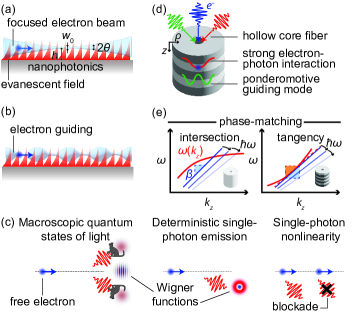
本稿では、ポンドモティブ誘導を用いて電子の回折を抑制し、ガイドされた光モードと長時間相互作用できる1次元光子的系である自由電子繊維を提案する。この方式により、強い結合($|g_Q| \gtrsim 1$)と単一光子非線形性($δ_{ν} \sim 2\pi$)を達成し、決定的単一光子放出と複雑なマルチモードダイナミクスを可能にする。
The observation that free electrons can interact coherently with quantized electromagnetic fields and matter systems has led to a plethora of proposals leveraging the unique quantum properties of free electrons. At the heart of these proposals lies the assumption of a strong quantum interaction between a flying free electron and a photonic mode. However, existing schemes are intrinsically limited by electron diffraction, which puts an upper bound on the interaction length and therefore the quantum coupling strength. Here, we propose the use of "free-electron fibers'': effectively one-dimensional photonic systems where free electrons co-propagate with two guided modes. The first mode applies a ponderomotive trap to the free electron, effectively lifting the limitations due to electron diffraction. The second mode strongly couples to the guided free electron, with an enhanced coupling that is orders of magnitude larger than previous designs. Moreover, the extended interaction lengths enabled by our scheme allows for strong single-photon nonlinearities mediated by free electrons. We predict a few interesting observable quantum effects in our system, such as deterministic single-photon emission and complex, nonlinear multimode dynamics. Our proposal paves the way towards the realization of many anticipated effects in free-electron quantum optics, such as non-Gaussian light generation, deterministic single photon emission, and quantum gates controlled by free-electron--photon interactions.
研究の動機と目的
- 自由電子量子光学における電子回折の根本的制限が相互作用長と結合強度を制限するのを克服すること。
- ポンドモティブ閉じ込めによって相互作用長を延長し、自由電子と光モードの強力な量子結合を実現すること。
- 自由電子を介した強い単一光子非線形性を実現し、非ガウス光の生成と決定的量子光学に不可欠な要因を達成すること。
- 高いコherenceと調整可能性を備えた自由電子-光子相互作用を用いた量子情報処理およびセンシングのためのプラットフォームを実現すること。
- 誘電体波ガイド構造において、決定的単一光子放出と複雑な非線形マルチモードダイナミクスの実現可能性を示すこと。
提案手法
- 自由電子が2つのガイドされた光モードと同時に共進路する1次元光子的系を設計する。1つはポンドモティブトラップに、もう1つは強力な結合に使用する。
- 電子回折を補償するためのポンドモティブポテンシャルを用い、電子の平均自由行程を効果的に延長し、長時間の相互作用を可能にする。
- 特徴的な光モード構造を採用して、結合強度 $|g_Q| \gtrsim 1$ を達成し、強力結合領域に進入する。
- 単一光子非線形性を記述するため、非線形反動項を含むジャインズ=カーマイン型ハミルトニアンを用いて電子-光子相互作用をモデル化する。
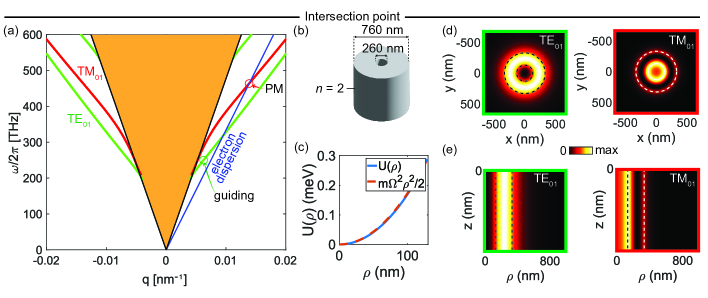
- 連続モード(交差点および接点)と離散キャビティモードの両方の位相一致条件を、エルミート-ガウスモード展開を用いて分析する。
- 線形および二次の分散関係の下で、光子放出振幅 $\bar{s}_n(t)$ の解析的表現を導出し、最大の結合を達成するための電子波動関数幅 $\sigma$ を最適化する。
実験結果
リサーチクエスチョン
- RQ1光子繊維構造におけるポンドモティブ誘導が、電子回折を克服し、光モードとの長時間相互作用を可能にするか?
- RQ2回折が抑制された状態で、自由電子-光子系における最大の達成可能な結合強度 $|g_Q|$ はどの程度か?
- RQ3量子反動効果を介して、自由電子ベースのプラットフォームで強い単一光子非線形性($δ_{\text{NL}} \sim 2\pi$)を実現できるか?
- RQ4連続モードまたは離散キャビティモードへの位相一致が、光子放出および非線形相互作用のダイナミクスにどのように影響するか?
- RQ5この系から、決定的単一光子放出やマルチモードもつれといった観測可能な量子効果が生じるか?
主な発見
- 提案された自由電子繊維により、回折限界をはるかに超える相互作用長が実現され、$|g_Q| \gtrsim 1$ の強力な結合が達成可能である。
- 交差位相一致の場合、最適なスケーリングパラメータは $\sigma' \approx 1.4$ であり、これが1モードへの最大光子放出を実現する。
- 接点位相一致の場合、最適なスケーリングは $\sigma' \approx 0.93$ であり、対称性のため偶数モードへの放出に限定され、放出プロファイルは特徴的な $\arctan$-様の位相進化を示す。
- 離散キャビティモードの場合、$1 - v_g/v_e = 2m$($m$ は整数)のとき、スーパーモード基底はキャビティモード基底と一致し、ダイナミクスが $s_n(t) = \frac{|g_Q|}{T} \exp(in \cdot 2\pi m t / T)$ に簡略化される。
- 非線形デチューニング $2\kappa$ がキャビティFSR $\Delta$ の整数倍であるとき、隣接モードへの段階的位相一致が発生し、非線形マルチモードダイナミクスが可能になる。
- 遅い電子($v_e \ll v_g$)および大きな $\delta_{\text{NL}}$ の極限では、系は単一モードのジャインズ=カーマイン相互作用に還元され、モデルの妥当性が確認される。
より良い研究を、今すぐ始めましょう
論文の読解から最終レビューまで、研究時間を劇的に削減しましょう。
クレジットカード登録不要
このレビューはAIが作成し、人間の編集者が確認しました。