
[論文レビュー] Studying continuous, time-varying, and/or complex exposures using longitudinal modified treatment policies
本論文は longitudinal modified treatment policies (LMTPs) を導入し、複雑で時変的または連続的曝露に対する統一的因果推論フレームワークを提供し、推定戦略と COVID-19 intubation timing ケーススタディを lmtp R package を用いて示します。
This tutorial discusses methodology for causal inference using longitudinal modified treatment policies. This method facilitates the mathematical formalization, identification, and estimation of many novel parameters, and mathematically generalizes many commonly used parameters, such as the average treatment effect. Longitudinal modified treatment policies apply to a wide variety of exposures, including binary, multivariate, and continuous, and can accommodate time-varying treatments and confounders, competing risks, loss-to-follow-up, as well as survival, binary, or continuous outcomes. Longitudinal modified treatment policies can be seen as an extension of static and dynamic interventions to involve the natural value of treatment, and, like dynamic interventions, can be used to define alternative estimands with a positivity assumption that is more likely to be satisfied than estimands corresponding to static interventions. This tutorial aims to illustrate several practical uses of the longitudinal modified treatment policy methodology, including describing different estimation strategies and their corresponding advantages and disadvantages. We provide numerous examples of types of research questions which can be answered using longitudinal modified treatment policies. We go into more depth with one of these examples--specifically, estimating the effect of delaying intubation on critically ill COVID-19 patients' mortality. We demonstrate the use of the open-source R package lmtp to estimate the effects, and we provide code on https://github.com/kathoffman/lmtp-tutorial.
研究の動機と目的
- Continuous と time-varying 曝露を含む静的介入を超えた因果質問の必要性を動機付ける。
- LMTPs を、静的、動的、確率的、および修正介入を包含する一般的なフレームワークとして提示する。
- 一般化 g-formula を用いた同定と、ポジティビティおよび逐次ランダム化仮定について説明する。
- 推定戦略の実用的な手法(パラメトリック g-計算、IPW、TMLE、SDR)と機械学習の可能性を含めて示す。
- 病院に入院した COVID-19 患者の人工呼吸器挿管遅延が死亡率に与える影響を推定するケーススタディと再現可能なコードを提供する。
提案手法
- LMTPs を定義し、治療の自然な値に依存するポリシー関数を許容することで静的/動的介入を拡張する。
- 介入関数 d_t を LMTPs の下で静的、動的、確率的、修正の分類に従って整理する。
- ポジティビティと逐次ランダム化仮定の下で generalize d-formul a による同定を述べる。
- 推定アプローチとして、パラメトリック g-計算、逆確率重み付け(IPW)、およびノンパラメトリックで機械学習ベースの方法(TMLE、SDR、iTMLE)を説明する。
- オープンソースの R パッケージ lmtp を用いたソフトウェア実装を議論し、再現コードと合成データを提供する。
実験結果
リサーチクエスチョン
- RQ1LMTPs の下で、時変かつ複雑な曝露に対して定義・同定できる因果指標は何か?
- RQ2LMTPs は longitudinal 設定におけるポジティビティの違反や情報性センサリングをどう扱えるか?
- RQ3LMTPs 内の推定戦略(g-計算、IPW、TMLE、SDR)の特性とトレードオフは何か?
- RQ4COVID-19 患者における挿管遅延が LMTPs の仮定下で 14 日死亡率にどう影響するか?
主な発見
- LMTPs は、時変、連続、複数曝露設定を含む幅広い曝露とアウトカムに対して因果効果を定義・同定・推定する統一的な方法を提供する。
- ポジティビティの問題は、観測されたサポート内で介入を設計することで緩和できる。構造的違反と実用的違反の議論を含む。
- ノンパラメトリック推定量(TMLE、SDR、iTMLE)は、柔軟なモデリングと有効な不確実性・二重堅牢性を提供し、機械学習を活用できる。
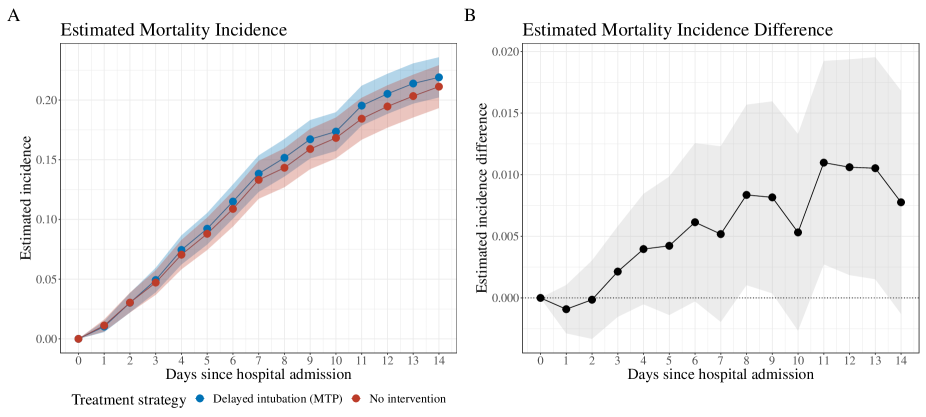
- COVID-19 のケーススタディでは、介入なしの場合の 14 日死亡率は 0.211(95% CI 0.193–0.229)で、1 日遅延の intubation LMTP の場合は 0.219(95% CI 0.202–0.236)だった。
より良い研究を、今すぐ始めましょう
論文設計から論文執筆まで、研究時間を劇的に削減しましょう。
クレジットカード登録不要
このレビューはAIが作成し、人間の編集者が確認しました。