
[論文レビュー] Sum-Rate Maximization of Uplink Rate Splitting Multiple Access (RSMA) Communication
本稿は、ユーザーの送信電力割り当てと基地局の復元順序を共同で最適化することにより、上行リンク・レートスプリットリング多重アクセス(RSMA)の和レート最大化フレームワークを提案する。非凸問題をレートスプリット変数のみの最適化問題に変換することで、最適なレートスプリットと電力割り当ての閉形式解を導出し、全探索を用いて最適な復元順序を特定する。シミュレーション結果から、RSMAはTDMAに対して最大83.7%、FDMAに対して22.2%、NOMAに対して10.0%の和レート向上を達成する。
In this paper, the problem of maximizing the wireless users' sum-rate for uplink rate splitting multiple access (RSMA) communications is studied. In the considered model, each user transmits a superposition of two messages to a base station (BS) with separate transmit power and the BS uses a successive decoding technique to decode the received messages. To maximize each user's transmission rate, the users must adjust their transmit power and the BS must determine the decoding order of the messages transmitted from the users to the BS. This problem is formulated as a sum-rate maximization problem with proportional rate constraints by adjusting the users' transmit power and the BS's decoding order. However, since the decoding order variable in the optimization problem is discrete, the original maximization problem with transmit power and decoding order variables can be transformed into a problem with only the rate splitting variable. Then, the optimal rate splitting of each user is determined. Given the optimal rate splitting of each user and a decoding order, the optimal transmit power of each user is calculated. Next, the optimal decoding order is determined by an exhaustive search method. To further reduce the complexity of the optimization algorithm used for sum-rate maximization in RSMA, a user pairing based algorithm is introduced, which enables two users to use RSMA in each pair and also enables the users in different pairs to be allocated with orthogonal frequency. For comparisons, the optimal sum-rate maximizing solutions with proportional rate constraints are obtained in closed form for non-orthogonal multiple access (NOMA), frequency division multiple access (FDMA), and time division multiple access (TDMA). Simulation results show that RSMA can achieve up to 10.0\%, 22.2\%, and 83.7\% gains in terms of sum-rate compared to NOMA, FDMA, and TDMA.
研究の動機と目的
- 上行リンクRSMAにおける電力割り当てと復元順序の共同最適化が不足している点に取り組み、スペクトル効率とユーザー公平性の両面で重要である。
- 比例レート制約下での和レート最大化問題を定式化し、離散的な復元順序と連続的な電力変数を組み込む。
- 元の非凸で混合整数の問題を、レートスプリット変数のみを含む等価問題に変換することで、閉形式解の導出を可能にする。
- 与えられた復元順序のもとで、各ユーザーの最適なレートスプリットと送信電力割り当てを導出し、全探索を用いてグローバルに最適な復元順序を特定する。
- 計算複雑性を低減しつつ高い和レート性能を維持できる、ユーザー対ベースのアルゴリズムを提案する。
提案手法
- ユーザーの送信電力と基地局の復元順序を最適化変数として含む、上行リンクRSMAの和レート最大化問題を定式化する。
- 解析的導出により電力および復元順序変数を除去することで、元の問題をレートスプリット変数のみを含む等価問題に変換する。
- KKT条件と電力制約を用いて、各ユーザーの最適なレートスプリット係数を閉形式で導出する。
- 固定された復元順序のもとで、導出したレートスプリット係数と信号対インターーフェアレンス+ノイズ比(SINR)式を用いて最適な送信電力割り当てを計算する。
- 全可能なユーザー情報復元順序の順列を全探索することで、グローバルに最適な復元順序を特定する。
- ペア内でのRSMAとペア間での周波数割り当ての直交性を可能にするユーザー対ベースのアルゴリズムを導入し、複雑性を低減する。
実験結果
リサーチクエスチョン
- RQ1送信電力と復元順序を最適化する条件下で、比例レート制約下における上行リンクRSMAの和レートをどのように最大化できるか?
- RQ2電力および復元順序制約下で和レートを最大化する各ユーザーの最適なレートスプリット戦略は何か?
- RQ3復元順序の選択が上行リンクRSMAにおける達成可能な和レートに与える影響は何か?また、グローバルに最適な順序は何か?
- RQ4和レートの観点から、従来の多重アクセス方式(NOMA、FDMA、TDMA)と比較してRSMAの性能向上はどの程度か?
- RQ5ユーザー対ベースのアルゴリズムは、計算複雑性を低減しつつ、近似的に最適な和レートを達成できるか?
主な発見
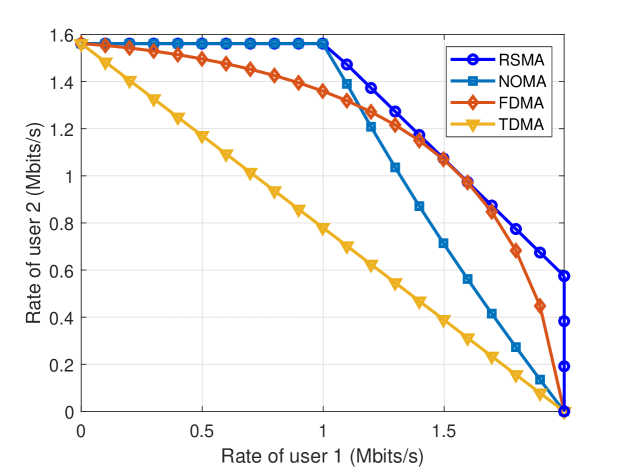
- 提案されたRSMAフレームワークは、同じ電力およびレート制約下で、非直交多重アクセス(NOMA)と比較して最大10.0%高い和レートを達成する。
- RSMAは、周波数分割多重アクセス(FDMA)に対して最大22.2%の和レート向上を示し、優れたスペクトル効率を実証する。
- RSMAの和レート向上は、時分割多重アクセス(TDMA)に対して最大83.7%に達し、多数の端末接続と高いスペクトル効率をサポートする点での優位性を強調する。
- 各ユーザーの最適なレートスプリット係数は閉形式で導出され、任意の与えられた復元順序のもとでの電力割り当ての効率的計算を可能にする。
- 全探索に基づく復元順序選択はグローバルな和レート最適解を達成し、ユーザー対アルゴリズムは複雑性を顕著に低減しつつ高い性能を維持する。
- ベンチマーク方式(NOMA、FDMA、TDMA)に対しても閉形式の最適解が導出され、RSMAの優位性を直接比較・検証可能となる。
より良い研究を、今すぐ始めましょう
論文の読解から最終レビューまで、研究時間を劇的に削減しましょう。
クレジットカード登録不要
このレビューはAIが作成し、人間の編集者が確認しました。