
[論文レビュー] Surface-near domain engineering in multi-domain x-cut lithium niobate tantalate mixed crystals
本研究では、リチウムニオブ酸タンタル酸化物(LiNb1−xTaxO3)混合結晶におけるリソグラフィ的に構造化された電極を用いた電界ポーリングにより、表面近傍の周期的ポーリングを実証した。自然に存在するヘッド・トゥ・ヘッドおよびテイル・トゥ・テイルのドメイン壁による課題にもかかわらず、電極ギャップサイズが内部ドメインサイズ(約10–30 µm)と同等またはそれ未満である場合、周期的ドメイン反転が達成され、集積型非線形フォトニクス応用のための準位相一致が可能となる。
Lithium niobate and lithium tantalate are among the most widespread materials for nonlinear, integrated photonics. Mixed crystals with arbitrary Nb-Ta ratios provide a new degree of freedom to tune materials properties, such as the birefringence, but also leverage the advantages of the singular compounds, for example, by combining the thermal stability of lithium tantalate with the larger nonlinear or piezoelectric constants of lithium niobate. Periodic poling is the prerequisite for any nonlinear optical application. For mixed crystals this has been challenging so far due to the lack of homogeneous, mono-domain crystals, which severely inhibit domain growth and nucleation. In this work we demonstrate that surface-near ($< 1$~$μ$m depth) periodic poling on x-cut lithium niobate tantalate mixed crystals can be achieved via electric field poling and lithographically structured electrodes. We find that naturally occurring head-to-head or tail-to-tail domain walls in the as-grown crystal inhibit domain inversion at a larger scale. However, periodic poling is possible, if the gap size between the poling electrodes is of the same order of magnitude or smaller than the average size of naturally occurring domains. This work provides the basis for the nonlinear optical application of lithium niobate tantalate mixed crystals.
研究の動機と目的
- ランダムなドメイン構造により妨げられる多ドメインx切片リチウムニオブ酸タンタル酸化物(LNTx)混合結晶における周期的ポーリングを可能にする。
- ポーリング中に大規模なドメイン反転を妨げる自然に存在するヘッド・トゥ・ヘッドおよびテイル・トゥ・テイルのドメイン壁の役割を調査する。
- 単一ドメイン結晶が存在しない状況下でも、表面近傍の周期的ドメイン工学が実現可能な条件を特定する。
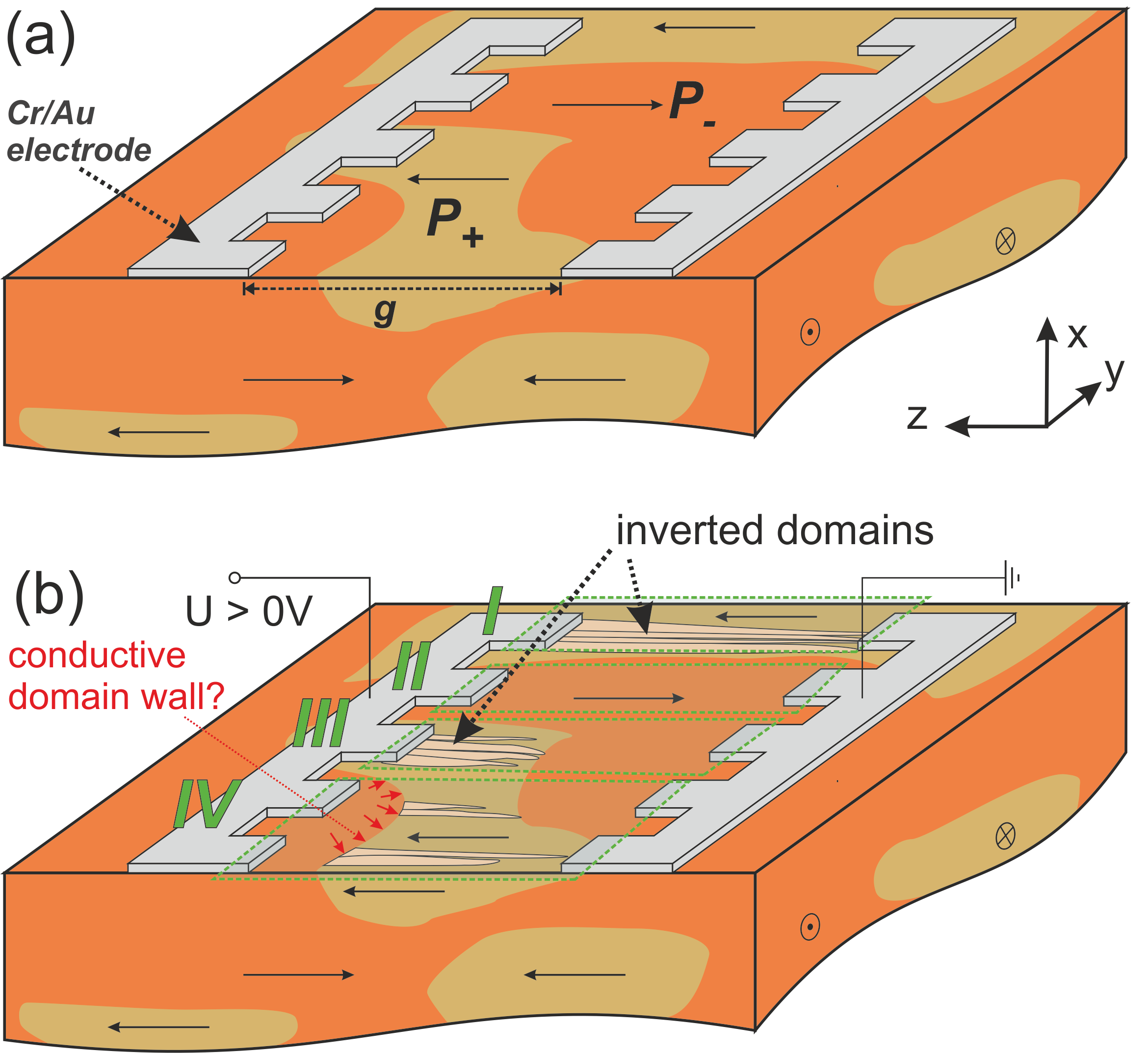
- 適用された電界下で導電性ドメイン壁がドメイン反転の核となる可能性を検討する。
- 局所的ポーリング技術を用いたLNTx材料系における非線形光学素子の基盤を構築する。
提案手法
- x切片LNTxウェーハ上に、ギャップサイズ(g)を制御したリソグラフィ的に定義された金属電極を用い、室温での電界ポーリングを実施する。
- 極性を交互に変更した複数回の電気的パルスを印加し、初期に多ドメイン構造を示す結晶に対しても周期的ドメイン反転を誘発する。
- 3 msのパルス幅と最大60 kV/mmの電界を用い、ドメインの核生成と成長を駆動する。
- 偏光顕微鏡を用いてポーリング前後におけるドメイン構造を撮影し、核生成部位と成長ダイナミクスを同定する。
- ヘッド・トゥ・ヘッドドメイン壁における導電性が、核生成のメカニズムとしての可能性を分析する。特に、電極に接触している場合に顕著である。
- 元のドメイン配向および欠陥構造の影響を評価するため、異なるドメイン配置(ケースI、III、IV)におけるポーリング結果を比較する。
実験結果
リサーチクエスチョン
- RQ1自然に存在するヘッド・トゥ・ヘッドおよびテイル・トゥ・テイルのドメイン壁が存在する多ドメインx切片LiNb1−xTa xO3結晶においても、表面近傍の周期的ポーリングは達成可能か?
- RQ2LNTx結晶における成功した周期的ポーリングのための、電極ギャップサイズと内部ドメインサイズとの間の臨界的関係は何か?
- RQ3ヘッド・トゥ・ヘッドドメイン壁がドメイン反転の核として機能する条件は何か?その導電性は必須要因か?
- RQ4結晶内の欠陥構造およびライン欠陥は、ドメイン成長およびポーリング安定性にどのように影響するか?
- RQ5成長直後のLNTx結晶に既存するドメインパターンは、大規模なドメイン反転を妨げるピン留め中心としてどの程度の影響を及ぼすか?
主な発見
- 電界ポーリングを用いて、x切片LiNb1−xTa xO3混合結晶において10 µmの周期と最大30 µmのギャップを有する表面近傍の周期的ポーリングが成功裏に達成された。
- 元のドメインが電極ギャップ内にあり、印加電界と逆向きに配向している場合にのみ、逆転ドメインの核生成と成長が観察され、フェロエレクトリックスイッチングの期待される挙動が確認された。
- ヘッド・トゥ・ヘッドドメイン壁が導電性であり、かつ電極と電気的に接触している場合、ドメイン反転の核として機能しうる。これは、ケースIVにおける局所的ドメイン形成によって裏付けられた。
- 高い電界(最大60 kV/mm)でも、ドメイン密度が高い領域(平均間隔≤5 µm)では核生成が抑制されるため、内部ドメイン構造による強いピン留めが示された。
- 逆方向ポーリングパルスでは部分的な逆転しか発生せず、多くのドメインが強くピン留めされ安定していることから、反転に対する高いエネルギー障壁があると示唆された。
- 線欠陊などの欠际は、両方の電極からのドメイン成長を遮断する強力なピン留めサイトとして機能し、逆転ポーリングを最小限に抑えつつ安定した周期的ポーリングを可能にする。
![Figure 2: Second-Harmonic microscope image of a poling result on single-domain, x-cut congruent lithium niobate. After application of a single voltage pulse, surface-near domain inversion can be achieved. The results, both poling and SHM contrast, are very similar to previous works [ 26 , 28 , 25 ]](https://ar5iv.labs.arxiv.org/html/2403.04590/assets/xcutLNO.png)
より良い研究を、今すぐ始めましょう
論文の読解から最終レビューまで、研究時間を劇的に削減しましょう。
クレジットカード登録不要
このレビューはAIが作成し、人間の編集者が確認しました。