
[論文レビュー] SwitchGPT: Adapting Large Language Models for Non-Text Outputs
SwitchGPTは、テキストベースの大規模言語モデル(LLMs)が画像や音声などの非テキスト出力を生成できるようにするための新しい手法を提案する。この手法では、最小限のモダリティに適合した指示微調整を通じて、LLMが意図する出力モダリティを認識できるようにする。これにより、LLMは事前学習済みのモダリティ変換モデルに指示をルーティングする知的なコントローラーとして機能し、マルチモーダル事前学習や複雑なファインチューニングを必要とせずに、高い正確性とプロンプト品質を達成する。
Large Language Models (LLMs), primarily trained on text-based datasets, exhibit exceptional proficiencies in understanding and executing complex linguistic instructions via text outputs. However, they falter when requests to generate non-text ones. Concurrently, modality conversion models, such as text-to-image, despite generating high-quality images, suffer from a lack of extensive textual pretraining. As a result, these models are only capable of accommodating specific image descriptions rather than comprehending more complex instructions. To bridge this gap, we propose a novel approach, \methodname, from a modality conversion perspective that evolves a text-based LLM into a multi-modal one. We specifically employ a minimal dataset to instruct LLMs to recognize the intended output modality as directed by the instructions. Consequently, the adapted LLM can effectively summon various off-the-shelf modality conversion models from the model zoos to generate non-text responses. This circumvents the necessity for complicated pretraining that typically requires immense quantities of paired multi-modal data, while simultaneously inheriting the extensive knowledge of LLMs and the ability of high-quality generative models. To evaluate and compare the adapted multi-modal LLM with its traditional counterparts, we have constructed a multi-modal instruction benchmark that solicits diverse modality outputs. The experiment results reveal that, with minimal training, LLMs can be conveniently adapted to comprehend requests for non-text responses, thus achieving higher flexibility in multi-modal scenarios. Code and data will be made available at https://github.com/xinke-wang/SwitchGPT.
研究の動機と目的
- テキストベースのLLMが画像や音声などの非テキスト出力を生成するという制限を克服すること。
- LLMが持つ推論力や一般的な常識的理解に欠けるモダリティ変換モデルの知識ギャップを埋めること。
- LLMが指示の意図に基づき、適切なオフザシェルのモダリティ変換モデルを選択・起動する知的な調整者として機能できるようにすること。
- 高遅延や不安定性に悩まされる既存のLLM-as-controllerフレームワークの計算効率の良い代替策を提供すること。
- 多様な出力モダリティを有するLLMのマルチモーダル指示従いを評価するベンチマークを確立すること。
提案手法
- LLMが指示から意図する出力モダリティを認識できるように、最小限のデータセットでモダリティ適合の指示微調整フェーズを導入する。
- 各指示を特定のモダリティ(テキスト、画像、音声)にマッピングし、対応する出力とペアにして、LLMがモダリティ固有の応答パターンを学習できるようにする。
- 適応されたLLMをコントローラーとして使用し、予測されたモダリティに応じて事前学習済みのオフザシェルのモダリティ変換モデル(例:画像にはStable Diffusion、音声にはTTS)を起動する。
- LLMの推論力と知識能力を活用して、モダリティ固有のモデル向けに高品質なプロンプトを生成することで、生成品質を向上させる。
- 標準的な指示微調整を用いてLLMをトレーニングし、複雑なマルチモーダル事前学習やペairedデータに対するエンドツーエンドのファインチューニングを回避する。
- 標準的な言語ベンチマークでのパフォーマンスを維持することで、LLMの推論力とテキスト生成能力がそのままであることを保証する。
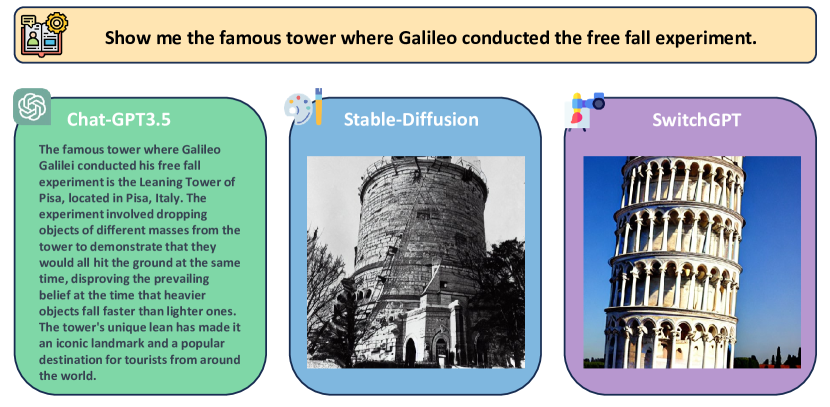
実験結果
リサーチクエスチョン
- RQ1非テキストデータに直接アクセスしない状態でも、テキストベースのLLMが非テキスト出力を効果的に理解・生成できるように適応できるか?
- RQ2最小限の指示微調整アプローチが、自然言語の指示から意図する出力モダリティを正しく特定できるか?
- RQ3事前学習済みのモダリティ変換モデルをコントローラーとして使用するLLMが、直接プロンプトを発行するかブラックボックスLLM制御に比べ、モダリティの正確性と出力品質で優れているか?
- RQ4モダリティに適合した指示微調整が、LLMの元の言語理解力と推論能力をどの程度保持しているか?
- RQ5提案手法が、トレーニング分布を越えた多様で複雑かつ会話形式の指示にも一般化可能か?
主な発見
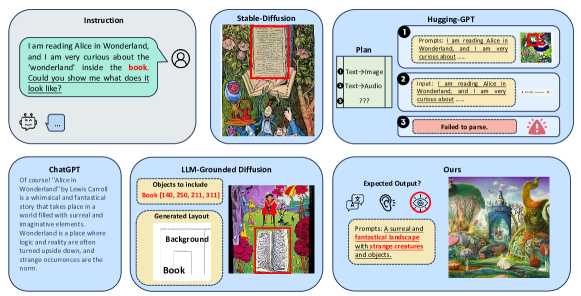
- SwitchGPTは、GPT-3.5-turboと同等の最先端のモダリティ正確性を達成し、HuggingGPT や LLM-grounded Diffusion を含む他のすべての手法を上回っている。
- OPT-6.7Bは非テキスト出力を生成できず、常にテキストにデフォルトするため、適切な指示微調整の重要性が浮き彫りになる。
- SwitchGPTは、すべての手法の中で最高のCLIPスコアを達成しており、画像生成モデル向けのプロンプト品質が優れていることを示している。
- LLMは強力な言語理解能力を維持しており、標準的な言語ベンチマークでLlama2-7Bと同等の正確性を達成している。
- 定性的な結果から、SwitchGPTは多様な会話形式の入力を正しく解釈し、訓練例とは異なる場合でも適切なマルチモーダル応答を生成していることが示された。
- このアプローチにより、マルチモーダル事前学習やペアデータへのアクセスなしに、LLMの低コストで効果的なマルチモーダル生成への適応が可能になった。
より良い研究を、今すぐ始めましょう
論文の読解から最終レビューまで、研究時間を劇的に削減しましょう。
クレジットカード登録不要
このレビューはAIが作成し、人間の編集者が確認しました。