
[論文レビュー] Symfind: Addressing the Fragility of Subhalo Finders and Revealing the Durability of Subhalos
Symfind は、粒子追跡に基づく新しい準銀河団探索手法であり、降着からの粒子追跡により、コスモロジカルシミュレーションにおける準銀河団検出を著しく改善し、Rockstar よりも桁違いに低い質量の準銀河団を回復可能にする。この手法により、準銀河団の生存期間が従来の予想よりもはるかに長く、『オーファン』準銀河団モデルへの依存が減少することが明らかになった。また、$n_{\text{peak}} \gtrsim 4\times10^3$ で質量損失が解像可能であり、$v_{\text{max}}$ の解像には $n_{\text{peak}} \gtrsim 3\times10^4$ 必要であることが示された。
A major question in $Λ$CDM is what this theory actually predicts for the properties of subhalo populations. Subhalos are difficult to simulate and to find within simulations, and this propagates into uncertainty in theoretical predictions for satellite galaxies. We present Symfind, a new particle-tracking-based subhalo finder, and demonstrate that it can track subhalos to orders-of-magnitude lower masses than commonly used halo-finding tools, with a focus on Rockstar and consistent-trees. These longer survival mean that at a fixed peak subhalo mass, we find $\approx 15\%{-}40\%$ more subhalos within the virial radius, $R_ extrm{vir}$, and $\approx 35\%-120\%$ more subhalos within $R_ extrm{vir}/4$ in the Symphony dark-matter-only simulation suite. More subhalos are found as resolution is increased. We perform extensive numerical testing. In agreement with idealized simulations, we show that the $v_{ m max}$ of subhalos is only resolved at high resolutions ($n_ extrm{peak}\gtrsim3 imes 10^4$), but that mass loss itself can be resolved at much more modest particle counts ($n_ extrm{peak}\gtrsim4 imes 10^3$). We show that Rockstar converges to false solutions for the mass function, radial distribution, and disruption masses of subhalos. We argue that our new method can trace resolved subhalos until the point of typical galaxy disruption without invoking ``orphan'' modeling. We outline a concrete set of steps for determining whether other subhalo finders meet the same criteria. We publicly release Symfind catalogs and particle data for the Symphony simulation suite at \url{http://web.stanford.edu/group/gfc/symphony}.
研究の動機と目的
- Rockstar のような既存の準銀河団探索手法が低質量領域で収束せず信頼性に欠ける問題に対処すること。
- 降着から破壊までの粒子追跡により、$\Lambda$CDM モデルにおける準銀河団の真の耐久性を定量化すること。
- 正確な準銀河団質量関数および速度関数の測定に必要な最小解像度を特定すること。
- 収束性と物理的整合性に基づいて、他の準銀河団探索手法を評価するための堅牢で検証可能なフレームワークを提供すること。
提案手法
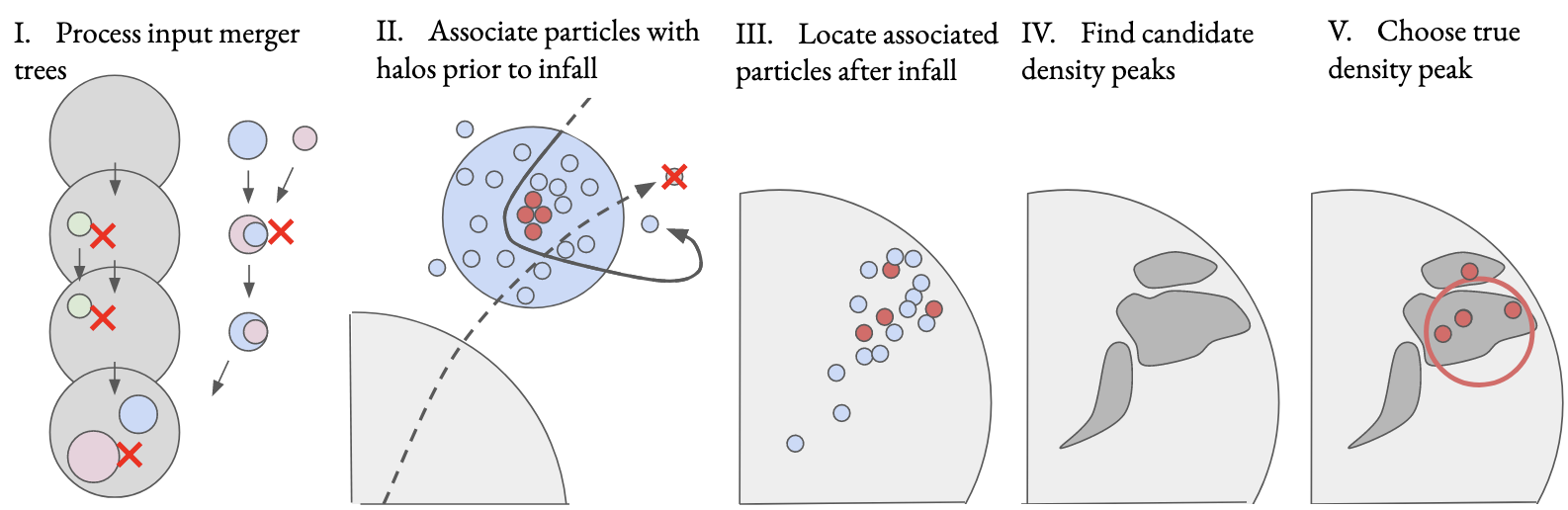
- Symfind は、準銀河団がハローに降着する際の粒子を追跡し、潮汐的剥ぎ取りの過程でもそのアイデンティティを保持する。
- 降着時における最も束縛エネルギーの高い粒子を、Subfind アルゴリズムによる準銀河団同一定義のシードとして用いる。
- 時間経過に伴う準銀河団の性質(質量、$v_{\text{max}}$、$m_{\text{peak}}$)の評価により、生存と破壊の状態を評価する。
- 物理的観測量の解像限界を特定するために、解像度レベルを変えて広範な数値的収束テストを実施する。
- Symfind の結果を Rockstar および一貫性のある木構造(consistent-trees)と直接比較し、既存ツールにおける誤った収束を露呈する。
- スタックされた質量損失曲線におけるサバイバー・バイアスを回避するための統計的補正を導入し、正確な質量変化の追跡を保証する。
実験結果
リサーチクエスチョン
- RQ1標準的な準銀河団探索手法(例:Rockstar)は、解像度が向上するにつれてどのように収束しなくなり、誤った準銀河団集団を生じさせるのか?
- RQ2準銀河団の質量損失と $v_{\text{max}}$ 変化を信頼性高く解像するための最小粒子数($n_{\text{peak}}$)はどの程度か?
- RQ3$\Lambda$CDM シミュレーションにおける準銀河団の耐久性はどの程度で、『オーファン』準銀河団の仮定なしに銀河破壊まで追跡可能か?
- RQ4スタックされた質量損失曲線はどの程度サバイバー・バイアスに影響を受けており、その是正はどのように行えるか?
- RQ5粒子追跡に基づく手法(例:Symfind)は、従来の位相空間探索手法に比べ、低質量準銀河団の回復性能を向上させられるか?
主な発見
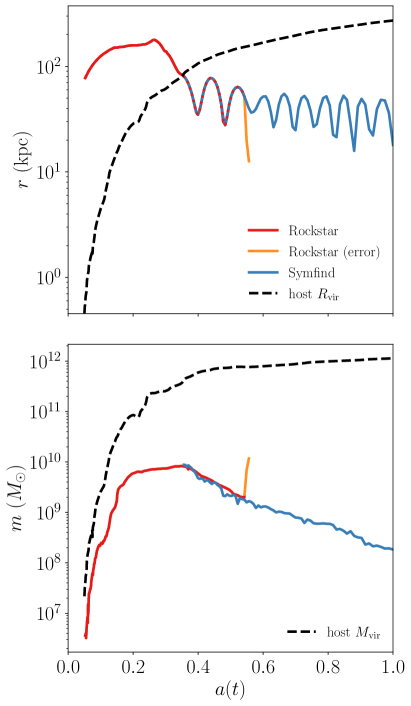
- Symfind は、固定された $m_{\text{peak}}$ 条件のもとで、$R_{\text{vir}}$ 内では 15% から 40%、$R_{\text{vir}}/4$ 内では 35% から 120% も Rockstar より多くの準銀河団を回復する。
- 準銀河団の質量損失は $n_{\text{peak}} \gtrsim 4\times10^3$ で解像可能であり、$v_{\text{max}}$ の解像には $n_{\text{peak}} \gtrsim 3\times10^4$ 必要である。
- Rockstar は解像度が向上するにつれて誤った収束を示し、信頼性の低い質量関数と半径分布を生じる。
- サバイバー・バイアスはスタックされた質量損失曲線を強く歪めるが、Symfind の統計的補正によりこのバイアスは完全に除去される。
- Symfind で追跡された準銀河団は、$n_{\text{peak}} > 4\times10^3$ では『オーファン』準銀河団モデルの導入が不要であるほど長期間生存する。
- この手法により、十分な解像度がある場合、理想化されたシミュレーションが深いついだ質量損失領域における $v_{\text{max}}$ 変化を正確に予測できることを確認した。
より良い研究を、今すぐ始めましょう
論文の読解から最終レビューまで、研究時間を劇的に削減しましょう。
クレジットカード登録不要
このレビューはAIが作成し、人間の編集者が確認しました。