
[論文レビュー] Symmetry constraints on superconductivity in twisted bilayer graphene: Fractional vortices, $4e$ condensates or non-unitary pairing
この論文は、ねじれビレイヤー・グラフェン(TBG)における超伝導の対称性に基づく制約を導出し、フラバー極化が存在しない場合、いかなる超伝導状態も非ユニタリーペアリング、電荷 $4e$ の超伝導体、または $h/4e$ フラックスを持つ分数的ストリングを有するユニタリーペアリングでなければならないことを示している。これらの特異な状態は、TBGの $\mathrm{SU}(4)$ フラバー対称性に起因し、ペアリングメカニズムに依存しない。
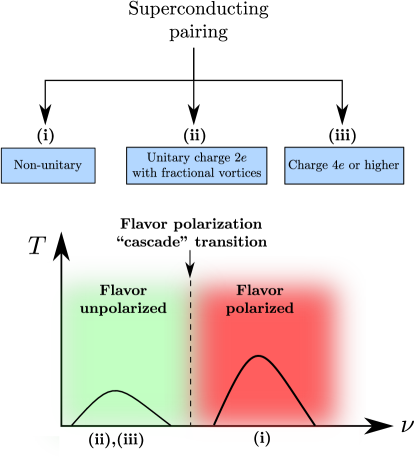
When two graphene sheets are twisted relative to each other by a small angle, enhanced correlations lead to superconductivity whose origin remains under debate. Here, we derive some general constraints on superconductivity in twisted bilayer graphene (TBG), independent of its underlying mechanism. Neglecting weak coupling between valleys, the global symmetry group of TBG consists of independent spin rotations in each valley in addition to valley charge rotations, $ { m SU}(2) imes { m SU}(2) imes { m U}_V(1) $. This symmetry is further enhanced to a full ${ m SU}(4)$ in the idealized chiral limit. In both cases, we show that any charge $2e$ pairing must break the global symmetry. Additionally, if the pairing is unitary the resulting superconductor admits fractional vortices. This leads to the following general statement: Any superconducting condensate in either symmetry class has to satisfy one of three possibilities: (i) the superconducting pairing is non-unitary, (ii) the superconducting condensate has charge $2e$ but admits at least half quantum vortices which carry a flux of $h/4e$, or (iii) the superconducting condensate has charge $2me$, $m>1$, with vortices carrying $h/2me$ flux. The latter possibility can be realized by a symmetric charge $4e$ superconductor ($m=2$). Non-unitary pairing (i) is expected in TBG for superconductors observed in the vicinity of flavor polarized states. On the other hand, in the absence of flavor polarization, e.g. in the vicinity of charge neutrality, one of the two exotic possibilities (ii) and (iii) is expected. We sketch how all three scenarios can be realized in different limits within a strong coupling theory of superconductivity based on skyrmions. Finally we discuss the effect of symmetry lowering anisotropies and experimental implications of these scenarios.
研究の動機と目的
- ペアリングの微視的メカニズムに依存しない、ねじれビレイヤー・グラフェン(TBG)における超伝導の普遍的な対称性的制約を特定すること。
- $\mathrm{SU}(4)$ フラバー対称性(またはその部分群)が超伝導オーダーパラメータの性質に与える影響を特定すること。
- フラバー極化のない領域における、TBGの可能な超伝導状態を対称性に基づいて分類すること。
- これらの対称性保護状態と、分数的ストリングや修正されたフラウンホーファー回折パターンのような実験的に観測可能なシグネチャーとの関連を示すこと。
- ハンズ結合や対称性を低下させる摂動が、これらの特異な超伝導相の安定化または変化に果たす役割を調査すること。
提案手法
- スピンおよびバルク自由度をフラバー指数として扱い、低エネルギー領域では $\mathrm{SU}(2)_S \times \mathrm{U}_V(1)$、チャイral極限では $\mathrm{SU}(4)$ としてTBGのグローバル対称性群を導出する。
- ペアリング行列の全フラバー対称性群における変換性を分析し、どのペアリング状態が対称性を保つか、破るかを特定する。
- 群論を用いて、ユニタリーペアリングの $2e$ 必ずグローバル対称性を破り、$h/4e$ フラックスを持つ分数的ストリングが生じることを示す。
- ユニタリーペアリングの $2e$ 超伝導状態として許容されるのは、非ユニタリーペアリングまたは分数的ストリングを有するものに限られ、そうでなければ高次電荷凝縮体($2me$、$m>1$)が必要になることを確立する。
- スカイム粒子に基づく強相関理論を構築し、非ユニタリーペアリング、$4e$ 超伝導、および分数的ストリングのすべての状況を実現する。
- 実験的シグネチャーを分析し、特にメソスコピックな環状ジョセフソン接合における $2\pi/m$($m=2$)の周期性の変更や、$h/4e$ フラックスジャンプの検出可能性を検討する。
実験結果
リサーチクエスチョン
- RQ1ペアリングメカニズムに依存しない、ねじれビレイヤー・グラフェンにおける超伝導オーダーパラメータの普遍的な対称性的制約は何か?
- RQ2なぜTBGにおけるユニタリーペアリングの $2e$ 超伝導体は、必然的に $h/4e$ フラックスを持つ分数的ストリングを有するのか?
- RQ3どのような条件下で、$4e$ 超伝導凝縮体がTBGにおいて対称性的に許容される状態として現れるのか?
- RQ4ハンズ結合のような対称性を低下させる効果が、分数的ストリングおよび非ユニタリーペアリングの安定性にどのように影響するのか?
- RQ5ジョセフソン接合やメソスコピックリングにおいて、これらの特異な超伝導状態の測定可能な実験的シグネチャーは何か?
主な発見
- TBGにおけるユニタリーペアリングの $2e$ 超伝導体は、必ずグローバル $\mathrm{SU}(4)$ フラバー対称性を破り、$h/4e$ フラックスを持つ分数的ストリングが生じる。
- フラバー極化が存在しない場合、TBGにおける超伝導は、非ユニタリーペアリング、電荷 $4e$ 凝縮体、または分数的ストリングを有するユニタリーペアリングのいずれかでなければならない。
- $4e$ 超伝導状態は対称性的に許容され、強相関スカイム粒子に基づく理論で実現可能であり、ストリングが $h/8e$ フラックスを運ぶ。
- $2e$ 超伝導体における分数的ストリングは、$m=2$ の場合に $2\pi/m$ の周期性の変更が観測可能なメソスコピック接合で、修正されたフラウンホーファー回折パターンを通じてプローブ可能である。
- メソスコピックな環状幾何における $h/4e$ フラックスジャンプは、半量子ストリングの存在を直接示すことができ、大規模系における対数的エネルギー発散を回避する。
- ハンズ結合が解けた(スイングレットペアリングを好む)が、$4e$ 凝縮体が安定した温度領域が存在し、この領域で分数的ストリングを観測可能である。
より良い研究を、今すぐ始めましょう
論文の読解から最終レビューまで、研究時間を劇的に削減しましょう。
クレジットカード登録不要
このレビューはAIが作成し、人間の編集者が確認しました。