
[論文レビュー] Systematic Meets Unintended: Prior Knowledge Adaptive 5G Vulnerability Detection via Multi-Fuzzing
要約: 論文はLAL、SyAL、SoAL戦略を備えたデジタルツインベースの事前知識適応ファジングフレームワークを提案し、5Gの脆弱性と予期せぬエマージェント挙動を検出。srsRANで129の脆弱性を発見しリコールを改善した。, どれも原文の数値はそのまま保持します
The virtualization and softwarization of 5G and NextG are critical enablers of the shift to flexibility, but they also present a potential attack surface for threats. However, current security research in communication systems focuses on specific aspects of security challenges and lacks a holistic perspective. To address this challenge, a novel systematic fuzzing approach is proposed to reveal, detect, and predict vulnerabilities with and without prior knowledge assumptions from attackers. It also serves as a digital twin platform for system testing and defense simulation pipeline. Three fuzzing strategies are proposed: Listen-and-Learn (LAL), Synchronize-and-Learn (SyAL), and Source-and-Learn (SoAL). The LAL strategy is a black-box fuzzing strategy used to discover vulnerabilities without prior protocol knowledge, while the SyAL strategy, also a black-box fuzzing method, targets vulnerabilities more accurately with attacker-accessible user information and a novel probability-based fuzzing approach. The white-box fuzzing strategy, SoAL, is then employed to identify and explain vulnerabilities through fuzzing of significant bits. Using the srsRAN 5G platform, the LAL strategy identifies 129 RRC connection vulnerabilities with an average detection duration of 0.072s. Leveraging the probability-based fuzzing algorithm, the SyAL strategy outperforms existing models in precision and recall, using significantly fewer fuzzing cases. SoAL detects three man-in-the-middle vulnerabilities stemming from 5G protocol vulnerabilities. The proposed solution is scalable to other open-source and commercial 5G platforms and protocols beyond RRC. Extensive experimental results demonstrate that the proposed solution is an effective and efficient approach to validate 5G security; meanwhile, it serves as real-time vulnerability detection and proactive defense.
研究の動機と目的
- 複雑でプログラム可能なスタックの中で、5G/NextGの総合的なセキュリティ検証を動機付ける。
- 体系的で適応的なファジングを可能とするデジタルツインプラットフォームを開発する。
- 3つのファジング戦略(Listen-and-Learn、Synchronize-and-Learn、Source-and-Learn)を、それぞれ異なる知識仮定で提案する。
- 脆弱性検知の効率を定量化し、リアルタイム検知と防御能力を実証する。
提案手法
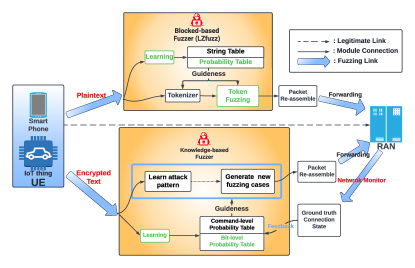
- MITMリレー、srsRAN、Open5GS、ZMQをつなぐデジタルツインベースの脆弱性検証プラットフォームを導入する。
- 3つのファジング戦略を定義する:LAL(ブラックボックス)、SyAL(確率ベースのファジングを用いるグレーボックス)、SoAL(ホワイトボックスのビットレベルファジング)。
- ファジングケース数を線形成長から対数成長へ低減する確率ベースのファジング手法を実装する。
- 状態-トランザクショングラフとLSTMベースの予測を用いて、コマンドレベルとビットレベルのファジング状態を記録・分析する。
- srsRAN上のRRCプロトコルファジングを実演し、129の発見脆弱性と平均検知時間0.072sを報告する。
- 他の5G/Open-RANプラットフォームやプロトコルへ拡張可能なデジタルツインフレームワークを提供する。
実験結果
リサーチクエスチョン
- RQ1前知識は5Gのファジング効果にどのような影響を与えるか。
- RQ2デジタルツインベースのマルチファジングフレームワークは、5Gプロトコル全体の脆弱性と予期せぬエマージェント挙動の両方を検出できるか。
- RQ3確率ベースのファジング手法は、ファジングケース数を削減する効率の向上につながるか。
- RQ4LAL、SyAL、SoALはRRCの脆弱性とMITM脅威の特定・予測にどの程度有効か。
主な発見
- LALフレームワークを用いてRRCプロトコルに129の脆弱性を特定した。
- 確率ベースのファジングを用いるSyALは、はるかに少ないファジングケースで高い精度とリコールを達成する。
- SoALは5Gプロトコルの弱点から生じる3つのMITM脆弱性を検出する。
- LALはプロトコルに依存せず動作し、新しい5Gスタックやプロトコルにも適応できる。
- 状態-トランザクション分析とLSTM予測子を組み合わせることで、脆弱性予測と早期警告が改善される。
より良い研究を、今すぐ始めましょう
論文設計から論文執筆まで、研究時間を劇的に削減しましょう。
クレジットカード登録不要
このレビューはAIが作成し、人間の編集者が確認しました。