
[論文レビュー] Ten Years of Generative Adversarial Nets (GANs): A survey of the state-of-the-art
A comprehensive survey of GANs from their 2014 inception to the present, covering architectures, theory, evaluation, training challenges, applications across domains, and hybridizations with emerging DL models.
Since their inception in 2014, Generative Adversarial Networks (GANs) have rapidly emerged as powerful tools for generating realistic and diverse data across various domains, including computer vision and other applied areas. Consisting of a discriminative network and a generative network engaged in a Minimax game, GANs have revolutionized the field of generative modeling. In February 2018, GAN secured the leading spot on the ``Top Ten Global Breakthrough Technologies List'' issued by the Massachusetts Science and Technology Review. Over the years, numerous advancements have been proposed, leading to a rich array of GAN variants, such as conditional GAN, Wasserstein GAN, CycleGAN, and StyleGAN, among many others. This survey aims to provide a general overview of GANs, summarizing the latent architecture, validation metrics, and application areas of the most widely recognized variants. We also delve into recent theoretical developments, exploring the profound connection between the adversarial principle underlying GAN and Jensen-Shannon divergence, while discussing the optimality characteristics of the GAN framework. The efficiency of GAN variants and their model architectures will be evaluated along with training obstacles as well as training solutions. In addition, a detailed discussion will be provided, examining the integration of GANs with newly developed deep learning frameworks such as Transformers, Physics-Informed Neural Networks, Large Language models, and Diffusion models. Finally, we reveal several issues as well as future research outlines in this field.
研究の動機と目的
- Provide a broad overview of GAN architectures and their evolution over the past decade.
- Summarize key theoretical developments linking adversarial training to divergence measures and optimality.
- Review evaluation metrics and practical training challenges, including stability and mode collapse.
- Discuss applications across domains (vision, NLP, time series, medicine, urban planning, geoscience) and practical integration with new frameworks.
- Outline future research directions and potential hybridizations with Transformers, PINNs, LLMs, and diffusion models.
提案手法
- Systematic literature review of seminal GAN works and their variants (conditional GAN, Wasserstein GAN, CycleGAN, StyleGAN, etc.).
- Chronological organization to illustrate architectural and methodological progress over the decade.
- Theoretical discussion of the adversarial objective and Jensen-Shannon divergence and related optimality considerations.
- Evaluation and limitations assessment with domain-specific performance considerations.
- Discussion of training challenges and proposed remedies, including stability improvements and alternative loss functions.
- Analysis of integrations with new DL paradigms (Transformers, PINNs, LLMs, Diffusion models) and their impact on GAN effectiveness.
実験結果
リサーチクエスチョン
- RQ1What are the major GAN variants developed over the past decade and what problems do they address?
- RQ2What are the key theoretical insights underpinning GANs, including connections to divergence measures and optimality?
- RQ3What metrics and evaluation strategies are used to assess GAN-generated data across domains?
- RQ4What training challenges limit GAN performance, and what solutions have been proposed?
- RQ5How can GANs be integrated with emerging deep learning frameworks to advance synthetic data generation in new applications?
主な発見
- GANs have evolved from vanilla architectures to specialized variants (e.g., conditional, Wasserstein, CycleGAN, StyleGAN) to tackle quality, diversity, and conditioning requirements.
- Training instability and mode collapse remain central challenges, with loss functions and architectural changes proposed to improve stability.
- Biases in generated data and ethical concerns are recognized issues needing careful evaluation and mitigation.
- Hybrid approaches with Transformers, PINNs, LLMs, and diffusion models show promise in expanding GAN capabilities and applications.
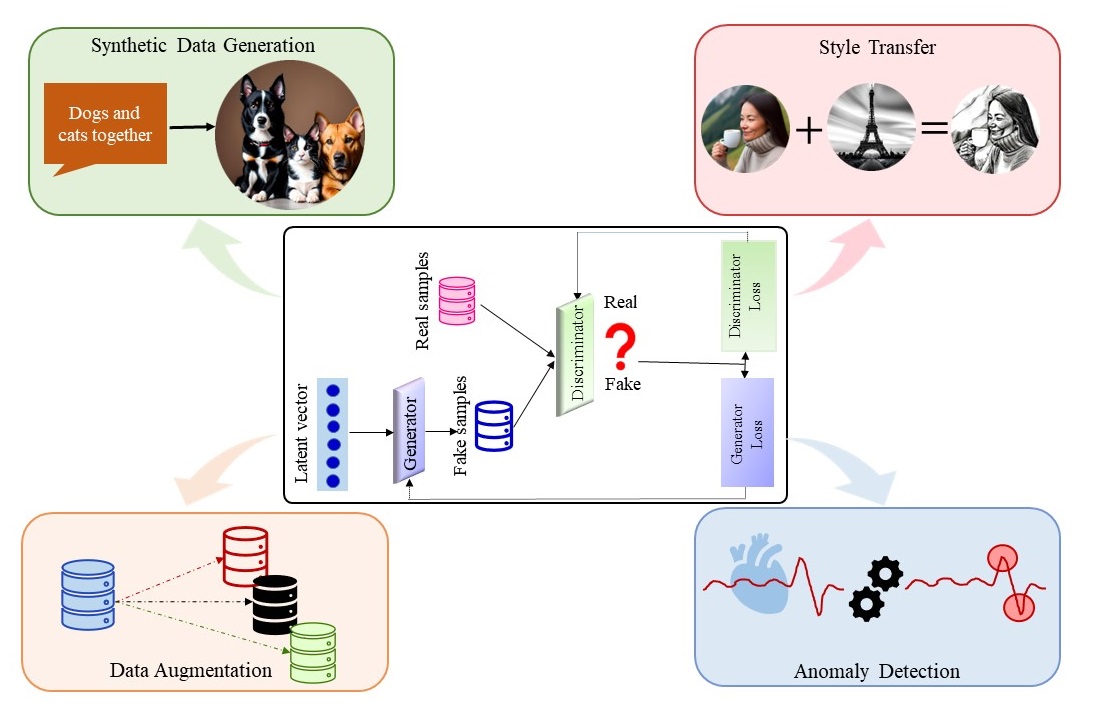
- GANs are applied across diverse domains, including computer vision, NLP, time series, medicine, geoscience, urban planning, and more, for generation, augmentation, style transfer, and simulation.

より良い研究を、今すぐ始めましょう
論文設計から論文執筆まで、研究時間を劇的に削減しましょう。
クレジットカード登録不要
このレビューはAIが作成し、人間の編集者が確認しました。