
[論文レビュー] Tensor Network Methods for Extracting CFT Data from Fixed-Point Tensors and Defect Coarse Graining
本稿では、2次元古典的イジング模型の固定点テンソルから、線形化テンソル結合強化群(lTRG)とグラフに依存しない局所切断(GILT)を用いて、共形場理論(CFT)のデータ——スケーリング次元やOPE係数——を抽出するテンソルネットワーク手法を提示する。境界条件を導入することで、lTRG固有ベクトルと一致する共形状態が生成されることを示し、HOTRG + GILTを用いることで、制御された条件下で高精度な2点および4点相関関数が得られ、最小カノニカル形式による安定性が向上している。
We present a comprehensive study on the extraction of CFT data using tensor network methods, specially, from the fixed-point tensor of the linearized tensor renormalization group (lTRG) for the 2D classical Ising model near the critical temperature. Utilizing two different methods, we extract operator scaling dimensions and operator-product-expansion (OPE) coefficients by introducing defects on the lattice and by employing the fixed-point tensor. We also explore the effects of point-like defects in the lattice on the coarse-graining process. We find that there is a correspondence between coarse-grained defect tensors and conformal states obtained from lTRG fixed-point equation. We also analyze the capabilities and limitations of our proposed coarse-graining scheme for tensor networks with point-like defects, which includes graph independent local truncation (GILT) and higher-order tensor renormalization group (HOTRG). Our results provide a better understanding of the capacity and limitations of the tenor renormalization group scheme in coarse-graining defect tensors, and we show that GILT+HOTRG can be used to give accurate two- and four-point functions under specific conditions. We also find that employing the minimal canonical form further improves the stability of the RG flow.
研究の動機と目的
- 臨界格子模型の固定点テンソルから、スケーリング次元やOPE係数を含むCFTデータを抽出する手法の開発を目的とする。
- 格子上の点的欠損がテンソルネットワークの粗粒度化に与える影響を調査し、共形状態の構築に利用可能かどうかを検討する。
- HOTRGとGILTが欠損の存在下でも相関関数とRGフローの安定性をどの程度維持できるかを評価する。
- 粗粒度化された欠損テンソルとlTRG固定点方程式から導かれる共形状態との間の対応関係を確立する。
- CFTデータから固定点テンソルを構築する逆ブートストラップ的手法の可能性を検討する。
提案手法
- 本研究では、臨界に近い2次元イジング模型の固定点テンソルから、スケーリング次元やOPE係数を抽出するために線形化テンソル結合強化群(lTRG)を用いる。
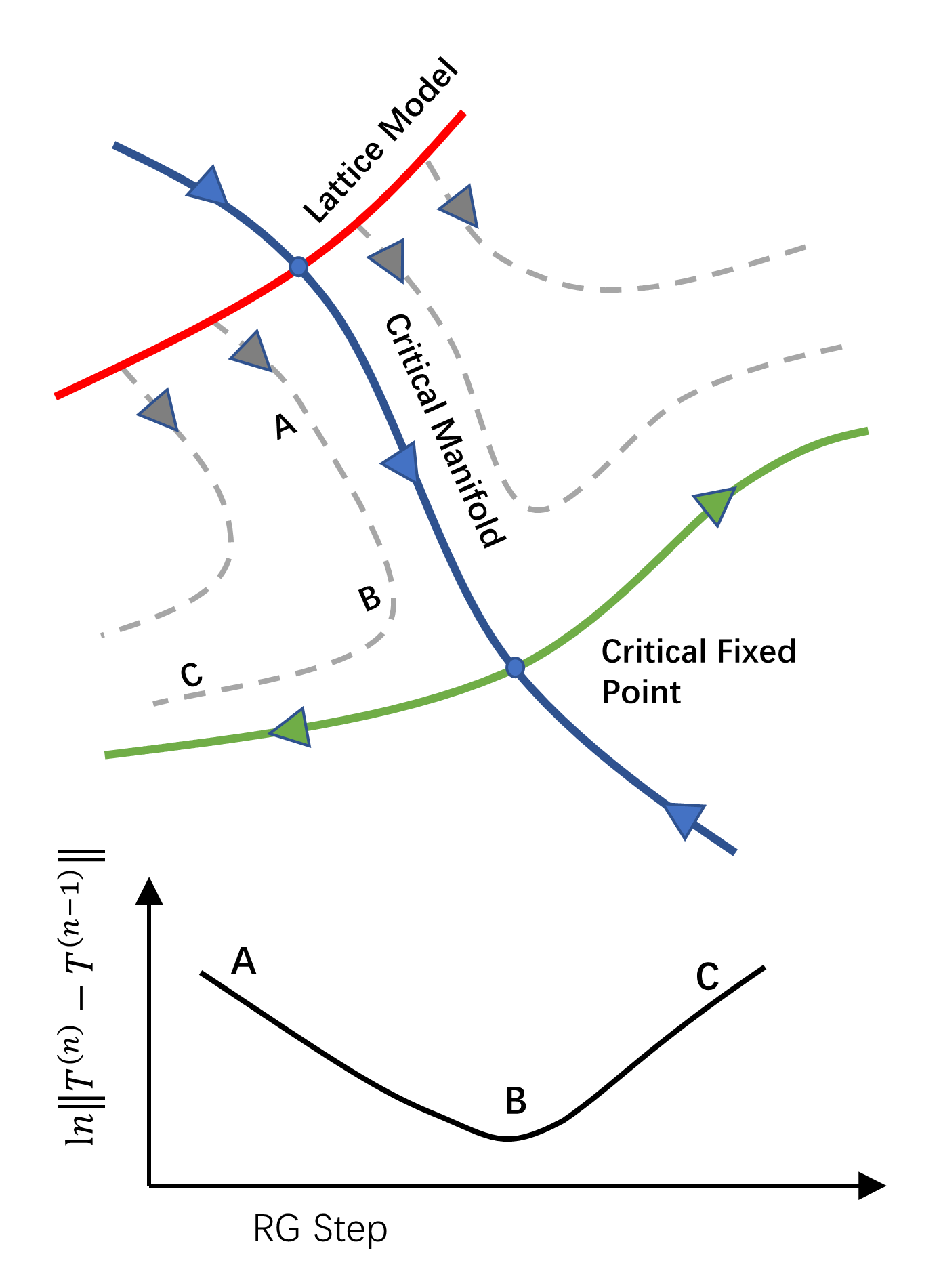
- 共形演算子の挿入を模倣するために、局所テンソルを変更することで格子上に欠損を導入し、共形状態の構築を可能にする。
- スプライアスな相関(CDLテンソル)を除去し、粗粒度化中のRGフローの安定性を高めるために、グラフに依存しない局所切断(GILT)を適用する。
- 効率的な粗粒度化のために高次テンソル結合強化群(HOTRG)を用い、各段階で切断とフィルタリングを適用する。
- lTRG固定点方程式の固有ベクトルと粗粒度化された欠損テンソルを比較し、共形状態との対応関係を検証する。
- RGフローの安定性を向上させ、数値的アーチファクトを低減するために、最小カノニカル形式を用いる。
実験結果
リサーチクエスチョン
- RQ1lTRGとGILTを用いて、2次元イジング模型の固定点テンソルから、スケーリング次元やOPE係数を高精度に抽出できるか?
- RQ2粗粒度化された欠損テンソルとlTRG固定点方程式から得られる共形状態との間に直接的な対応関係があるか?
- RQ3点的欠損はHOTRGとGILTによる粗粒度化の下でどのように振る舞い、相関関数にどのような影響を与えるか?
- RQ4GILT + HOTRGは、欠損の存在下でも2点および4点相関関数をどの程度正確に保持できるか?
- RQ5最小カノニカル形式は、欠損系におけるテンソルネットワークのRGフローの安定性と正確性を向上させることができるか?
主な発見
- 臨界2次元イジング模型におけるスケーリング次元Δ < 3の共形状態について、lTRGおよび遷移行列法を用いて高精度に抽出され、解析的結果と一致した。
- lTRG固有ベクトルからOPE係数Cσσεが成功裏に計算され、既知のCFTデータと整合性を示した。
- 臨界に近い位置で2点スピンスピン相関関数が計算され、抽出された指数がスケーリング次元と非常に高い精度で一致した。
- 4点相関関数が計算され、品質は低かったが、それでもスケーリング次元とOPE係数の抽出が可能であった。
- 粗粒度化の過程で欠損は「粒子雲」に拡散することが判明したが、特にコーナーやエッジ部で強い拡散が見られたが、この効果は回復可能であり、正確な相関関数が再構築可能であった。
- lTRG固定点方程式の固有ベクトルが、粗粒度化された欠損テンソルと正確に一致することが示され、格子演算子挿入からの共形状態の構築が妥当であることが検証された。

より良い研究を、今すぐ始めましょう
論文の読解から最終レビューまで、研究時間を劇的に削減しましょう。
クレジットカード登録不要
このレビューはAIが作成し、人間の編集者が確認しました。