
[論文レビュー] TESS first look at evolved compact pulsators : Discovery and asteroseismic probing of the g-mode hot B subdwarf pulsator EC 21494-7018
本論文は、TESS第1セクタのデータで同定された新しいgモード脈動する高温B型亜巨星EC 21494-7018の発見と星震学的解析を報告する。120秒間隔の光度曲線と高度なsdB星モデルを用いた前向きモデリングにより、星の質量(0.391 ± 0.009 M☉)、ヘリウムを含まない水素-richな包層質量(0.0037 ± 0.0010 M☉)、およびコア組成が特定され、低質量の前身星がヘリウムコアフラッシュを回避した可能性が示され、コア酸素濃度の直接推定値(X(O)core = 0.16⁺⁰.¹³₋₀.₀₅)が得られた。
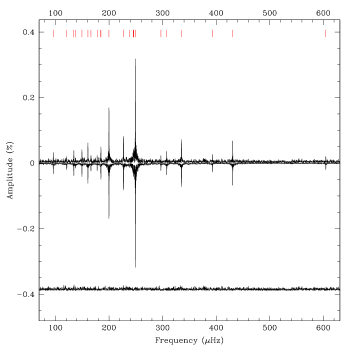
We present the discovery and asteroseismic analysis of a new g-mode hot B subdwarf (sdB) pulsator, EC 21494-7018 (TIC 278659026), monitored in TESS first sector using 120-second cadence. The light curve analysis reveals that EC 21494-7018 is a sdB pulsator counting up to 20 frequencies associated with independent g-modes. The seismic analysis singles out an optimal model solution in full agreement with independent measurements provided by spectroscopy (atmospheric parameters derived from model atmospheres) and astrometry (distance evaluated from Gaia DR2 trigonometric parallax). Several key parameters of the star are derived. Its mass (0.391 +/- 0.009 Msun) is significantly lower than the typical mass of sdB stars, and suggests that its progenitor has not undergone the He-core flash, and therefore could originate from a massive (>2 Msun) red giant, an alternative channel for the formation of hot B subdwarfs. Other derived parameters include the H-rich envelope mass (0.0037 +/- 0.0010 Msun), radius (0.1694 +/- 0.0081 Rsun), and luminosity (8.2+/-1.1 Lsun). The optimal model fit has a double-layered He+H composition profile, which we interpret as an incomplete but ongoing process of gravitational settling of helium at the bottom of a thick H-rich envelope. Moreover, the derived properties of the core indicate that EC 21494-7018 has burnt ~43% (in mass) of its central helium and possesses a relatively large mixed core (Mcore = 0.198 +/- 0.010 Msun), in line with trends already uncovered from other g-mode sdB pulsators analysed with asteroseismology. Finally, we obtain for the first time an estimate of the amount of oxygen (in mass; X(O)core = 0.16 -0.05 +0.13) produced at this stage of evolution by an helium-burning core. This result, along with the core-size estimate, is an interesting constraint that may help to narrow down the still uncertain C12(alpha,gamma)O16 nuclear reaction rate.
研究の動機と目的
- TESSの光度曲線を用いて、新たに発見された高温B型亜巨星EC 21494-7018の脈動特性と内部構造を調査する。
- 星震学的モデリングにより、星の基本的パラメータ(質量、半径、全放射光度、包層質量)を特定する。
- 低質量およびコア構造に基づき、星の進化状態を評価する。特に、ヘリウムコアフラッシュを回避したかどうかを検討する。
- 地震学的モデリングを用いてコア組成、特にヘリウム燃焼による酸素生成を制約する。
- 独立した分光的測定と天測距離(Gaia DR2)と照合して、地震学的モデルの妥当性を検証する。
提案手法
- 標準的な周波数抽出手法(プリホイティーニング)を用いて、TESS第1セクタの120秒間隔光度曲線を解析し、脈動周波数を抽出した。
- 観測された周波数に一致させるために、新世代の詳細な非対流的・非回転型sdB星モデルを用いた前向きモデリングを実施した。
- 観測されたすべてのgモード周波数を同時にフィットし、最適な一致モデルを特定することで、星のパラメータと内部構造を同定した。
- 最良適合モデルを用いて、水素-richな包層質量、コア質量、およびコア組成(酸素濃度を含む)を推定した。
- 分光的大気パラメータとGaia DR2の三角測距による距離を用いて、地震学的解を検証した。
- 包層の基部における不完全な重力的沈降を表現するため、二重層構造のヘリウム+水素組成プロファイルをモデルに適用した。

実験結果
リサーチクエスチョン
- RQ1新たに発見されたgモード脈動星EC 21494-7018の内部構造と基本的パラメータは何か?
- RQ2EC 21494-7018の低質量は、進化過程でヘリウムコアフラッシュを回避したことを示唆するか?
- RQ3ヘリウム燃焼コアで生成された酸素の濃度は何か? また、これは¹²C(α,γ)¹⁶O反応速度の制約にどのように寄与するか?
- RQ4観測された脈動スペクトルは、非対流的sdBモデルにおける理論的gモード周波数とどのように一致するか?
- RQ5観測された組成プロファイルは、包層におけるヘリウムの継続的重力的沈降とどの程度整合するか?
主な発見
- EC 21494-7018は、TESSの光度曲線に20個の独立した脈動周波数が検出されたgモード脈動星である。
- 星の質量は0.391 ± 0.009 M☉であり、典型的なsdB星よりも顕著に低く、ヘリウムコアフラッシュを回避した可能性を示唆している。
- 水素-richな包層質量は0.0037 ± 0.0010 M☉であり、厚いが完全に混合されていない包層と整合的である。
- コア質量は0.198 ± 0.010 M☉であり、他のgモードsdB脈動星と同様に、相対的に大きな混合コアを示している。
- コアでは約43%の中心ヘリウムが燃焼済みであり、コアにおける酸素濃度の直接推定値としてX(O)core = 0.16⁺⁰.¹³₋₀.₀₅が得られた。
- 最適なモデルは二重層構造のヘリウム+水素組成プロファイルを示しており、水素-richな包層の基部におけるヘリウムの不完全な重力的沈降を解釈するものである。
より良い研究を、今すぐ始めましょう
論文の読解から最終レビューまで、研究時間を劇的に削減しましょう。
クレジットカード登録不要
このレビューはAIが作成し、人間の編集者が確認しました。