
[論文レビュー] Testing symmetry on quantum computers
本稿では、量子コンピュータを用いて量子状態および量子チャネルの対称性をテストするための量子アルゴリズムを提案し、これらのアルゴリズムの受容確率が最大対称フィデリティに等しいことを示した。これにより、これらの測度に運用的意味が与えられる。このアプローチでは、変分量子回路を用いて量子プローバーを置き換え、ノイズのないおよびノイズのあるシミュレータにおいても安定した性能を示し、もつれ、分離可能性、非対称性の資源理論への応用が可能である。
Symmetry is a unifying concept in physics. In quantum information and beyond, it is known that quantum states possessing symmetry are not useful for certain information-processing tasks. For example, states that commute with a Hamiltonian realizing a time evolution are not useful for timekeeping during that evolution, and bipartite states that are highly extendible are not strongly entangled and thus not useful for basic tasks like teleportation. Motivated by this perspective, this paper details several quantum algorithms that test the symmetry of quantum states and channels. For the case of testing Bose symmetry of a state, we show that there is a simple and efficient quantum algorithm, while the tests for other kinds of symmetry rely on the aid of a quantum prover. We prove that the acceptance probability of each algorithm is equal to the maximum symmetric fidelity of the state being tested, thus giving a firm operational meaning to these latter resource quantifiers. Special cases of the algorithms test for incoherence or separability of quantum states. We evaluate the performance of these algorithms on choice examples by using the variational approach to quantum algorithms, replacing the quantum prover with a parameterized circuit. We demonstrate this approach for numerous examples using the IBM quantum noiseless and noisy simulators, and we observe that the algorithms perform well in the noiseless case and exhibit noise resilience in the noisy case. We also show that the maximum symmetric fidelities can be calculated by semi-definite programs, which is useful for benchmarking the performance of these algorithms for sufficiently small examples. Finally, we establish various generalizations of the resource theory of asymmetry, with the upshot being that the acceptance probabilities of the algorithms are resource monotones and thus well motivated from the resource-theoretic perspective.
研究の動機と目的
- 量子状態および量子チャネルにおける対称性をテストする量子アルゴリズムを開発し、対称フィデリティ測度に運用的意味を与える。
- 先行研究を超えて非対称性の資源理論を一般化し、ボーズ対称性および拡張可能性を含む。
- 近い将来の量子デバイスにおける対称性の実用的テストを可能にする変分量子アルゴリズムを実現する。
- 小規模な例のベンチマークのために半定型計画法(SDP)を用いる。
- フレームワークを量子チャネルへと拡張し、共変性対称性およびシグナル伝達制約を含む。
提案手法
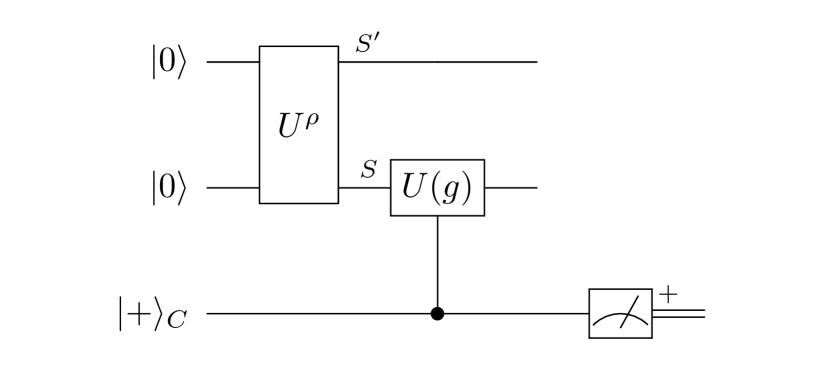
- 量子回路を用いて$G$-ボーズ対称性、$G$-対称性、およびそれらの拡張バージョンをテストするための量子アルゴリズムを提案する。
- インタラクティブプローフレームワークにおける量子プローバーを、近い将来のデバイス向けにパラメータ化された変分回路に置き換える。
- ユニタリ表現および対称射影を用いて、受容確率が最大対称フィデリティに等しいことを確立する。
- ベンチマークのための小規模な例の最大対称フィデリティを計算するために半定型計画法(SDP)を用いる。
- 変分的手法を用いて、2粒子および多粒子状態の$k$-拡張可能性および$k$-ボーズ拡張可能性をテストする。
- 非対称性の資源理論を一般化し、受容確率が資源単調性であることを証明する。
実験結果
リサーチクエスチョン
- RQ1量子状態および量子チャネルにおける対称性を、運用的意味を持つようにテストする量子アルゴリズムを設計できるか?
- RQ2最大対称フィデリティを、量子テストの受容確率とどのように結びつけることができるか?
- RQ3変分量子回路は、近い将来の量子ハードウェアにおける対称性テストにおいて、量子プローバーを効果的に置き換えられるか?
- RQ4これらのアルゴリズムは、ノイズのないおよびノイズのある量子シミュレータでどの程度の性能を示すか?
- RQ5提案された対称性の概念は、分離可能性、拡張不能性、フレームネスといった既存の概念をどのように一般化するか?
主な発見
- 各対称性テストアルゴリズムの受容確率は、入力状態の最大対称フィデリティに等しく、これによりこの資源測定子に運用的意味が与えられる。
- ノイズのないシミュレーションでは良好な性能を示し、ノイズのあるシミュレータでもノイズに強く、実用的妥当性が裏付けられる。
- 小規模な例の最大対称フィデリティは半定型計画法で正確に計算可能であり、量子アルゴリズムのベンチマークが可能になる。
- 変分的手法により、量子プローバーが効果的に置き換えられ、現在の量子ハードウェアで対称フィデリティの推定が可能になる。
- フレームワークは非対称性の資源理論を一般化し、受容確率が資源単調性であることを証明した。これにより、それらを資源測定子として使用することが正当化される。
- このアプローチは量子チャネルへと拡張可能であり、共変性対称性およびチャネルの$G$-対称的拡張可能性をテストするアルゴリズムが提案されている。
より良い研究を、今すぐ始めましょう
論文の読解から最終レビューまで、研究時間を劇的に削減しましょう。
クレジットカード登録不要
このレビューはAIが作成し、人間の編集者が確認しました。