
[論文レビュー] The 2022 high-energy outburst and radio disappearing act of the magnetar 1E 1547.0-5408
本研究では、1E 1547.0−5408という電波強度が強い磁気星の2022年の爆発を報告する。軟X線放射率の上昇と、事前に持続的電波放射が消失した後、回転速度上昇のグルーブが発生し、回転減速率が持続的に上昇した。硬X線スペクトルに変化が見られないことから、磁気極付近での局所的磁気再配置が原因であり、大規模なクライストラクチャの亀裂や一時的な粒子風によるものと推測されるが、全体的な磁場再組織化は伴わない。
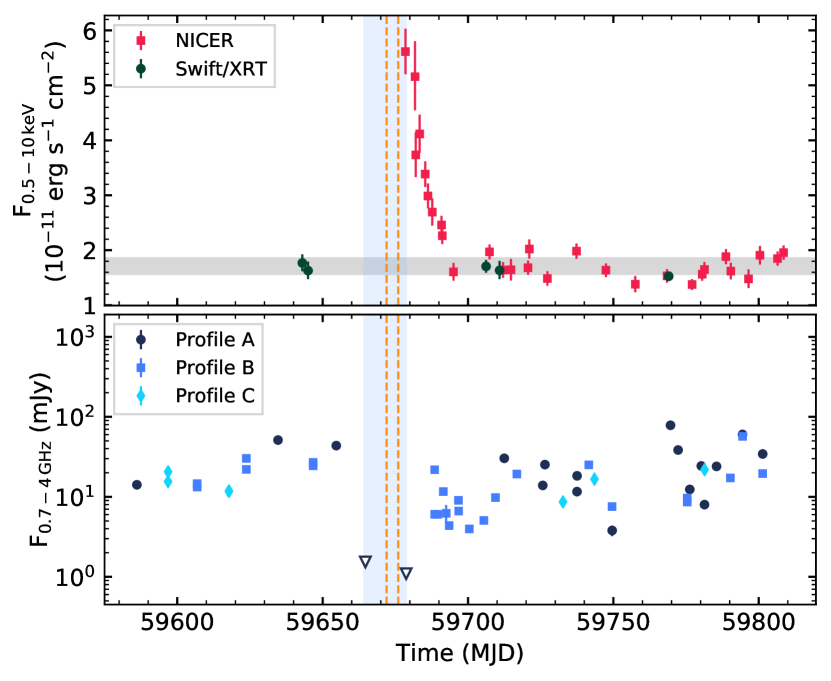
We report the radio and high-energy properties of a new outburst from the radio-loud magnetar 1E 1547.0$-$5408. Following the detection of a short burst from the source with Swift-BAT on 2022 April 7, observations by NICER detected an increased flux peaking at $(6.0 \pm 0.4) imes 10^{-11}$ erg s$^{-1}$ cm$^{-2}$ in the soft X-ray band, falling to the baseline level of $1.7 imes10^{-11}$ erg s$^{-1}$ cm$^{-2}$ over a 17-day period. Joint spectroscopic measurements by NICER and NuSTAR indicated no change in the hard non-thermal tail despite the prominent increase in soft X-rays. Observations at radio wavelengths with Murriyang, the 64-m Parkes radio telescope, revealed that the persistent radio emission from the magnetar disappeared at least 22 days prior to the initial Swift-BAT detection and was re-detected two weeks later. Such behavior is unprecedented in a radio-loud magnetar, and may point to an unnoticed slow rise in the high-energy activity prior to the detected short-bursts. Finally, our combined radio and X-ray timing revealed the outburst coincided with a spin-up glitch, where the spin-frequency and spin-down rate increased by $0.2 \pm 0.1$ $μ$Hz and $(-2.4 \pm 0.1) imes 10^{-12}$ s$^{-2}$ respectively. A linear increase in spin-down rate of $(-2.0 \pm 0.1) imes 10^{-19}$ s$^{-3}$ was also observed over 147 d of post-outburst timing. Our results suggest that the outburst may have been associated with a reconfiguration of the quasi-polar field lines, likely signalling a changing twist, accompanied by spatially broader heating of the surface and a brief quenching of the radio signal, yet without any measurable impact on the hard X-ray properties.
研究の動機と目的
- 新規爆発における電波強度が強い磁気星 1E 1547.0−5408 の高エネルギー的および電波的挙動を特徴づけること。
- 爆発中および爆発後の磁気星の時間的変化を調査し、特にグルーブの存在を特定すること。
- 電波放射の消失が高エネルギー活動の発生よりも前であったかどうかを検証し、標準的爆発モデルに疑問を呈すること。
- 爆発が硬X線非熱的尾部および磁場トポロジーに与える影響を評価すること。
- 観測された電波の遮断および回転減速率の変化の背後にある物理的メカニズムを探索すること。
提案手法
- Swift-BATを用いた初期爆発検出とNICERを用いた軟X線光曲線およびスペクトル解析による多波長モニタリング。
- NICERおよびNuSTARを併用したX線スペクトル解析により、硬非熱的尾部を測定し、スペクトル変化の有無を調査。
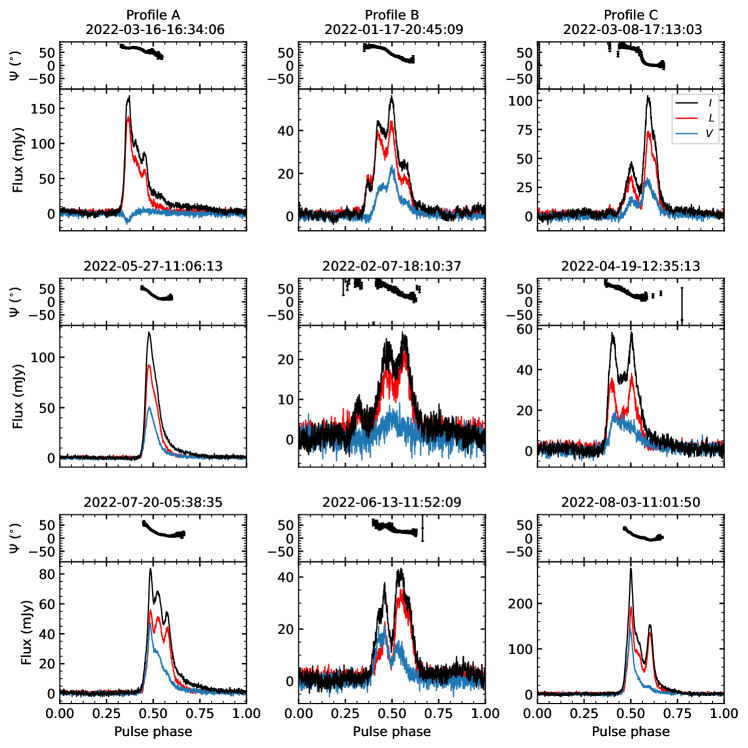
- パーキーズ望遠鏡(Murriyang)を用いた高頻度の電波観測により、パルス電波放射の持続性および消失を追跡。
- tempo2およびRMNestソフトウェアを用いた電波およびX線データのタイミング解析により、回転上昇グルーブの検出および回転周波数と回転減速率の時間的変化を測定。
- 回転周波数の時間的3階微分を抽出するために、回転減速率の変化を線形フィットでモデル化。
- データの前処理およびパルスプロファイル解析には、HEAsoft、XSPEC、PSRCHIVEを用いる。
実験結果
リサーチクエスチョン
- RQ11E 1547.0−5408の電波放射は、高エネルギー的爆発の発生よりも前に対象となったか?
- RQ2軟X線放射率の上昇の性質は何か? また、硬X線非熱的成分の変化と相関があるか?
- RQ3観測された回転上昇グルーブの原因は何か? また、持続的な回転減速率の上昇は、磁場再配置とどのように関係しているか?
- RQ4硬X線スペクトルに顕著な変化が見られない中で、なぜ電波放射が遮断されたのか?
- RQ52008年の爆発と類似していることから、この爆発が長期的な活動増加の一部である可能性は考えられるか?
主な発見
- 軟X線放射率は17日間で (6.0±0.4)×10⁻¹¹ erg s⁻¹ cm⁻² に上昇し、ピークに達した後、基準値 (1.7×10⁻¹¹ erg s⁻¹ cm⁻²) に戻った。
- 軟X線フレア中、硬X線非熱的尾部にスペクトル変化は認められず、全体的な磁場再組織化は発生しなかった。
- 持続的電波放射は、Swift-BATによる爆発検出より少なくとも22日前に消失した。これは、高エネルギー的活動の隠れた前駆的段階が存在した可能性を示唆する。
- 電波放射は初期爆発から2週間後に再出現し、約3週間で爆発前のレベルに回復した。
- 回転上昇グルーブが発生し、瞬時の回転周波数上昇が 0.2±0.1 μHz、回転減速率の上昇が (−2.4±0.1)×10⁻¹² s⁻² であった。
- 爆発後147日間で、回転減速率の線形的上昇が (−2.0±0.1)×10⁻¹⁹ s⁻³ で測定され、磁場ストレスの継続的緩和が進行中であることが示された。
この論文を読む
Nubintのビューアで原文を開き、読みながら気になる箇所をすぐに質問できます。
Nubintでこの論文を読むこのレビューはAIが論文の原文をもとに作成しました。引用する前に原文をご確認ください。