
[論文レビュー] The ALMA Survey of 70 μm Dark High-mass Clumps in Early Stages (ASHES). VIII. Dynamics of Embedded Dense Cores
本研究では、ALMA観測を用いて12個の赤外暗黒星雲(IRDC)内の294個の高密度核の力学的性質を分析し、高質量星形成メカニズムを評価した。結果として、原始星核はプレ原始星核よりも重力的に束縛されていることが判明し、プレ原始星核から原始星核への段階で乱流が顕著に増加しないことから、『クラスターフィード』モデルが『コアーフィード』シナリオよりも支持される。
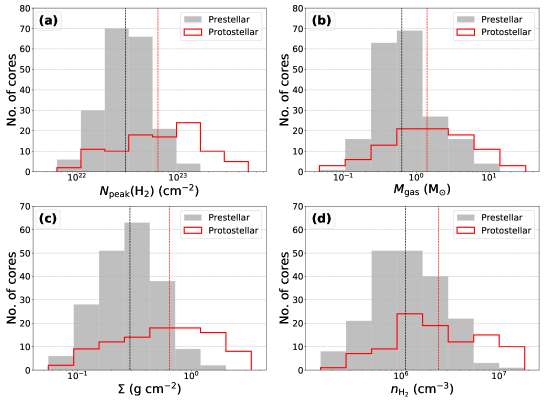
We present the dynamical properties of 294 cores embedded in twelve IRDCs observed as part of the ASHES Survey. Protostellar cores have higher gas masses, surface densities, column densities, and volume densities than prestellar cores, indicating core mass growth from the prestellar to the protostellar phase. We find that ~80% of cores with virial parameter ($α$) measurements are gravitationally bound ($α$< 2). We also find an anti-correlation between the mass and the virial parameter of cores, with massive cores having on average lower virial parameters. Protostellar cores are more gravitationally bound than prestellar cores, with an average virial parameter of 1.2 and 1.5, respectively. The observed non-thermal velocity dispersion (from N$_{2}$D$^{+}$ or DCO$^{+}$) is consistent with simulations in which turbulence is continuously injected, whereas the core-to-core velocity dispersion is neither in agreement with driven nor decaying turbulence simulations. We find no significant increment in the line velocity dispersion from prestellar to protostellar cores, suggesting that dense gas within the core traced by these deuterated molecules is not yet severely affected by turbulence injected from outflow activity at the early evolutionary stages traced in ASHES. The most massive cores are strongly self-gravitating and have greater surface density, Mach number, and velocity dispersion than cores with lower masses. Dense cores have not significant velocity shifts relative to their low-density envelopes, suggesting that dense cores are co-moving with their envelopes. We conclude that the observed core properties are more in line with predictions of ``clump-fed" scenarios rather than with ``core-fed" scenarios.
研究の動機と目的
- 初期段階の高質量星形成領域における埋蔵された高密度核の力学的性質を調査すること。
- コアの性質が『コアーフィード』か『クラスターフィード』の高質量星形成モデルに適合するかを特定すること。
- 初期コア進化段階における乱流、重力的収縮、コア-エンvelope運動の役割を評価すること。
- 観測されたコア力学と駆動された乱流および減衰する乱流の理論的シミュレーションを比較すること。
- 初期段階における降着とフィードバックがコアの速度分散に与える影響を評価すること。
提案手法
- 70 μmの暗黒IRDCを対象に高分解能ALMAデータを取得し、埋蔵された高密度コアを同定および特徴づけた。
- N2D+およびDCO+線放出からのガス質量、サイズ、速度分散を用いてコアのバーリンパラメータ(α)を測定した。
- 非熱的速度分散とコアサイズから乱流マッハ数を計算した。
- コア間速度分散をクラスタスケールのC18Oデータと比較し、運動的分離の有無を評価した。
- 統計的手法(例:LINMIX)を用いて質量、表面密度、速度分散の相関関係を分析した。
- 半径に伴うライン幅のスケーリングを評価し、スケールを越えて第一のラーソン則が成り立つかを検証した。
実験結果
リサーチクエスチョン
- RQ1原始星核はプレ原始星核よりも重力的に束縛されているか? その性質は質量に伴ってどのように変化するか?
- RQ2プレ原始星核から原始星核への段階で乱流が顕著に増加するか? これは噴流フィードバックを示唆するか?
- RQ3高密度コアは低密度エンベロープと運動的に一致しているか、それとも力学的運動をしているか?
- RQ4観測されたコア力学は『コアーフィード』と『クラスターフィード』の高質量星形成モデルの予測とどのように一致するか?
- RQ5重力的収縮は原始星核のライン幅に主要因として寄与しているか?
主な発見
- バーリンパラメータの測定がなされたコアの約80%が重力的に束縛されている(α < 2)。原始星核の平均αは1.2、プレ原始星核は1.5であった。
- 質量の大きいコアは平均的に低いバーリンパラメータを示し、自己重力が強く、表面密度、マッハ数、速度分散が質量の小さいコアよりも高い。
- プレ原始星核から原始星核への段階でライン速度分散に顕著な増加は認められず、重水素化分子が噴流駆動乱流の影響を強く受けていないガスをトレースしている可能性を示唆する。
- コア間速度分散は、連続的に注入される乱流のシミュレーションと一致するが、コア速度分散は駆動または減衰する乱流モデルと一致しない。
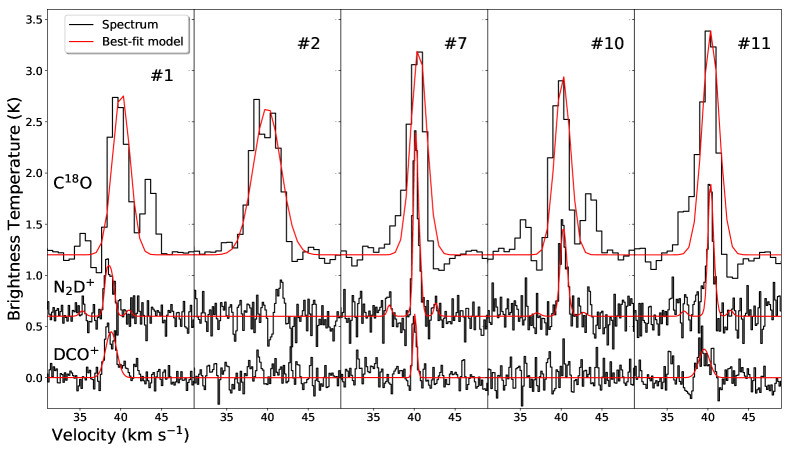
- 高密度コアは低密度エンベロープ(C18O)に対して小さな速度シフトを示しており、ボールスティック運動ではなく、運動的に一致していることを示唆する。
- 第一のラーソン則(速度分散 vs. サイズ)は、GMCからコアスケールまで成り立っており、観測された力学的性質は『コアーフィード』乱流降着モデルとは不一致だが、競合的降着やグローバル階層的崩壊のような『クラスターフィード』モデルとは部分的に一致する。
より良い研究を、今すぐ始めましょう
論文の読解から最終レビューまで、研究時間を劇的に削減しましょう。
クレジットカード登録不要
このレビューはAIが作成し、人間の編集者が確認しました。