
[論文レビュー] The baryon cycle in modern cosmological hydrodynamical simulations
この論文は、3つの公的宇宙論流体シミュレーション(EAGLE, IllustrisTNG, SIMBA)におけるバリオン循環を、ガス流れを測定する統一のオイラー方法を用いて比較し、モデル間で異なるアウトフローの範囲とリサイクル挙動を明らかにする。
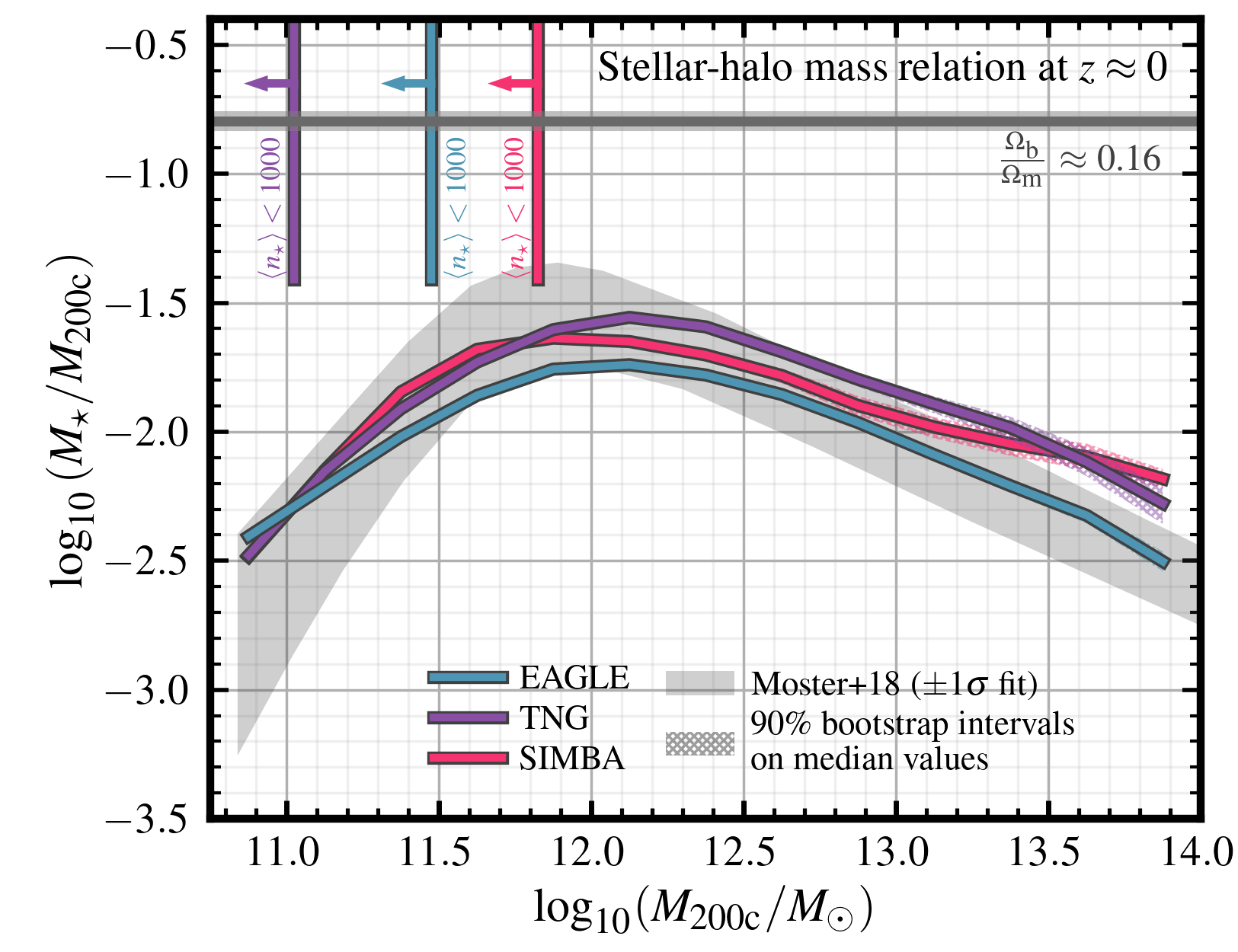
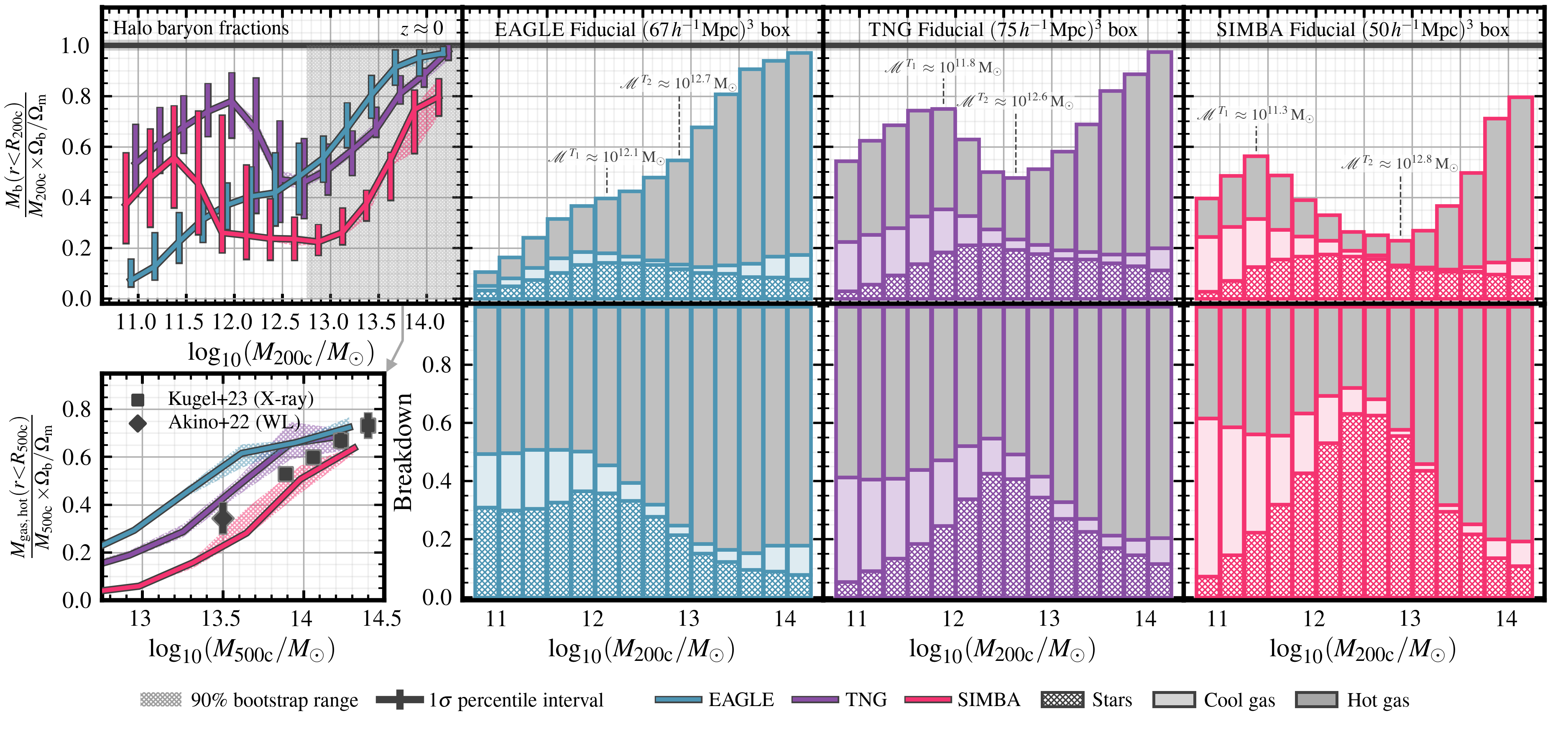
In recent years, cosmological hydrodynamical simulations have proven their utility as key interpretative tools in the study of galaxy formation and evolution. In this work, we present a like-for-like comparison between the baryon cycle in three publicly available, leading cosmological simulation suites: EAGLE, IllustrisTNG, and SIMBA. While these simulations broadly agree in terms of their predictions for the stellar mass content and star formation rates of galaxies at $z\approx0$, they achieve this result for markedly different reasons. In EAGLE and SIMBA, we demonstrate that at low halo masses ($M_{ m 200c}\lesssim 10^{11.5}\, M_{\odot}$), stellar feedback (SF)-driven outflows can reach far beyond the scale of the halo, extending up to $2-3 imes R_{ m 200c}$. In contrast, in TNG, SF-driven outflows, while stronger at the scale of the ISM, recycle within the CGM (within $R_{ m 200c}$). We find that AGN-driven outflows in SIMBA are notably potent, reaching several times $R_{ m 200c}$ even at halo masses up to $M_{ m 200c}\approx10^{13.5}\, M_{\odot}$. In both TNG and EAGLE, AGN feedback can eject gas beyond $R_{ m 200c}$ at this mass scale, but seldom beyond $2-3 imes R_{ m 200c}$. We find that the scale of feedback-driven outflows can be directly linked with the prevention of cosmological inflow, as well as the total baryon fraction of haloes within $R_{ m 200c}$. This work lays the foundation to develop targeted observational tests that can discriminate between feedback scenarios, and inform sub-grid feedback models in the next generation of simulations.
研究の動機と目的
- 現代のシミュレーションにおいて、異なるサブグリッドフィードバック実装がバリオン循環に与える影響を理解する。
- ハロー質量全体にわたる星形成とAGN駆動のアウトフローの空間的範囲を定量化する。
- アウトフローの規模がハローのガス量およびバリオンの保持量に与える影響を評価する。
- フィードバックモデルを区別する観測的テストの枠組みを提供する。
提案手法
- EAGLE、IllustrisTNG、SIMBAにおいて、中心銀河を取り囲む球対称シェル全体でオイラー的ガス流測定を用いる。
- r = R のシェルと幅Δr = 0.2Rの境界ガス要素を同定し、半径方向速度に基づいて流入・流出を分類する。
- 境界を横断する質量流量を式 Ṁ_k(r=R) = (1/Δr) sum_i (m_i v_{r,i}) によって計算する。ここで v_{r,i} は半径方向の速度成分である。
- ハローカタログをFOF + SUBFIND (EAGLE/TNG) または ROCKSTAR (SIMBA) で構築し、ハロー中心・質量・半径 (R_{200c}) を定義する。
- R_{200c} 内の静的なバリオン含有量と相分布をシミュレーション間で比較し、流れ測定を解釈する。
- フィードバックのパラダイムを同等に比較できるよう、一貫した定義に基づいて分析を行う。
実験結果
リサーチクエスチョン
- RQ1EAGLEとIllustrisTNG、SIMBAにおける星形成駆動およびAGN駆動のアウトフローは、空間的な範囲とリサイクル挙動においてどのように異なるのか?
- RQ2フィードバック駆動アウトフローの規模と、ハローへの宇宙論的インフローの抑制との関係は?
- RQ3アウトフローの到達範囲の違いは、ハロー内の総バリオン分率と星・冷ガス・熱ガスの間の配分にどのように影響するのか?
- RQ4統一された観測的枠組みは、これらのシミュレーションで実装されているフィードバック実装を区別することができるのか?
主な発見
- EAGLEとSIMBAにおける星形成フィードバック駆動のアウトフローは、低質量のハローにおいてハローを超えて2-3 R200cに達する (M200c ≲ 10^11.5 M⊙)。
- IllustrisTNGでは、星駆動の風はISMスケールで最も強く、CGM内でリサイクルする(R200c内)。
- SIMBAのAGN駆動のアウトフローは非常に強力で、M200c ≈ 10^13.5 M⊙ までのハロー質量に対してR200cの数倍に達する。
- TNGとEAGLEのいずれでも、これらの質量でAGNフィードバックはガスをR200c beyondに放出できるが、2-3 R200cを超えることはまれである。
- フィードバック駆動のアウトフローの規模は、宇宙論的インフローの抑制とR200c内の総ハロー・バリオン分率に直接結びついている。
- 本研究は、フィードバックシナリオを区別するための標的となる観測テストの基盤を提供し、将来のシミュレーションのサブグリッドフィードバックモデルにも情報を提供する。
より良い研究を、今すぐ始めましょう
論文設計から論文執筆まで、研究時間を劇的に削減しましょう。
クレジットカード登録不要
このレビューはAIが作成し、人間の編集者が確認しました。