
[論文レビュー] The case for large-scale AGN feedback in galaxy formation simulations: insights from XFABLE
This paper analyzes an extreme AGN feedback model (XFABLE) within the FABLE framework, showing that radio-mode feedback with distant jet-thermalization can match weak lensing+kSZ constraints while preserving GSMF and gas fractions.
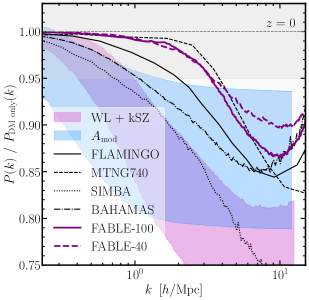
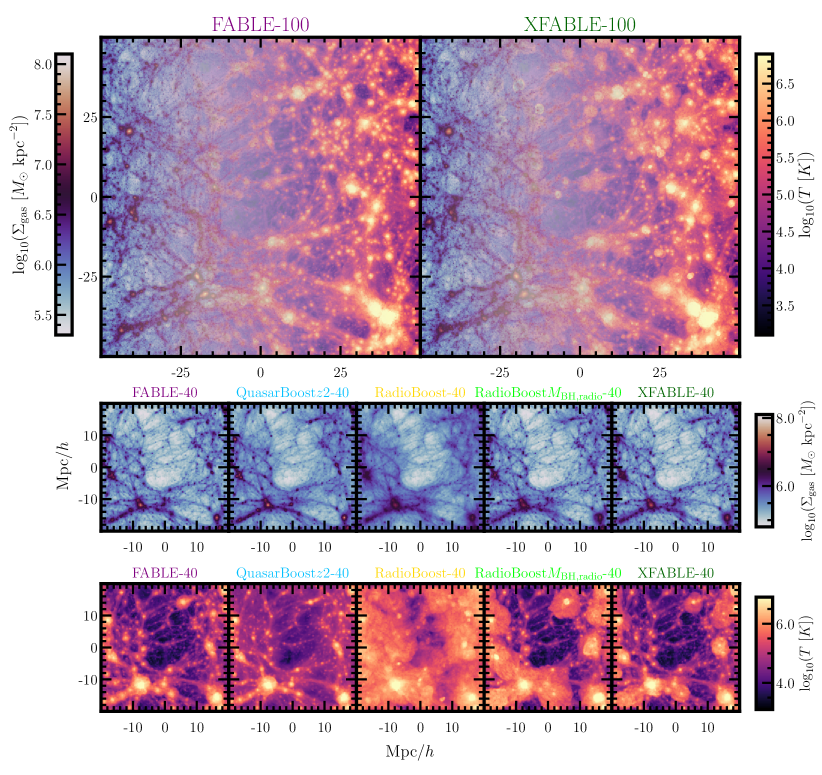
While cosmological simulations of galaxy formation have reached maturity, able to reproduce many fundamental galaxy and halo properties, no consensus has yet been reached on the impact of `baryonic feedback' on the non-linear matter power spectrum. This severely limits the precision of (and potentially biases) small-scale cosmological constraints obtained from weak lensing and galaxy surveys. Recent observational evidence indicates that `baryonic feedback' may be more extreme than commonly assumed in current cosmological hydrodynamical simulations. In this paper, we therefore explore a range of empirical AGN feedback models, within the FABLE simulation suite, with different parameterizations as a function of cosmic time, host halo properties, and/or spatial location where feedback energy is thermalized. We demonstrate that an AGN radio-mode feedback acting in a larger population of black holes, with jets thermalizing at relatively large cluster-centric distances, as exemplified by our XFABLE model, is in good agreement with the latest weak lensing + kSZ constraints across all k-scales. Furthermore, XFABLE maintains good agreement with the galaxy stellar mass function, gas fraction measurements, and all key galaxy group and cluster properties, including scaling relations and ICM radial profiles. Our work highlights the pressing need to model black hole accretion and feedback physics with a greater level of realism, including relativistic, magnetized jets in full cosmological simulations. Finally, we discuss how a range of complementary observational probes in the near future will enable us to constrain AGN feedback models, and therefore reduce `baryonic feedback' modelling uncertainty for the upcoming era of large cosmological surveys.
研究の動機と目的
- Motivate the need to understand baryonic feedback’s impact on the non-linear matter power spectrum for precision cosmology.
- Investigate whether more extreme AGN feedback can reconcile S8 tensions without breaking key galaxy/cluster observables.
- Test a range of AGN feedback parameterizations within the FABLE framework against observations.
提案手法
- Use Arepo to run a suite of 40 and 100 Mpc/h boxes with FABLE-like physics as baseline.
- Modify AGN feedback to create XFABLE variants with different radio-mode parameters (Table 1) and bubble injection prescriptions.
- Compute matter power spectrum Pm(k) and its suppression relative to DMonly, via Pylians routines.
- Compare predictions to GSMF, hot gas fractions in groups/clusters, and X-ray/SZ observations across redshift.
- Evaluate redshift and spatial dependence of feedback effects on the non-linear power spectrum.
実験結果
リサーチクエスチョン
- RQ1Can extreme AGN feedback models yield the level of matter power spectrum suppression required by S8 tensions?
- RQ2Do such extreme feedback models remain consistent with GSMF and hot gas fractions in groups and clusters?
- RQ3What is the role of radio-mode jet energetics and bubble injection in shaping the total matter distribution?
- RQ4How do box size and stochasticity in feedback affect predicted observables across scales?
主な発見
- XFABLE’s radio-mode feedback with jets heating at relatively large cluster-centric distances can be in good agreement with WL+kSZ constraints across all k-scales.
- XFABLE maintains good agreement with the galaxy stellar mass function and gas fraction measurements as well as key group/cluster scaling relations and ICM radial profiles.
- Different hydrodynamical simulations predict a wide range of power-spectrum suppression, highlighting degeneracies in sub-grid feedback modelling.
- More extreme AGN feedback may be required to reconcile S8 tensions while staying compatible with X-ray and tSZ constraints, motivating higher realism in jet physics.
- The study emphasizes the need to model black hole accretion and feedback with greater realism, including relativistic, magnetized jets in cosmological simulations.
より良い研究を、今すぐ始めましょう
論文設計から論文執筆まで、研究時間を劇的に削減しましょう。
クレジットカード登録不要
このレビューはAIが作成し、人間の編集者が確認しました。