
[論文レビュー] The dust enrichment of early galaxies in the JWST and ALMA era
研究はデルフィ半解析モデルを用い、赤shiftsと質量に依存しない2つのパラメータで高赤方偏移銀河のUVおよびFIR特性を予測。塵の影響、UV可視性、FIR進化を強調。
Recent observations with the James Webb Space Telescope are yielding tantalizing hints of an early population of massive, bright galaxies at $z > 10$, with Atacama Large Millimeter Array (ALMA) observations indicating significant dust masses as early as $z\sim 7$. To understand the implications of these observations, we use the DELPHI semi-analytic model that jointly tracks the assembly of dark matter halos and their baryons, including the key processes of dust enrichment. Our model employs only two redshift- and mass-independent free parameters (the maximum star-formation efficiency and the fraction of supernova energy that couples to gas) that are tuned against all available galaxy data at $z \sim 5-9$ before it is used to make predictions up to $z \sim 20$. Our key results are: (i) the model under-predicts the observed ultraviolet luminosity function (UV LF) at $z > 12$; observations at $z>16$ lie close to, or even above, a "maximal" model where all available gas is turned into stars; (ii) UV selection would miss 34\% of the star formation rate density at $z \sim 5$, decreasing to 17\% by $z \sim 10$ for bright galaxies with $ m{M_{UV}} < -19$; (iii) the dust mass ($M_d$) evolves with the stellar mass ($M_*$) and redshift as $\log(M_d) = 1.194\log(M_*) + 0.0975z - 5.433$; (iv) the dust temperature increases with stellar mass, ranging between $30-33$ K for $M_* \sim 10^{9-11}M_\odot$ galaxies at $z \sim 7$. Finally, we predict the far infrared LF at $z \sim 5-20$, testable with ALMA observations, and caution that spectroscopic redshifts and dust masses must be pinned down before invoking unphysical extrema in galaxy formation models.
研究の動機と目的
- JWSTとALMA時代における塵の濃縮と初期銀河の観測量への影響の理解を動機づける。
- 高赤方偏移銀河におけるUVおよびFIR光度とUV光の塵減衰を予測する。
- 塵質量と温度を星形成質量と赤shiftに結びつけ、FIR光度関数を informing する。
- z~20までのUV光度関数、星質量関数、宇宙SFR密度に対するモデル予測を検証する。
提案手法
- ダークマターハローの組立とバリオンの進化を追跡し、塵濃縮を組み込んだデルフィ半解析モデルを用いる。
- 赤shiftと質量に依存しない2つの自由パラメータを使用: 最大星形成効率f_*とSNエネルギー結合分数f_wを、z~5-9のデータに対して校正。
- 金属と塵の成長・破壊を含む結合した微分方程式を介してガス取り込み、星形成、SNフィードバック、塵の進化を計算。
- BPASS星母集団に基づく固有のUV光度を生成し、塵光学深さをM_dとr_dに結びつけたスラブ幾何学を用いて塵減衰を適用。
- エネルギー収支を満たすようFIR光度を導出し、L_FIRとM_dから塵温度を推定。高赤方偏移でのCMB影響を考慮。
実験結果
リサーチクエスチョン
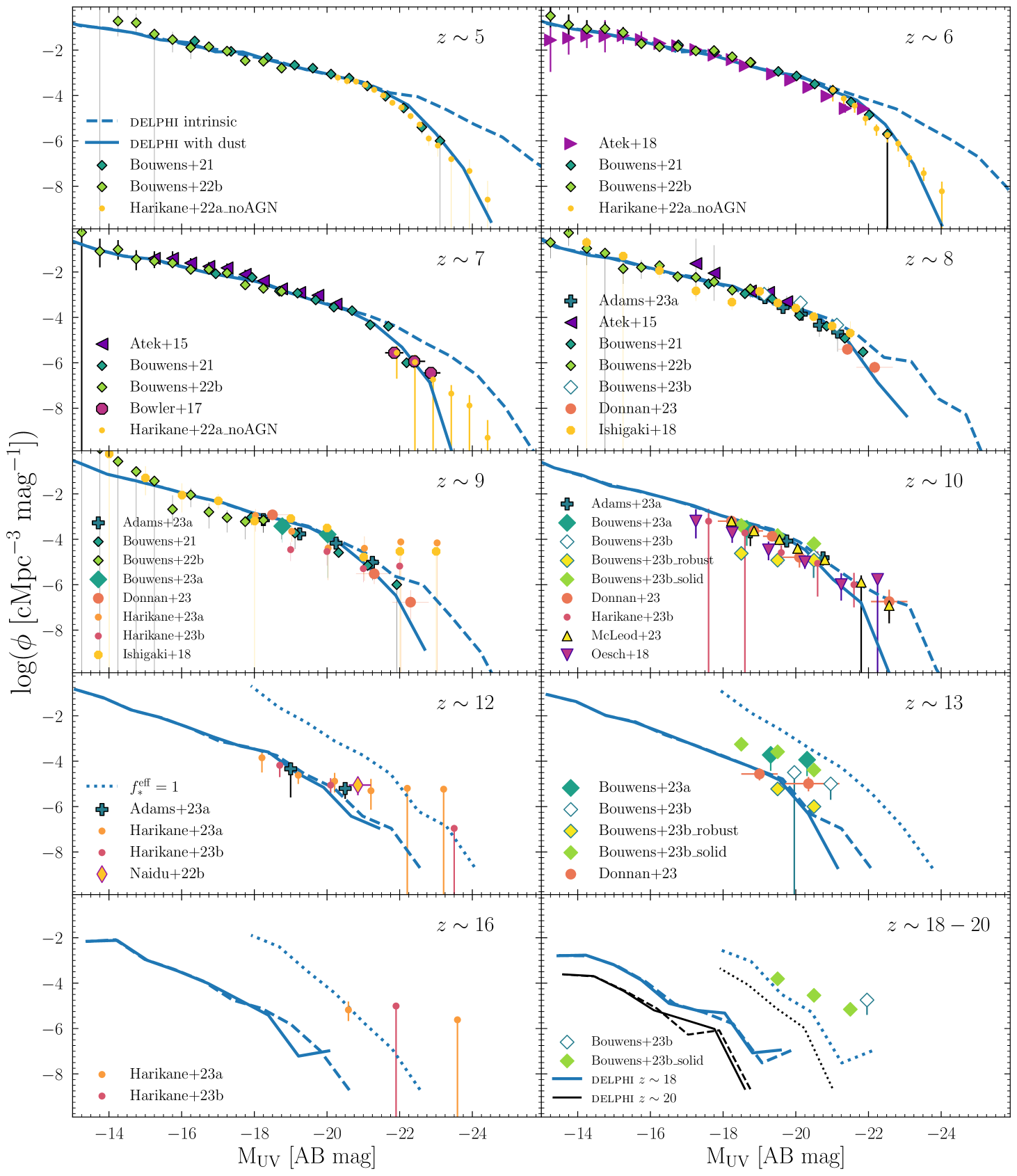
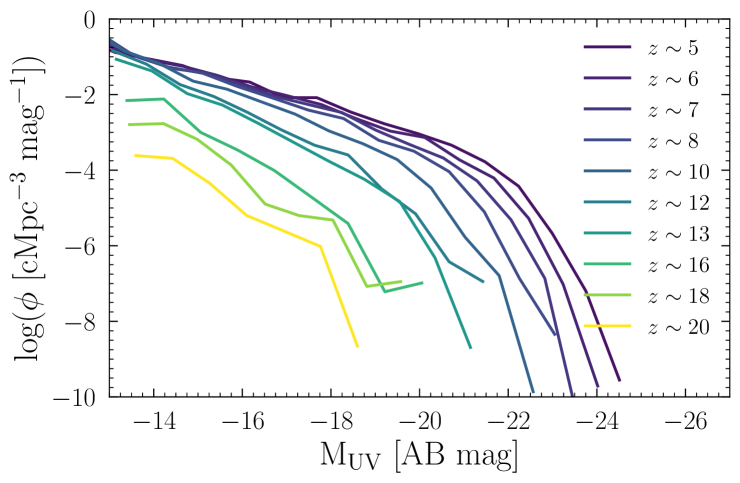
- RQ1塵濃縮は高赤方偏移の銀河のUV光度関数とUV可視性にどのような影響を与えるか(z~20まで)?
- RQ2初期銀河における塵質量、星質量、星形成、赤shiftの関係はFIR放射にどう影響するか?
- RQ3モデルはz~5-9の観測されたUVおよび星質量関数を再現でき、z~5-20のFIR光度関数を予測できるか?
- RQ4UV選択で塵減衰により見落とされる星形成の割合はどれくらいか、特に明るい銀河について?
- RQ5塵温度とUVエスケープ分率は銀河質量と赤shiftとともにどう進化するか?
主な発見
- モデルはz>12でUV LFを過小評価する傾向があり、z>16では観測が最大モデルと高い星形成効率を取る。
- UV選択はz~5で明るい銀河(M_UV<-19)のSFR密度の34%を見逃し、z~10までに17%へ低下。
- 塵質量は星形成質量と赤shiftに対してlog(M_d)=1.194 log(M_*)+0.0975 z-5.433でスケールする。
- 塵温度はz~7でM_* ~10^9-10^11 M_sunのとき約30-33 Kの範囲で、星質量とともに増加する。
- モデルはFIR光度を予測し、z~5-20で遠赤外LFを制約できるが、スペクトroscopic redshiftsと塵質量決定には注意が必要。
- UV LFの進化は塵の影響がz~5-10の明るさ/中程度の光度域で実質的となり、 brightest 系ではz>12で無視できる。
より良い研究を、今すぐ始めましょう
論文設計から論文執筆まで、研究時間を劇的に削減しましょう。
クレジットカード登録不要
このレビューはAIが作成し、人間の編集者が確認しました。