
[論文レビュー] The Effect of Thermal Torques on AGN Disc Migration Traps and Gravitational Wave Populations
要約: 本論文はAGNディスクにおける熱トルクが恒星質ブラックホールの移動トラップを作成し、移動、EMRI供給、LVK GW集団に影響を与える可能性を分析する。
Accretion discs in active galactic nuclei (AGN) foster black hole (BH) formation, growth, and mergers. Stellar mass BHs migrate inwards under the influence of hydrodynamical torques unless they encounter a region where the torque flips sign. At these migration traps, BHs accumulate and merge via dynamical or gas-assisted interactions, producing high-frequency LIGO/Virgo/KAGRA (LVK) gravitational wave (GW) sources and potentially cutting off the supply of extreme mass ratio inspirals that would otherwise make low-frequency, {\it LISA}-band GWs. In this paper, we study the interplay between different types of migration torques, focusing especially on the ``thermal torques'' generated by the thermal response of the AGN to embedded stellar-mass BHs that accrete through their own mini-discs.In contrast to previous work, we find that Type I torques cannot produce migration traps on their own, but thermal torques often do, particularly in low-mass AGN. The migration traps produced by thermal torques exist at much larger radii ($\sim 10^{3-5}$ gravitational radii) than do previously identified Type I traps, carrying implications for GW populations at multiple frequencies. Finally, we identify a bifurcation of AGN discs into two regimes: migration traps exist below a critical AGN luminosity, and do not at higher luminosities. This critical luminosity is fit as $\log_{10} L_{ m AGN}^c = 45 - 0.32 \log_{10}{(α/0.01)}$ where $α$ is the AGN alpha viscosity parameter, a range compatible with recent claims that LVK GWs are not preferentially associated with high-luminosity AGN.
研究の動機と目的
- AGNディスクにおけるブラックホール移動への熱トルクの影響を評価する。
- 移動トラップが形成または消失する条件を特定する。
- 移動トラップが重力波源集団(LVKとEMRI)に与える影響を特定する。
- AGN光度とディスクパラメータ(α、dot{m}、MBH質量)への依存性を探る。
提案手法
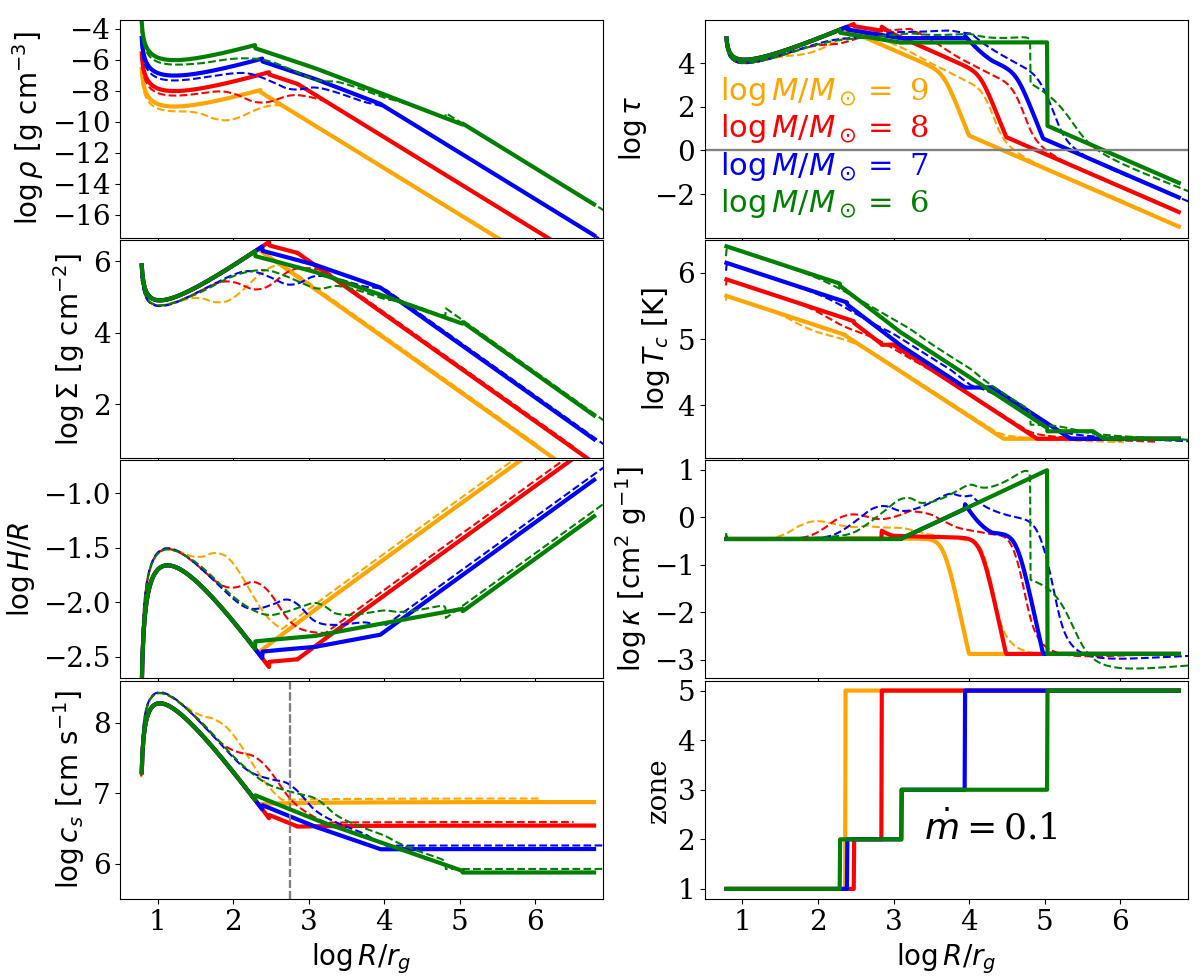
- 多ゾーン・不透明度 regimeを含む解析的Shakura–Sunyaev様のAGNディスクモデルを構築する。
- 最新の較正(Paardekooper et al. 2010; Jiménez & Masset 2017)を用いて更新されたType I移動トルクを導出し、熱トルク寄与と比較する。
- Masset (2017) の熱トルク定式化を組み込み、臨界光度 L_c および lobe diffusion scale lambda を考慮する。
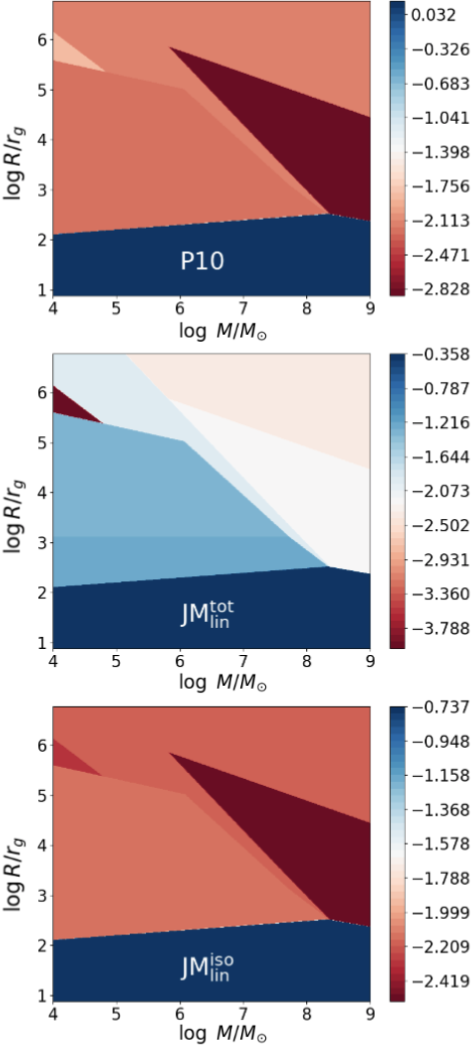
- ディスクパラメータとMBH質量を跨ぐType Iと熱トルクを合計して正味トルクを計算する。
- 全トルク符号が変わる領域を同定し、移動トラップとアンチトラップを特定する。
- MBH質量とAGN光度に対するトラップの存在の依存性を分析し、臨界光度関係を導出する。
実験結果
リサーチクエスチョン
- RQ1AGNディスクにおいて熱トルクはType Iトルクより支配的か、またどの条件で移動トラップを生み出すか。
- RQ2移動トラップの位置はMBH質量、ディスク粘性α、降着率dot{m}、AGN光度にどう依存するか。
- RQ3トラップが存在するディスク領域と消えるディスク領域の分岐(光度依存の分岐)はあるか。
- RQ4LVKのブラックホール合体とLISA帯のEMRI集団に対する移動トラップの影響は何か。
主な発見
- 熱トルクは標準的なType Iトルクよりも優勢になることが多く、特に低質量のAGNディスクで、Type I単独では生じない移動トラップを生みうる。
- 熱トルクによる移動トラップは、古典的なType Iトラップよりも大きな半径領域(おおよそ10^3–10^5 重力半径)で発生する。
- AGNディスクには分岐が存在する:移動トラップは臨界光度以下で存在し、高光度では発生しない。
- 臨界光度はおおよそ log10 L_AGN^c = 45 - 0.32 log10(alpha/0.01) にスケールする。
- MBH質量が低いディスクは熱トルクによる外向き移動を起こしやすく、SMBH二重系の環境とGW源集団に影響を与える。
- 結果はLVKのGWイベントが高光度AGNと優先的に関連するという主張と整合的である。
より良い研究を、今すぐ始めましょう
論文設計から論文執筆まで、研究時間を劇的に削減しましょう。
クレジットカード登録不要
このレビューはAIが作成し、人間の編集者が確認しました。