
[論文レビュー] The evolution of the galaxy UV luminosity function at redshifts z ~ 8-15 from deep JWST and ground-based near-infrared imaging
この研究は early JWST NIRCam データと地上深域 UltraVISTA 画像を COSMOS で組み合わせ、z ≃ 8 から 15 までの進化する銀河 UV 光度関数を導出し、z ≈ 10 付近までの二重冪 LF を見出し、z ≈ 15 付近までの ρUV および ρSFR の徐々の低下を明らかにする。
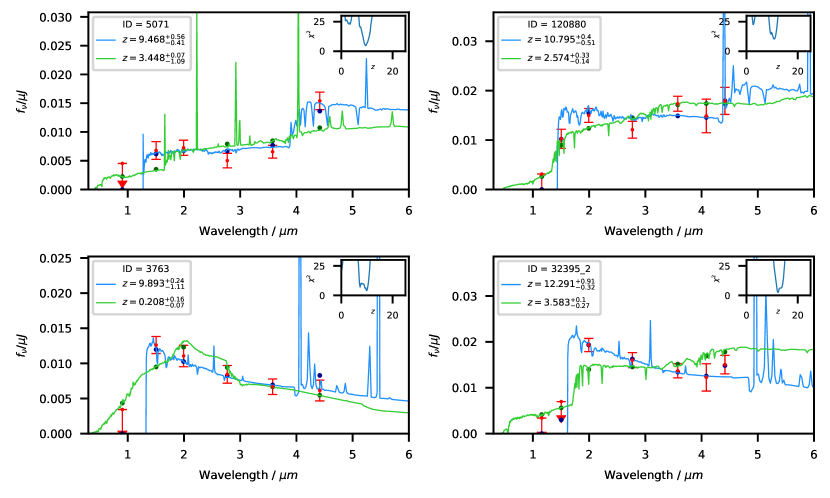
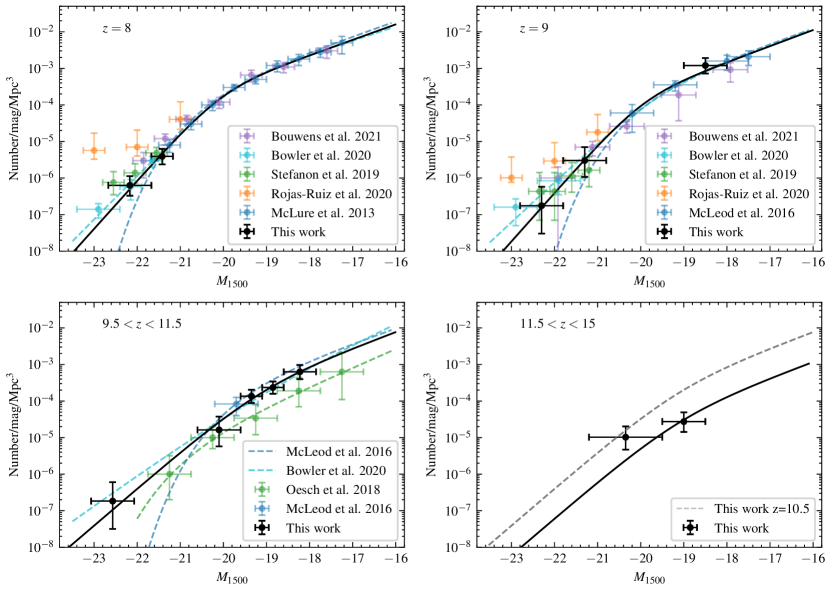
We reduce and analyse the available James Webb Space Telescope (JWST) ERO and ERS NIRCam imaging (SMACS0723, GLASS, CEERS) in combination with the latest deep ground-based near-infrared imaging in the COSMOS field (provided by UltraVISTA DR5) to produce a new measurement of the evolving galaxy UV luminosity function (LF) over the redshift range $z = 8 - 15$. This yields a new estimate of the evolution of UV luminosity density ($ρ_{ m UV}$), and hence cosmic star-formation rate density ($ρ_{ m SFR}$) out to within $< 300$\, Myr of the Big Bang. Our results confirm that the high-redshift LF is best described by a double power-law (rather than a Schechter) function up to $z\sim10$, and that the LF and the resulting derived $ρ_{ m UV}$ (and thus $ρ_{ m SFR}$), continues to decline gradually and steadily up to $z\sim15$ (as anticipated from previous studies which analysed the pre-existing data in a consistent manner to this study). We provide details of the 61 high-redshift galaxy candidates, 47 of which are new, that have enabled this new analysis. Our sample contains 6 galaxies at $z \ge 12$, one of which appears to set a new redshift record as an apparently robust galaxy candidate at $z \simeq 16.4$, the properties of which we therefore consider in detail. The advances presented here emphasize the importance of achieving high dynamic range in studies of early galaxy evolution, and re-affirm the enormous potential of forthcoming larger JWST programmes to transform our understanding of the young Universe.
研究の動機と目的
- z ≳ 8 での銀河 UV 光度関数の進化を新しい JWST ERO/ERS NIRCam データと COSMOS/UltraVISTA DR5 画像を用いて動機づけ、定量化する。
- 3 つの JWST 観測領域と COSMOS/UltraVISTA で z > 7.5 の堅牢な高赤方偏移銀河サンプルを構築し、LF と導出された UV 光度密度および星形成率密度を測定する。
- LF の形状(double power-law vs Schechter)と z ≈ 15 までの進化を評価し、z ≈ 16.4 の候補天体を含む高赤方偏移銀河候補を特定する。
- マルチバンド光度測定、SED フィッティング、クロスフィールドの一貫性を用いて低-z 汚染物を最小化し、高赤方偏移選択のダイナミックレンジと信頼性を評価する。
提案手法
- JWST NIRCam 撮影(SMACS0723, CEERS, GLASS)を COSMOS/UltraVISTA DR5 の近赤外データと組み合わせて z > 7.5 の銀河サンプルを構築する。
- PSF の均質化と局所的な感度深度の推定を行い、一貫した多波長フォトメトリを得る。
- Pegase テンプレートを用いて EAZY で フォトメトリック赤shifts を算出し、brown dwarf 汚染と照合し、LePhare および McLure らのコードで検証する。
- 各フィールドに合わせたドロップアウト基準で高-z候補を選択し、Δχ2 条件を用いて堅牢な高-z 解を要求する。
- UV絶対等級を導出し、総フラックスを補正して、z = 8 から z ≈ 15 までの赤方偏移ビンで UV 光度関数を推定する。
実験結果
リサーチクエスチョン
- RQ1JWST 深場と COSMOS/UltraVISTA データを組み合わせた場合、z ≈ 8 から 15 までの銀河 UV 光度関数の進化形はどのようになるか?
- RQ2高-z の UV LF は z ≈ 10 まで二重冪関数(double power-law)か Schechter 関数でより適切に記述されるのか、z ≈ 15 に向けてどのように進化するのか?
- RQ3z > 8 における UV 光度密度と宇宙規模の星形成率密度への含意は何か、z ≈ 16 までの可能性のある明るい端の銀河を含めて考察する。
主な発見
- 高-z UV 光度関数は z ≈ 10 までは二重冪関数で最もよく記述され、Schechter 関数ではない。
- UV 光度密度 ρUV および導出される宇宙星形成率密度 ρSFR は z ≈ 15 まで徐々に、着実に低下する。
- 61 の高-z銀河候補サンプル(47 新規)はLF解析を可能にし、z ≥ 12 の銀河6例と堅牢な z ≈ 16.4 候補を含む。
- 本研究は、JWST 深場と地上観測の広域イメージングを組み合わせることで高ダイナミックレンジを活用できることを示した。
- 詳細には、3 つのフィールドにまたがる合計 45 arcmin^2 の JWST NIRCam データと、1.8 deg^2 の UltraVISTA COSMOS 画像が含まれ、COSMOS/UltraVISTA には z > 7.5 の銀河が 16 個ある。
より良い研究を、今すぐ始めましょう
論文設計から論文執筆まで、研究時間を劇的に削減しましょう。
クレジットカード登録不要
このレビューはAIが作成し、人間の編集者が確認しました。