
[論文レビュー] The fate of quasiparticles at high-temperature
本研究では、相関金属Sr2RuO4における準粒子が200 K以上の温度まで存続することを明らかにした。その残留部数Zは温度上昇に伴い減少するのではなく増加する。角度分解光電子分光法と動的平均場理論を用いて、著者らは準粒子が重さを失うのではなく、超プランク散乱と過剰な幅広がりによって消滅することを示し、悪金属における準粒子崩壊の従来の見解に挑戦する。
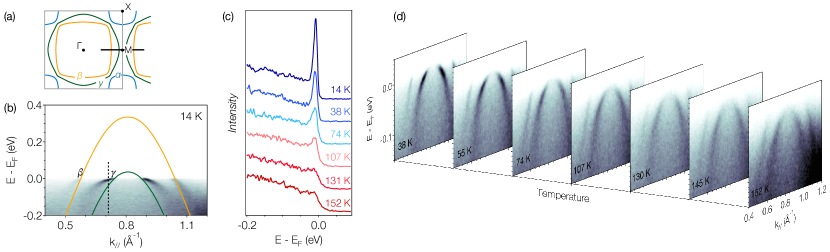
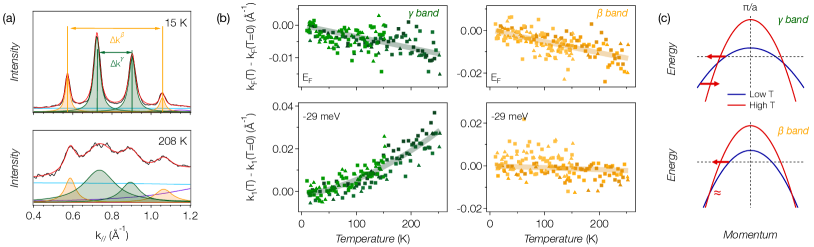
We study the temperature evolution of quasiparticles in the correlated metal Sr_{2}RuO_{4}. Our angle resolved photoemission data show that quasiparticles persist up to temperatures above 200 K, far beyond the Fermi liquid regime. Extracting the quasiparticle self-energy, we demonstrate that the quasiparticle residue Z increases with increasing temperature. Quasiparticles eventually disappear on approaching the bad metal state of Sr_{2}RuO_{4} not by losing weight but via excessive broadening from super-Planckian scattering. We further show that the Fermi surface of Sr_{2}RuO_{4}-defined as the loci where the spectral function peaks-deflates with increasing temperature. These findings are in semiquantitative agreement with dynamical mean field theory calculations.
研究の動機と目的
- 高温における相関金属、特にモット=イェフ=レーゲル限界を超えた悪金属領域における準粒子の運命を解明すること。
- 悪金属において準粒子残留部数Zが温度上昇に伴い減少するとされる一般的な仮定に挑戦すること。
- Sr2RuO4における準粒子性の喪失に、準粒子重みかスペクトル幅広がりのどちらが支配的かを特定すること。
- ARPES測定データが、温度依存的準粒子挙動に関する動的平均場理論の予測と整合するかを検証すること。
- スペクトル関数の線形形状の変化とバックグラウンド除去の役割が、信頼性のある準粒子パラメータ抽出に与える影響を明確にすること。
提案手法
- 角度分解光電子分光法(ARPES)を用いて、Sr2RuO4のエネルギーおよび運動量依存スペクトル関数を、約250 Kまでの温度範囲で測定した。
- 自己エネルギーを準粒子ピークエネルギーω₀のまわりで一次近似でフィッティングすることで、準粒子残留部数Zを分散関係から抽出した。
- 実用的なバックグラウンド除去法を採用し、π/aの運動量において直接遷移が存在しないスペクトルを用いて、内在的スペクトル関数を分離した。
- 線形状の変化をモデル化するため、次式の修正スペクトル関数表現を用いた:A(k,δω) ≈ Z / π * [Z(Σ′′₀ + αδω)] / [δω² + Z(Σ′′₀ + αδω)²]。これにより、温度依存の幅広がりとピーク強度解析が可能になった。
- 実験結果を、動的平均場理論(DMFT)計算と比較した。スペクトルを一致させるために、温度に依存しないグローバルなスケーリング係数を用いた。
- DMFTデータから自己エネルギーの微分∂Σ′/∂ωを計算し、抽出されたZ値の妥当性を検証するとともに、ARPESで得られた準粒子重みと整合していることを確認した。
実験結果
リサーチクエスチョン
- RQ1悪金属において伝統的に想定されているように、Sr2RuO4における準粒子残留部数Zは温度上昇に伴い減少するのか?
- RQ2高温における準粒子ピークの消失を引き起こす主なメカニズムは何か—スペクトル重みの損失か、過剰な幅広がりか?
- RQ3Sr2RuO4におけるフェルミ表面(スペクトル関数のピークとして定義される)は温度上昇に伴いどのように変化するか?
- RQ4ピークが幅広がり、弱体化した状態においても、ARPESで測定されたスペクトル関数は準粒子挙動をどれほど保持しているか?
- RQ5温度上昇に伴うZの増加は、多バンド相関系に対するDMFT予測と整合的か?
主な発見
- 準粒子残留部数ZはSr2RuO4において温度上昇に伴い増加するが、これは高温でZ → 0になるとされる従来の予想とは逆である。
- 準粒子は、フェルミ液体領域およびモット=イェフ=レーゲル限界をはるかに超えて、200 K以上の温度までスペクトル関数に存続する。
- スペクトルピークは温度上昇に伴い著しく幅広がり、非対称なフェルミ液体的形状からローレンツ型へと変化し、超プランク散乱を示唆する。
- スペクトル関数の最大強度の位置として定義されるフェルミ表面は、温度上昇に伴い収縮する。これはコherencyの低下を反映している。
- バックグラウンド除去後のARPESデータは、DMFT計算と優れた定性的および準定量的整合性を示し、Zの温度上昇を支持する。
- 本研究では、ピーク強度が低下する中で準粒子重みが温度上昇に伴い増加することを示し、幅広がりが常にZの減少を意味するという仮定に挑戦する。
より良い研究を、今すぐ始めましょう
論文の読解から最終レビューまで、研究時間を劇的に削減しましょう。
クレジットカード登録不要
このレビューはAIが作成し、人間の編集者が確認しました。