
[論文レビュー] The galaxy UV luminosity function at $\mathbf{z \simeq 11}$ from a suite of public JWST ERS, ERO and Cycle-1 programs
要約: 本論文は広域 JWST NIRCam 調査(約260平方アーク分)を用いて 61 件の堅牢な z>9.5星系候補を得て、UV 輝度関数の進化を z≈9.5 から 12.5 まで制約し、ダブルパワー法則形状と弱い端の急峻な勾配を支持する。
We present a new determination of the evolving galaxy UV luminosity function (LF) over the redshift range $9.5250$ arcmin$^2$) data set of JWST NIRCam near-infrared imaging assembled from thirteen public JWST surveys. Our relatively large-area search allows us to uncover a sample of 61 robust $z>9.5$ candidates detected at $\geq 8σ$, and hence place new constraints on the intermediate-to-bright end of the UV LF. When combined with our previous JWST+UltraVISTA results, this allows us to measure the form of the LF over a luminosity range corresponding to four magnitudes ($M_{1500}$). At these early times we find that the galaxy UV LF is best described by a double power-law function, consistent with results obtained from recent ground-based and early JWST studies at similar redshifts. Our measurements provide further evidence for a relative lack of evolution at the bright-end of the UV LF at $z=9-11$, but do favour a steep faint-end slope ($α\leq-2$). The luminosity-weighted integral of our evolving UV LF provides further evidence for a gradual, smooth (exponential) decline in co-moving star-formation rate density ($ρ_{\mathrm{SFR}}$) at least out to $z\simeq12$, with our determination of $ρ_{\mathrm{SFR}}(z=11)$ lying significantly above the predictions of many theoretical models of galaxy evolution.
研究の動機と目的
- rest-frame UVgalaxy luminosity function (LF) の evolu tion を z≈9.5–12.5 で広域 JWST NIRCam データセットを用いて描く。
- M1500 での UV LF の明るい〜中間端を四オーダー分の Magnitude で測定し、その機能形状を評価する。
- 新しい広域結果を前 JWST+UltraVISTA 制約と組み合わせて z≈12 までの ρ_SFR の進化を導く。
- z>9.5 の明るい銀河の豊富さを評価し、銀河進化の理論モデルと比較する。
提案手法
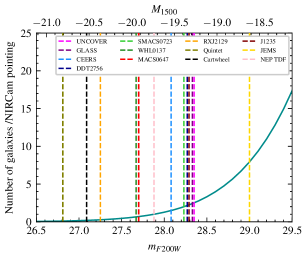
- 公開調査を含む13のJWST NIRCam カタログを統合し、クラスタリング/レンズ影響がある場合は masking 後 約260 角分²とする。
- PSF の均質化と直径 0.35″ のアパーチャ光度測定を実施し、Kron アパーチャ外の 10% の光を追加で flux_AUTO による総量補正を適用。
- BC03 テンプレート、Chabrier IMF、Calzetti 局、Madau IGM 減衰を用いて SED フィットを LePhare で実施し、photometric redshift と M1500 を推定。
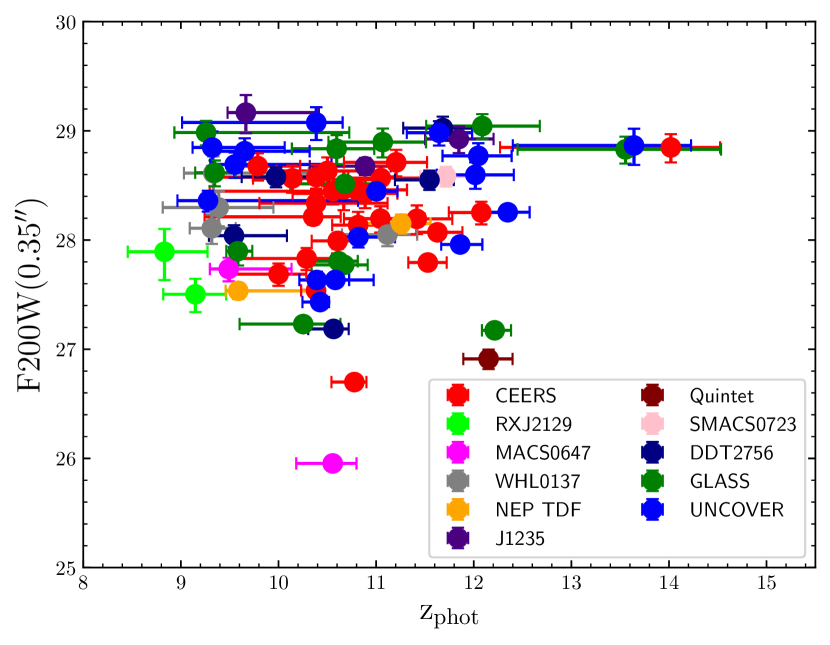
- zphot≥8.5、主解と副解の Δχ²≥4、少なくとも主要バンドで ≥8σ の検出、Lyman ブレより手前のバンドでノン検出という頑健な z>9.5 選択を適用。
- クラスタ場(例:SMACS 0723)でレンズ効果および実効サーベイ領域を考慮し、公開済みレンズモデルを用いてデレンズ領域と拡大倍率を導出する。
実験結果
リサーチクエスチョン
- RQ1約 four-magnitude の範囲で z≈9.5–12.5 の UV LF の形はどうなるか。
- RQ2これらの赤方距離で明るい端に対して Schechter 関数よりもダブルパワー法則が適しているのか。
- RQ3z≈12 までの光度密度と推定される星形成率密度(ρ_SFR)の進化はどうなるか。
- RQ4z>9.5 で JWST により得られた LF 測定は初期銀河進化の理論モデルとどのように比較されるか。
主な発見
- z≈9.5–12.5 の UV LF はダブルパワー法則で最もよく説明され、地上観測と初期 JWST 研究と整合する。
- z=9–11 における UV LF の明るい端の evolve には相対的な欠如の証拠がある。
- faint-end の勾配は鋭い( α ≤ −2 )とみなせる、結合データに基づく。
- 進化する UV LF の光度重み付き積分は、共動宇宙の星形成率密度の緩やかな指数関数的低下を z≈12 まで示す。
- 導出された ρ_SFR(z=11) は多くの理論モデル予測を大きく上回り、初期宇宙での星形成活動が一部のモデルが予想するより高いことを示唆する。
より良い研究を、今すぐ始めましょう
論文設計から論文執筆まで、研究時間を劇的に削減しましょう。
クレジットカード登録不要
このレビューはAIが作成し、人間の編集者が確認しました。