
[論文レビュー] The helion charge radius from laser spectroscopy of muonic helium-3 ions
レーザー分光法によるμ子 helium-3 イオンは、ラームシフト、超微細分、精細構造の測定を通じて高度に精密なヘリオン(3He) RMS 電荷半径 r_h = 1.97007(94) fm を得る。
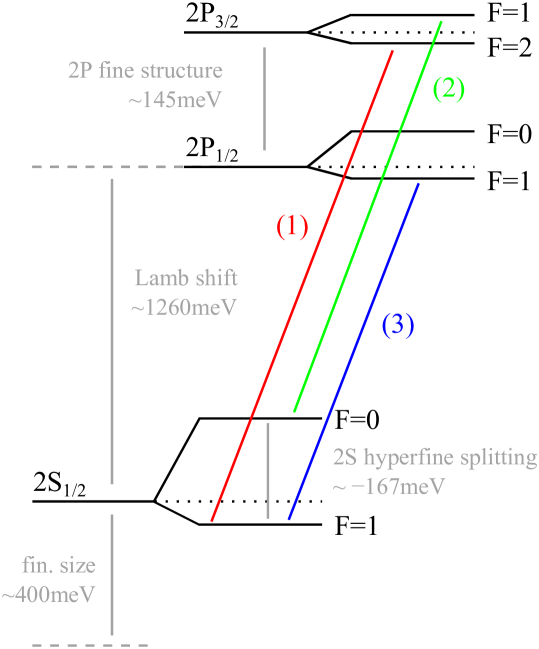
Hydrogen-like light muonic ions, in which one negative muon replaces all the electrons, are extremely sensitive probes of nuclear structure, because the large muon mass increases tremendously the wave function overlap with the nucleus. Using pulsed laser spectroscopy we have measured three 2S-2P transitions in the muonic helium-3 ion ($μ^3$He$^+$), an ion formed by a negative muon and bare helium-3 nucleus. This allowed us to extract the Lamb shift $E(2P_{1/2}-2S_{1/2})= 1258.598(48)^{ m exp}(3)^{ m theo}$ meV, the 2P fine structure splitting $E_{ m FS}^{ m exp} = 144.958(114)$ meV, and the 2S-hyperfine splitting (HFS) $E_{ m HFS}^{ m exp} = -166.495(104)^{ m exp}(3)^{ m theo}$ meV in $μ^3$He$^+$. Comparing these measurements to theory we determine the rms charge radius of the helion ($^3$He nucleus) to be $r_h$ = 1.97007(94) fm. This radius represents a benchmark for few nucleon theories and opens the way for precision tests in $^3$He atoms and $^3$He-ions. This radius is in good agreement with the value from elastic electron scattering, but a factor 15 more accurate. Combining our Lamb shift measurement with our earlier one in $μ^4$He$^+$ we obtain $r_h^2-r_α^2 = 1.0636(6)^{ m exp}(30)^{ m theo}$ fm$^2$ to be compared to results from the isotope shift measurements in regular He atoms, which are however affected by long-standing tensions. By comparing $E_{ m HFS}^{ m exp}$ with theory we also obtain the two-photon-exchange contribution (including higher orders) which is another important benchmark for ab-initio few-nucleon theories aiming at understanding the magnetic and current structure of light nuclei.
研究の動機と目的
- μ子的ヘリウム-3イオンの3つの 2S-2P 遷移を測定し、ラームシフト、2S 超微細分、2P 精細構造の主要エネルギー分割を抽出する。
- 実験的ラームシフトを理論と比較してヘリオンの RMS 電荷半径を抽出する。
- 軽原子核における二重光子交換寄与および核構造効果をベンチマークする。
提案手法
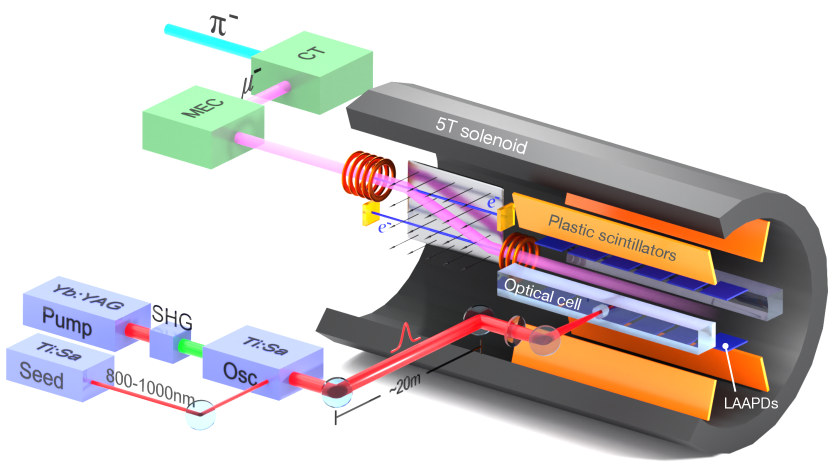
- 低圧の3He標的内でkeV級ミュオンを停止させ、5 Tソレノイド内に μonic He+ イオンを形成する。
- パルス状レーザー分光を多重パス光学キャビティと組み合わせて、約850–940 nmで2S→2P遷移を励起する。
- レーザー照射と時相一致させて、2P→1S脱励起に伴う8 keV Kα X線を検出し共鳴を特定する。
- 飽和とレーザーエネルギー変動を補正したライン形状フィットから遷移周波数を抽出する。
- 更新された2P準位理論と2P中心値定義を用いて、測定されたエネルギー差をE_LS, E_HFS, E_FSに関連付ける方程式系を解く。
実験結果
リサーチクエスチョン
- RQ13つの測定遷移から推定される μonic 3He+ のラームシフト E_LS はいくらか?
- RQ2データから抽出された2S超微細分割 E_HFS と2P精細分割 E_FS はいくらか?
- RQ3最新理論と組み合わせたとき E_LS から得られるヘリオン電荷半径 r_h は?
- RQ4測定された E_HFS は二重光子交換(2PE)および高次の核構造寄与をどのように制約するか?
- RQ5結果は弾性電子散乱および核理論予測とどう比較されるか?
主な発見
- r_h = 1.97007(94) fm、ラームシフトを実験値と理論値の入力から導出。
- E_LS^exp = 1258.598(48) meV および E_HFS^exp = -166.496(104) meV は理論と組み合わせた後、E_FS^exp = 144.958(114) meV。
- 測定された E_FS^exp は理論と一致する: 144.979(5) meV、2P準位理論を支持。
- 同位体シフトに基づく量 r_h^2 - r_alpha^2 = 1.0636(6)(30) fm^2、 μonic 3He+ と μonic 4He+ データを組み合わせた結果。通常の He 原子における Amsterdam 結果に対して 3.6 シグマの差異がある。
- この結果は従来のエラスティック散乱による測定より約15倍の精度でヘリオン半径を向上させ、その値と一致する。
より良い研究を、今すぐ始めましょう
論文設計から論文執筆まで、研究時間を劇的に削減しましょう。
クレジットカード登録不要
このレビューはAIが作成し、人間の編集者が確認しました。