
[論文レビュー] The Herschel Virgo Cluster Survey. XVII. SPIRE point-source catalogs and number counts
本論文は、タイムラインベースの光度測定とガウス分布源の差し引きを用いた反復的源抽出法を用いて、ハーシェル・バーヴォ・クラスター調査におけるSPIREの250、350、500 µm波長での独立した3つの点源カタログを提示する。カタログは200 mJy未塔の数密度が急激に増加する傾向を示しており、これは微弱なサブミリ波長銀河における強い進化を示唆する。理論的モデルは、短波長領域のレイリー=ジェーンズスペクトルエネルギー分布(SED)の不完全なモデル化のため、明るいfluxesで性能を発揮できない。
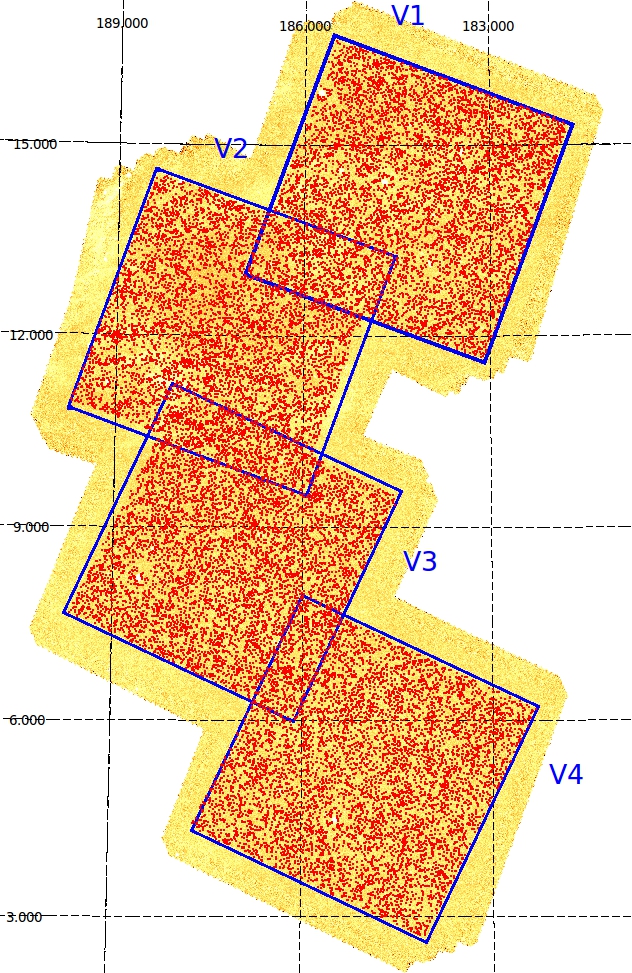
We present three independent catalogs of point-sources extracted from SPIRE images at 250, 350, and 500 micron as a part of the Herschel Virgo Cluster Survey (HeViCS). The source positions are determined by estimating the likelihood to be a real source for each peak on the maps and the flux densities are estimated using the sourceExtractorTimeline, a timeline-based point source fitter. Afterwards, each source is subtracted from the maps, removing a Gaussian function in every position with the full width half maximum equal to that estimated in sourceExtractorTimeline. This procedure improves the robustness of our algorithm in terms of source identification. The HeViCS catalogs contain about 52000, 42200, and 18700 sources selected at 250, 350, and 500 micron above 3sigma and are ~ 75%, 62%, and 50% complete at flux densities of 20 mJy at 250, 350, 500 micron, respectively. We then measured source number counts at 250, 350, and 500 micron and we also cross-correlated the catalogs with the Sloan Digital Sky Survey to investigate the redshift distribution of the nearby sources. From this cross-correlation, we select ~2000 sources with reliable fluxes and a high signal-to-noise ratio, finding an average redshift z~0.3+/-0.22. The number counts at 250, 350, and 500 micron show an increase in the slope below 200 mJy, indicating a strong evolution in number of density for galaxies at these fluxes. In general, models tend to overpredict the counts at brighter flux densities, underlying the importance of studying the Rayleigh-Jeans part of the spectral energy distribution to refine the theoretical recipes of the models. Our iterative method for source identification allowed the detection of a family of 500 micron sources that are not foreground objects belonging to Virgo and not found in other catalogs.
研究の動機と目的
- バーヴォークラスター領域のハーシェルSPIREマップから、信頼性が高く、完全でかつ正確な点源カタログを生成すること。
- 250、350、500 µmにおける源の数密度を測定し、サブミリ波長銀河の進化を調査すること。
- 人工源の注入と順列交換法を用いて、カタログの信頼性と完全性を評価すること。
- SDSSと照合して赤方偏移分布を特定し、光学的に検出されたか否かの集団を区別すること。
- 観測された数密度と比較して、半アナリティカルモデルの性能を評価し、SEDモデル化の不一致を同定すること。
提案手法
- SourceExtractorSussextractorタスクを用いた反復的ピーク尤度推定による源検出。
- タイムラインベースの点源フィッターであるsourceExtractorTimelineを用いた光度測定。この手法は源プロファイルをガウス関数でモデル化する。
- 検出された各源の位置でガウス関数を差し引くことで、源の混雑を低減し、より微弱な源の検出を向上させる。
- タイムラインに人工源を注入し、回復率を測定することで、完全性と光度精度を評価。
- 偽検出率を推定するために順列交換法を用いてカタログの信頼性を評価。
- SDSS DR10との相関照合により、一部の源に光学的対応物と赤方偏移を割り当てる。
実験結果
リサーチクエスチョン
- RQ1バーヴォークラスター領域におけるSPIRE点源カタログの250、350、500 µmでの完全性と信頼性はどの程度か?
- RQ2サブミリ波長源の数密度はSPIREバンド全体でどのように進化するのか?また、銀河進化に関する何を明らかにするか?
- RQ3検出された源の赤方偏移分布はどのようなものか?光学的に検出されたとされない集団にどのように分かれるか?
- RQ4現在の半アナリティカルモデルはなぜ明るいfluxesで観測された数密度を再現できないのか?
- RQ5SEDのレイリー=ジェーンズ領域が、観測された数密度とモデルの不一致にどの程度寄与しているか?
主な発見
- 250、350、500 µmでの3σ以上の源はそれぞれ約52,000、42,200、18,700個であり、それぞれ20 mJyで完全性が約75%、62%、50%に達する。
- 数密度は200 mJy未塔で勾配が急になる傾向を示しており、微弱なサブミリ波長銀河の数密度における強い進化を示唆する。
- 250 µmから長波長にかけて数密度の勾配が急になる傾向があり、高赤方偏移で活発に星形成が進行する銀河の寄与が増加していることを示唆する。
- 40 mJy未塔では、混雑ノイズのため数密度が平坦化し減少し、非常に微弱なfluxesでの信頼できる源検出が制限される。
- モデルは明るいfluxesで一貫して観測された数密度を過剰に予測しており、理論的フレームワークにおけるレイリー=ジェーンズSEDモデル化の改善が求められる。
- SDSSに光学的対応物がない源は、光学的対応物がある源よりも速やかに進化しており、それらのSEDは高い赤方偏移(z ~ 0.3 ± 0.22)と冷却されたダスト温度と整合的である。
より良い研究を、今すぐ始めましょう
論文の読解から最終レビューまで、研究時間を劇的に削減しましょう。
クレジットカード登録不要
このレビューはAIが作成し、人間の編集者が確認しました。