
[論文レビュー] The hot circumgalactic medium in the eROSITA All-Sky Survey I. X-ray surface brightness profiles
本論文は、eROSITA eRASS:4 データのスタッキングを用いて、銀河系質量およびそれ以上の中心銀河の周囲にある熱い circum-galactic medium を virial radius まで検出・特徴づけ、AGN/XRB 汚染をモデル化して減算する。
The circumgalactic medium (CGM) provides the material needed for galaxy formation and influences galaxy evolution. The hot ($T>10^6K$) CGM is poorly detected around galaxies with stellar masses ($M_*$) lower than $3 imes10^{11}M_\odot$ due to the low surface brightness. We used the X-ray data from the first four SRG/eROSITA All-Sky Surveys (eRASS:4). Based on the SDSS spectroscopic survey and halo-based group finder algorithm, we selected central galaxies with spectroscopic redshifts of $z_{ m spec}<0.2$ and stellar masses of $10.0<\log(M_*/M_\odot)<11.5$ (85,222 galaxies) -- or halo masses of $11.5<\log(M_{ m 200m}/M_\odot)<14.0$ (125,512 galaxies). By stacking the X-ray emission around galaxies, masking the detected X-ray point sources and carefully modeling the X-ray emission from the unresolved active galactic nuclei (AGN) and X-ray binaries (XRB), we obtain the X-ray emission from the hot CGM. We detected the X-ray emission around MW-mass and more massive central galaxies extending up to the virial radius ($R_{ m vir}$). We used a $β$ model to describe the X-ray surface brightness profile and found $β=0.43^{+0.10}_{-0.06}\,(0.37^{+0.04}_{-0.02})$ for MW-mass (M31-mass) galaxies.We estimated the baryon budget of the hot CGM and obtained a value that is lower than the prediction of $Λ$CDM cosmology, indicating significant gas depletion in these halos. We extrapolated the hot CGM profile measured within $R_{ m vir}$ to larger radii and found that within $\approx 3 R_{ m vir}$, the baryon budget is close to the $Λ$CDM cosmology prediction. Our results set a firm footing for the presence of the hot CGM around such galaxies. These measurements constitute a new benchmark for galaxy evolution models and possible implementations of feedback processes therein.
研究の動機と目的
- 周囲銀河圏物質を大きなバリオン貯蔵庫として研究する動機づけと、銀河進化におけるその役割の理解。
- MW質量およびそれ以上の中心銀河の周囲の熱い CGM の X 線表面輝度プロファイルを、eROSITA 全天測 Survey データを用いて測定する。
- CGM 発光を AGN および X 緦子(X-ray binaries)から分離する、堅牢なスタッキングとマスキングの枠組みを構築・検証する。
- スタッキング解析における衛星汚染を最小化するために、慎重に定義された中心銀河サンプルと孤立銀河サンプルを構築する。
提案手法
- 0.5–2 keV 帯で、最初の4回の eROSITA 全天測調査(eRASS:4)からの X 線データをスタッキングする。
- 各銀河について物理的距離キューブを作成し、検出された X 線源をマスクし、マスク領域と吸収の補正を行う。
- 分解能未解決の AGN および X 線バイナリからの残存発光をモデル化して、熱い CGM 発光を分離する。
- 得られた表面輝度プロファイルを beta-model でフィットし、eROSITA の PSF と畳み込み、パラメータ(S_X,0, β, r_c)を推定するために MCMC を用いる。
- スタッキングの Poisson統計とジャックナイフ再サンプリングによって不確かさを推定する。
実験結果
リサーチクエスチョン
- RQ1MW-mass およびそれより大きい中心銀河の virial radius までの熱い CGM の平均 X 線表面輝度プロファイルはどうなるか?
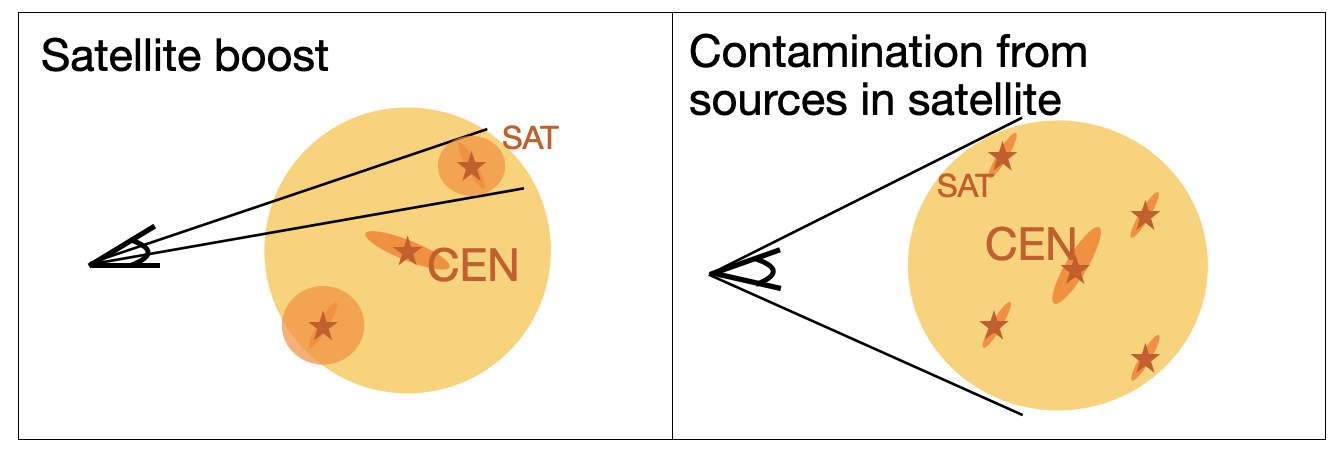
- RQ2分解不能な AGN/XRB 汚染と衛星銀河がスタッキング測定にどのようなバイアスをもたらすか、そしてそれをどのように緩和できるか?
- RQ3熱い CGM を表す最良のフィット β-model パラメータは何で、それはその構造をどう示唆するか?
- RQ4MW-mass およびそれ以上の系の熱い CGM の推定バリオン予算はどれくらいで、ΛCDM予測とどう比較されるか?
主な発見
- MW-mass およびそれより大きい中心銀河の virial radius(R_vir)までにおける熱い CGM からの拡張X線放射の有意な検出。
- MW-mass 銀河: S_X,0 ≈ 3.1×10^35 erg s^-1 kpc^-2, β ≈ 0.42; M31-mass 銀河: S_X,0 ≈ 1.3×10^36 erg s^-1 kpc^-2, β ≈ 0.37; 高質量ビン(log M_* = 11.25–11.50): S_X,0 ≈ 6.3×10^36 erg s^-1 kpc^-2, β ≈ 0.35。
- 有意性のレベル: ≈12.3σ for M31-mass and ≈8.1σ for MW-mass within R_vir; ≈4.5σ (MW) and ≈3.1σ (M31) within 0.5–1 R_vir。
- R_vir まで拡張放射が検出され、MW-mass およびそれ以上の銀河周囲に熱い CGM が存在する確かな根拠を提供する。
- 孤立銀河は、環境を考慮した後、中心銀河と比較して表面輝度プロファイルに顕著な差を示さない。

より良い研究を、今すぐ始めましょう
論文設計から論文執筆まで、研究時間を劇的に削減しましょう。
クレジットカード登録不要
このレビューはAIが作成し、人間の編集者が確認しました。