
[論文レビュー] The interstellar medium conditions of a strong Lya emitter at z = 8.279 revealed by JWST: a robust LyC leaker candidate at the Epoch of Reionization
JWSTのNIRSpecおよびNIRCamデータを用いて、z = 8.279に位置する強力なLyα発光体GN-z8-LAEを分析した本研究では、f_esc > 14%の明確なLyman連続体(LyC)漏れ候補であることが判明した。この銀河は極めて高い星形成および星の質量表面密度を示し、硬い電離場と稀なNIII]発光線を有しており、これは超太陽系の窒素含有量を示し、再イオン化時代における初期の再イオン化主因である可能性を裏付けている。
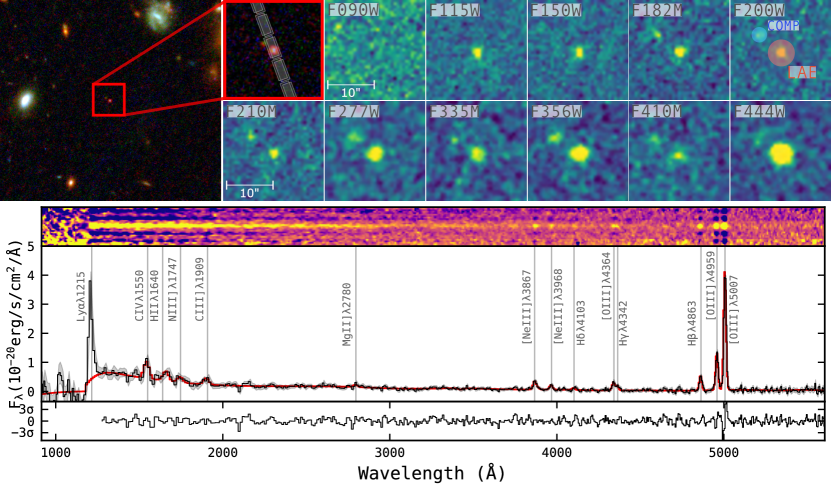
Making use of JWST NIRSpec and NIRCam data, we conduct a detailed analysis of the spectroscopic and photometric properties of GN-z8-LAE, a strong Lya emitter at z=8.279. Our goal is to investigate the interstellar medium (ISM) physical conditions that enable the Lya detection in this source at the Epoch of Reionization (EoR) and scrutinize GN-z8-LAE as an early reionizer. In broad agreement with previous results, we find that GN-z8-LAE is a young galaxy (age ~ 10 Myr) with a low stellar mass (M* ~ 10^7.66 Msun), significantly lower than those of most Lya emitters known at similarly high redshifts. The derived stellar mass and star formation rate surface densities are 355 Msun/pc^2 and 88 Msun/yr/kpc^2, respectively. Our spectral analysis indicates that: the Lya line peak has a small velocity offset 133+-72 km/s with respect to the galaxy systemic redshift; CIV] / CIII] ~ 3.3; the ISM is characterized by a hard ionization field, although no signature of AGN is present. Moreover, we report the presence of NIII]1750 emission with super-solar N abundance, which makes GN-z8-LAE one of the first known cases of a simultaneous strong Lya and nitrogen emitter at the EoR. Based on all these properties, we apply a wide range of methods to constrain the absolute Lyman continuum escape fraction of GN-z8-LAE, and find that it is >14% in all cases. Therefore, we conclude that GN-z8-LAE is a robust candidate for a Lyman continuum (LyC) leaker at the EoR which is being caught at the moment of efficiently reionizing its surrounding medium.
研究の動機と目的
- 再イオン化時代(EoR)に存在する高赤方偏移銀河におけるLyα発光を可能にする星間物質(ISM)状態を調査すること。
- GN-z8-LAEがLyman連続体(LyC)の漏れに適した強力な候補であるかどうかを評価すること。これは、宇宙の再イオン化を駆動するための重要な要件である。
- 星の質量、星形成率表面密度、および電離場の硬さといったGN-z8-LAEの物理的性質を特徴づけること。
- 高赤方偏移銀河における希少なNIII] λ1749–1753発光線の起源を探索し、金属量および星風の影響を考察すること。
- 複数の間接的手法を用いてLyC漏れ率(f_esc)を決定し、再イオン化への潜在的寄与を確実に制約すること。
提案手法
- JWSTのNIRSpecおよびNIRCamデータを用いて、Lyα、CIV、CIII]、およびNIII]線を含む発光線特性を測定する深さのある分光分析を実施した。
- 系統的赤方偏移からのLyα線速度オフセット(Δv = 133 ± 72 km/s)を計算し、共鳴散乱およびISMの幾何学的配置を評価した。
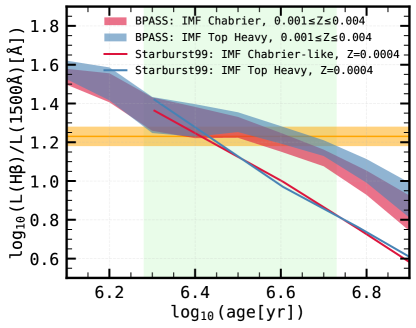
- BAGPIPESコードを用いたスペクトルエネルギー分布(SED)フィッティングとダスト減光モデルを用いて、星の質量(M* ≈ 10^7.66 M☉)および星形成率(SFR)を推定した。
- 表面密度を計算した:Σ_M* ≈ 355 M☉/pc²およびΣ_SFR ≈ 88 M☉ yr⁻¹ kpc⁻²。これにより、銀河のコンパクトさと星形成の強度を評価した。
- CIV/CIII]比、[OIII]/[OII]比、Lyα線幅、およびUV傾き(β ≈ -2.2 から -2.7)といった複数の間接的指標を用いてf_escを制約した。
- CIV/CIII]比(≈3.3)とNIII]の検出を用いて、それぞれ電離場の硬さと窒素過剰を推定した。
実験結果
リサーチクエスチョン
- RQ1GN-z8-LAEにおけるz = 8.279で強いLyα発光を可能にする星間物質(ISM)状態は何か?
- RQ2GN-z8-LAEにおけるLyC漏れ率(f_esc)はどの程度であり、再イオン化を駆動するのに必要な閾値を超えているか?
- RQ3この高赤方偏移銀河でNIII] λ1749–1753発光線が検出された原因は何か?金属量および電離状態にどのような含意があるか?
- RQ4GN-z8-LAEが示す星の質量および星形成率の極めて高い表面密度は、LyC漏れ状態とどのように関係しているか?
- RQ5複数の間接的指標が、再イオン化時代におけるGN-z8-LAEが明確なLyC漏れ候補であることを一貫して支持できるか?
主な発見
- GN-z8-LAEは年齢が約10 Myrの若さで、M* ≈ 10^7.66 M☉の低質量であり、同赤方偏移の他のLyα発光体と比較してより小さく、質量が小さい。
- この銀河は高い表面密度を示しており、Σ_M* ≈ 355 M☉/pc²およびΣ_SFR ≈ 88 M☉ yr⁻¹ kpc⁻²であり、z ≈ 8における最もコンパクトで強力な星形成系の一つに位置する。
- Lyα線のピークは系統的赤方偏移からわずかΔv = 133 ± 72 km/sのオフセットであり、共鳴散乱が最小限で、LyC漏れに有利な幾何的配置であることを示している。
- CIV/CIII]線比は ≈3.3であり、AGNの兆候が見られないにもかかわらず、硬い電離場を示しており、LyC漏れ候補に一致する。
- NIII] λ1749–1753発光線の検出は、超太陽系の窒素含有量を示しており、推定された亜太陽系金属量とは整合せず、極めて高い表面密度またはWolf-Rayet星との関連が考えられる。
- 適用されたすべての手法がf_esc > 14%を示しており、GN-z8-LAEは再イオン化時代においてこれまでに発見された中で最も明確なLyC漏れ候補であると結論づけられた。
この論文を読む
Nubintのビューアで原文を開き、読みながら気になる箇所をすぐに質問できます。
Nubintでこの論文を読むこのレビューはAIが論文の原文をもとに作成しました。引用する前に原文をご確認ください。