
[論文レビュー] The JWST Early Release Science Program for Direct Observations of Exoplanetary Systems II: A 1 to 20 Micron Spectrum of the Planetary-Mass Companion VHS 1256-1257 b
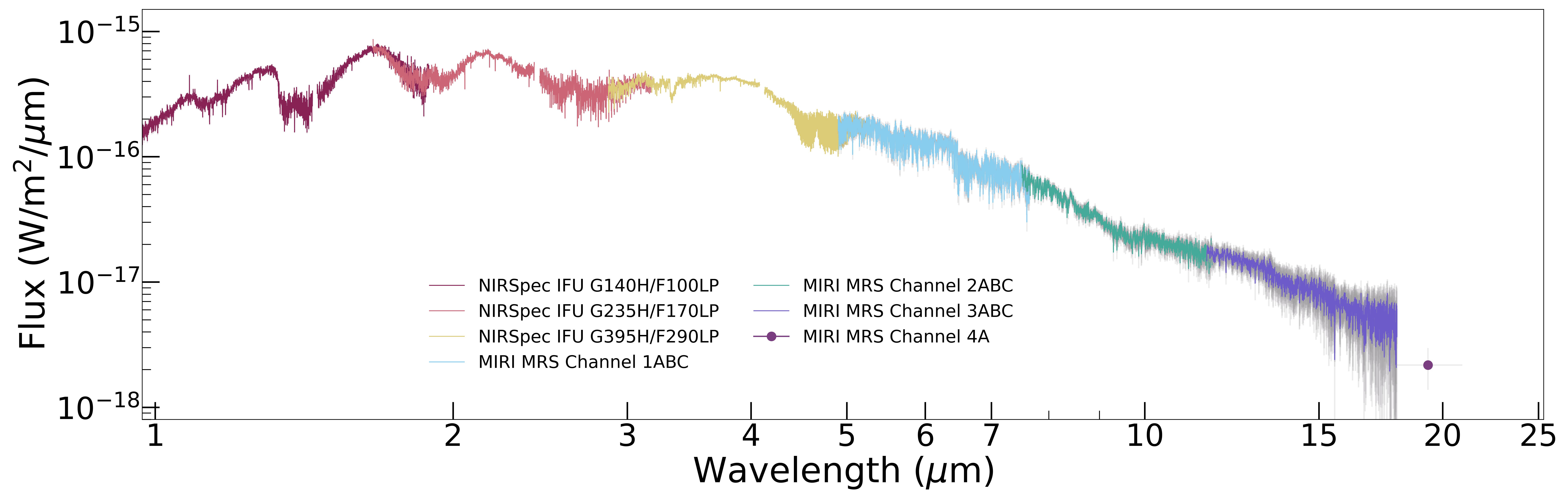
本論文は、ジェームズ・ウェッブ宇宙望遠鏡(JWST)のNIRSpec IFUおよびMIRI MRS機器を用いて、初期公開科学プログラム中に取得した、惑星質量準天体VHS 1256-1257 bの最初の中分解能1–20 μmスペクトルを提示する。データは、水、メタン、一酸化炭素、二酸化炭素、および顕著なケイ酸塩特徴を示しており、不均一なケイ酸塩雲と強い大気混合を示しており、最良の適合モデルでは二重の厚い雲デッキ、低表面重力(log g = 4.5)、効果的温度1100 Kを必要としている。
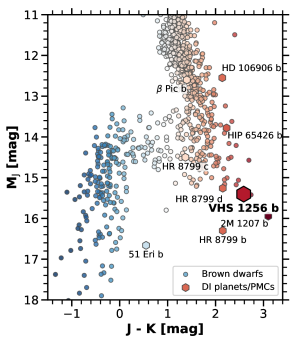
We present the highest fidelity spectrum to date of a planetary-mass object. VHS 1256 b is a $<$20 M$_\mathrm{Jup}$ widely separated ($\sim$8\arcsec, a = 150 au), young, planetary-mass companion that shares photometric colors and spectroscopic features with the directly imaged exoplanets HR 8799 c, d, and e. As an L-to-T transition object, VHS 1256 b exists along the region of the color-magnitude diagram where substellar atmospheres transition from cloudy to clear. We observed VHS 1256~b with extit{JWST}'s NIRSpec IFU and MIRI MRS modes for coverage from 1 $μ$m to 20 $μ$m at resolutions of $\sim$1,000 - 3,700. Water, methane, carbon monoxide, carbon dioxide, sodium, and potassium are observed in several portions of the extit{JWST} spectrum based on comparisons from template brown dwarf spectra, molecular opacities, and atmospheric models. The spectral shape of VHS 1256 b is influenced by disequilibrium chemistry and clouds. We directly detect silicate clouds, the first such detection reported for a planetary-mass companion.
研究の動機と目的
- JWSTのNIRSpecおよびMIRI機器を用いて、1–20 μmの波長域でVHS 1256-1257 bの高感度・中分解能スペクトルを取得すること。
- スペクトル解析を通じて、大気組成、雲構造、および垂直混合を、惑星質量準天体としての特徴づけを行うこと。
- ボリオメトリック光度および質量上限を高精度で決定すること。
- 若く低重力の褐色矮星および系外惑星に、非平衡化学と乱流垂直混合を含む大気モデルをテストすること。
- 0.97 μmから19.8 μmまでの詳細な大気モデル化の可能性を示し、将来のJWST観測のベンチマークを確立すること。
提案手法
- JWSTのNIRSpecインテグラルフィールドユニット(IFU)およびMIRIミッドインフラレッド機器(MRS)を用いて、0.97–19.8 μmの波長域で中分解能分光測定を実施した。
- 標準的なJWSTパイプライン手順に加え、拡大源向けの特別なキャリブレーションを用いて、データの低減およびフラックスキャリブレーションを実施した。
- 可変な雲デッキ、混合係数(Kzz)、化学組成を有する大気モデルを用いて、観測スペクトルのフォワードモデリングを実施した。
- ケイ酸塩特徴およびスペクトル形状を再現するために、二層雲モデル(f_sed = 0.6およびf_sed = 1.0)を適合させた。
- 放射線輸送および大気構造モデルを用いて、最良適合スペクトルから効果的温度、表面重力、光度を導出した。
- 光度の不確実性を評価し、log(L_bol/L_sun) = -4.55 ± 0.009を算出し、VHS 1256-1257 bの質量上限は20 M_Jupであると導いた。
実験結果
リサーチクエスチョン
- RQ11–20 μmの波長域において、VHS 1256-1257 bの大気組成は何か? どの分子種が検出可能か?
- RQ2VHS 1256-1257 bの雲構造は何か? 複数の雲デッキは観測スペクトルにどのように影響を与えるか?
- RQ3乱流垂直混合(Kzz)は、この若く低重力の天体の大気化学およびスペクトル特徴にどの程度影響を与えるか?
- RQ4JWST観測から、VHS 1256-1257 bのボリオメトリック光度および質量上限はどの程度高精度で制約できるか?
- RQ5非平衡化学および不均一な雲形成を含むモデルは、観測されたスペクトル特徴を説明できるか?
主な発見
- スペクトルは、水、メタン、一酸化炭素、二酸化炭素の強い吸収特徴および、小さな雲粒子を示す顕著な10 μmケイ酸塩特徴を示している。
- 最良適合大気モデルでは、表面圧力f_sed = 0.6(90%)およびf_sed = 1.0(10%)の二重の厚い雲デッキを必要としており、雲カバレッジの不均一性を示している。
- 導出された効果的温度は1100 K、表面重力はlog(g) = 4.5、半径は1.27 R_Jupであり、若く低重力の天体と整合的である。
- 垂直混合係数Kzzは10^8~10^9 cm² s⁻¹の範囲にあり、より深い大気で混合が強くなる傾向にあり、乱流対流を支持している。
- ボリオメトリック光度は高精度で測定され、log(L_bol/L_sun) = -4.55 ± 0.009であり、VHS 1256-1257 bの質量上限は20 M_Jupであると導かれた。
- モデルは全体的なスペクトル形状を捉えているが、分子吸収特徴の深さをやや低く見積もっており、非平衡化学のフォワードモデリングにおける現在の限界を示唆している。
より良い研究を、今すぐ始めましょう
論文の読解から最終レビューまで、研究時間を劇的に削減しましょう。
クレジットカード登録不要
このレビューはAIが作成し、人間の編集者が確認しました。