
[論文レビュー] The Machine Psychology of Cooperation: Can GPT models operationalise prompts for altruism, cooperation, competitiveness and selfishness in economic games?
tldr: 本研究はGPT-3.5が利他主義、利己主義、および関連特性を自然言語のプロンプトとして説明し、それを反復的囚人のジレンマシミュレーションにおける協調的または競合的な行動へ翻訳できるかを検証する。
We investigated the capability of the GPT-3.5 large language model (LLM) to operationalize natural language descriptions of cooperative, competitive, altruistic, and self-interested behavior in two social dilemmas: the repeated Prisoners Dilemma and the one-shot Dictator Game. Using a within-subject experimental design, we used a prompt to describe the task environment using a similar protocol to that used in experimental psychology studies with human subjects. We tested our research question by manipulating the part of our prompt which was used to create a simulated persona with different cooperative and competitive stances. We then assessed the resulting simulacras' level of cooperation in each social dilemma, taking into account the effect of different partner conditions for the repeated game. Our results provide evidence that LLMs can, to some extent, translate natural language descriptions of different cooperative stances into corresponding descriptions of appropriate task behaviour, particularly in the one-shot game. There is some evidence of behaviour resembling conditional reciprocity for the cooperative simulacra in the repeated game, and for the later version of the model there is evidence of altruistic behaviour. Our study has potential implications for using LLM chatbots in task environments that involve cooperation, e.g. using chatbots as mediators and facilitators in public-goods negotiations.
研究の動機と目的
- 社会的ジレンマにおける自然言語描述を行動方針に翻訳できるかをLLMが検証する。
- LLMの模擬体を異なるプロンプトで実装した場合の反復的囚人のジレンマにおける協力を評価する。
- 多エージェント設定での出現的協力行動に対するプロンプトベースのペルソナとパートナー戦略の影響を examine する。
提案手法
- GPT-3.5-turboを用いた被験者内デザインで、5つの動機グループ(競争的、利他的、自己中心的、混合、対照)における15の模擬体を自動的にシミュレート。
- predefined payoff matrix(T=7、R=5、P=3、S=0; 2R>T+S)を用いた6ラウンドの反復的囚人のジレンマに参加者が従事。
- 各グループにつき3つのパートナー条件(無条件ディフェクト、無条件協力、タイ・フォー・ティット変種)と3つのプロンプト変種を適用。
- 正規表現で選択肢を抽出し、総得点と協力度を算出することで1800回のPDラウンドからデータを収集。
- 付録にはプロンプトとトランスクリプトを提供。コードはリポジトリに公開。
実験結果
リサーチクエスチョン
- RQ1LLMは利他主義や利己主義を自然言語プロンプトとして説明し、それに対応する協調的または競合的な行動を実行可能化できるか。
- RQ2異なるプロンプトによって誘発されたペルソナ(利他的、競争的、自己中心的、混合)が、反復的非ゼロ和ゲームにおける協力にどのように影響するか。
- RQ3LLM生成のエージェントはパートナーの行動(互恵性)に基づいて協力を適応するか、それとも初期プロンプトを主に反映するか。
- RQ4パートナー戦略(無条件、タイ・フォー・ティット)が、プロンプトで実体化されたエージェントの出現行動をどう形成するか。
主な発見
| count | mean | std | min | 25% | 50% | 75% | max | |
|---|---|---|---|---|---|---|---|---|
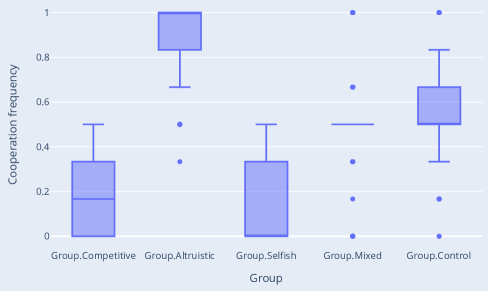
| Group.Altruistic | 360.00 | 0.90 | 0.17 | 0.33 | 0.83 | 1.00 | 1.00 | 1.00 |
| Group.Competitive | 360.00 | 0.14 | 0.16 | 0.00 | 0.00 | 0.17 | 0.33 | 0.50 |
| Group.Control | 345.00 | 0.53 | 0.24 | 0.00 | 0.50 | 0.50 | 0.67 | 1.00 |
| Group.Mixed | 360.00 | 0.52 | 0.25 | 0.00 | 0.50 | 0.50 | 0.50 | 1.00 |
| Group.Selfish | 360.00 | 0.15 | 0.17 | 0.00 | 0.00 | 0.00 | 0.33 | 0.50 |
- 協力的および競争的性質をエンコードしたプロンプトは、反復的囚人のジレンマにおける協力水準に明確な差を生じさせる。
- 利他主義、競争的、混合、自己中心的な模擬体は協力パターンに差を示し、プロンプトの行動への部分的翻訳を示唆。
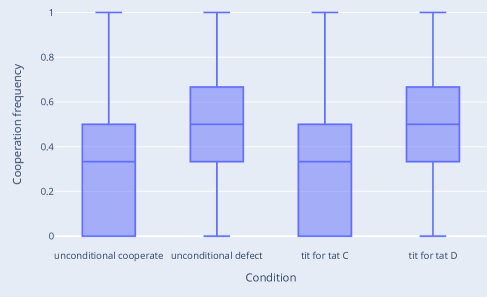
- 対照群は人間的PD行動と一致する場合もあるが、全体としてはパートナーの互恵性に基づく戦略適応には限界がある。
- ディフェクターとの協力増加や協力者との協力減少といった結果が観察され、人間の社会規範の一般化には限界があることを示唆。
- GPT-3.5は利他主義/利己主義をある程度実現できるが、互恵性への微妙な適応には限界がある。
より良い研究を、今すぐ始めましょう
論文設計から論文執筆まで、研究時間を劇的に削減しましょう。
クレジットカード登録不要
このレビューはAIが作成し、人間の編集者が確認しました。