
[論文レビュー] The massive relic galaxy NGC 1277 is dark matter deficient. From dynamical models of integral-field stellar kinematics out to five effective radii
本研究は深度積分場データに対してJeans異方性モデリングを用い、NGC 1277 が5つの有効半径内で暗黒物質がごく僅かであることを示し、LCDMの期待に挑戦する。
According to the $Λ$CDM cosmology, present-day galaxies with stellar masses $M_\star>10^{11} { m M}_\odot$ should contain a sizable fraction of dark matter within their stellar body. Models indicate that in massive early-type galaxies (ETGs) dark matter should account for $\sim60\%$ of the dynamical mass within five effective radii ($5 R_{ m e}$). Most massive ETGs have been shaped through a two-phase process: the rapid growth of a compact core was followed by the accretion of an extended envelope through mergers. The exceedingly rare galaxies that have avoided the second phase, the so-called relic galaxies, are thought to be the frozen remains of the massive ETG population at $z\gtrsim2$. The best relic galaxy candidate discovered to date is NGC 1277, in the Perseus cluster. We used deep integral field GCMS data to revisit NGC 1277 out to an unprecedented radius of 6 kpc (corresponding to $5 R_{ m e}$). By using Jeans anisotropic modelling we find a negligible dark matter fraction within $5 R_{ m e}$ ($f_{ m DM}(5 R_{ m e})<0.05$; two-sigma confidence level), which is in tension with the expectation. Since the lack of an extended envelope would reduce dynamical friction and prevent the accretion of an envelope, we propose that NGC 1277 lost its dark matter very early or that it was dark matter deficient ab initio. We discuss our discovery in the framework of recent proposals suggesting that some relic galaxies may result from dark matter stripping as they fell in and interacted within galaxy clusters. Alternatively, NGC 1277 might have been born in a high-velocity collision of gas-rich proto-galactic fragments, where dark matter left behind a disc of dissipative baryons. We speculate that the relative velocities of $\approx2000 { m km/s}$ required for the latter process to happen were possible in the progenitors of the present-day rich galaxy clusters.
研究の動機と目的
- 5 ReまでのNGC 1277の暗黒物質量分布を深度のある積分場データを用いて評価する。
- 大質量初期型銀河に対するΛCDMの予想とDMフラクションを比較する。
- NGC 1277が通常の二相エンベロープ成長を回避した Relic銀河かどうかを調査する。
- 観測運動を説明するのにDMハローが必要かを動力学モデリングで検証する。
提案手法
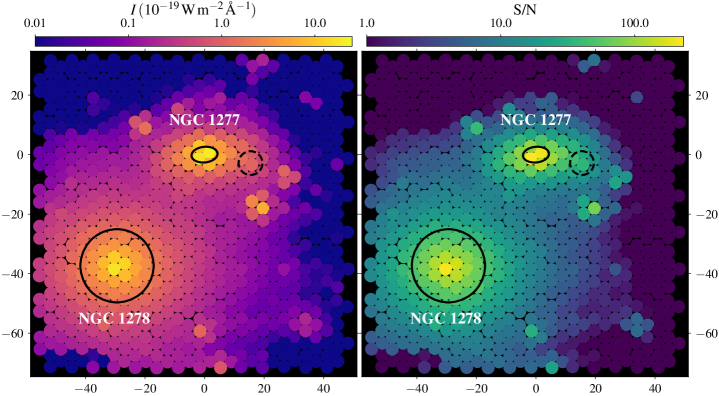
- George and Cynthia Mitchel Spectrograph (GCMS)を用いてNGC 1277とNGC 1278の深部積分場分光を取得し、~5 Re までの恒星運動学をマッピングする。
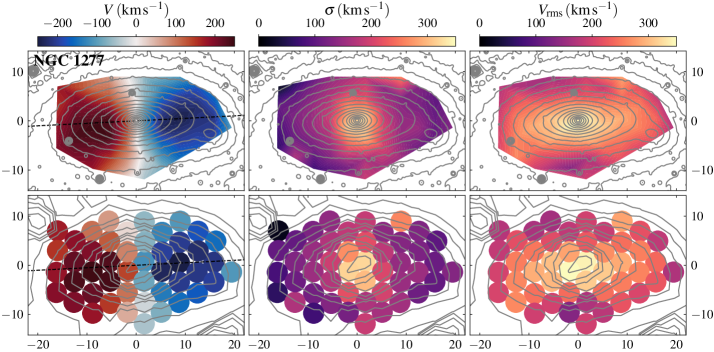
- E-MILESテンプレートを用いたpPXFで恒星運動学を抽出し、V、sigma、V_rmsマップを推定する。
- HST画像からの多ガウス展開(MGE)により光度・質量モデルを構築し、バリオニック分布を追跡する。
- JAM( Jeans anisotropic modelling)を適用して総質量(暗黒物質ハローを含む)を推定し、5 Re内のDMフラクションを導出する。
- 高解像度の内部データ(NIFS、HST)を組み入れて中央ポテンシャルとブラックホール質量を制約し、外部領域のDMへ与える影響を評価する。
- 平坦な宇宙論を採用(H0=71 km/s/Mpc, Omega_m0=0.265)、Perseusの距離(z=0.017195)を物理スケールに用いる。
実験結果
リサーチクエスチョン
- RQ1NGC 1277の5つの有効半径内の暗黒物質フラクションはいくらか?
- RQ2NGC 1277は大半径まで恒星運動学を説明するために拡張DMハローを必要とするか?
- RQ3NGC 1277のDM含有量は巨質ETGに対するLCDM期待とどう比較されるか?
- RQ4観測範囲内でのDM含有量と遺物性(拡張エンベロープの欠如)との整合性は?
- RQ5ブラックホール質量推定と中心質量モデリングが推定DM分布に及ぼす影響は?
主な発見
- f_DM(5 Re) < 0.05 at two-sigma, 5 Re内で暗黒物質がごく僅かであることを示唆。
- NGC 1277は外側の領域で恒星運動学を再現するために拡張DMハローを必要とする要件がほとんどない、あるいは全くない。
- 観測されたDM不足は、巨大ETGに対する1 Re内約15%、5 Re内約60%というLCDMの期待と相矛盾する。
- 遺物性(拡張エンベロープの欠如)は減少したダイナミカル摩擦とエンベロープ成長の説明になり得て、内側領域での低DM枠組みと整合する。
- 早期にDMが剥ぎ取られた、あるいはDM自体が初めから欠如していたというシナリオが提案されており、クラスタ侵入過程や高速形成イベントに関連している可能性がある。
より良い研究を、今すぐ始めましょう
論文設計から論文執筆まで、研究時間を劇的に削減しましょう。
クレジットカード登録不要
このレビューはAIが作成し、人間の編集者が確認しました。