
[論文レビュー] The Media Bias Taxonomy: A Systematic Literature Review on the Forms and Automated Detection of Media Bias
This paper introduces the Media Bias Taxonomy and conducts a systematic literature review of 3,140 papers (2019–2022) on media bias detection, highlighting transformer-based advances and gaps in interdisciplinarity.
The way the media presents events can significantly affect public perception, which in turn can alter people's beliefs and views. Media bias describes a one-sided or polarizing perspective on a topic. This article summarizes the research on computational methods to detect media bias by systematically reviewing 3140 research papers published between 2019 and 2022. To structure our review and support a mutual understanding of bias across research domains, we introduce the Media Bias Taxonomy, which provides a coherent overview of the current state of research on media bias from different perspectives. We show that media bias detection is a highly active research field, in which transformer-based classification approaches have led to significant improvements in recent years. These improvements include higher classification accuracy and the ability to detect more fine-granular types of bias. However, we have identified a lack of interdisciplinarity in existing projects, and a need for more awareness of the various types of media bias to support methodologically thorough performance evaluations of media bias detection systems. Concluding from our analysis, we see the integration of recent machine learning advancements with reliable and diverse bias assessment strategies from other research areas as the most promising area for future research contributions in the field.
研究の動機と目的
- Develop a unified Media Bias Taxonomy to organize concepts and terms across disciplines.
- Summarize computer science contributions to media bias detection and categorize methods.
- Assess datasets and evaluation practices to improve bias detection systems.
- Identify gaps and propose directions for integrating machine learning with social science perspectives.
提案手法
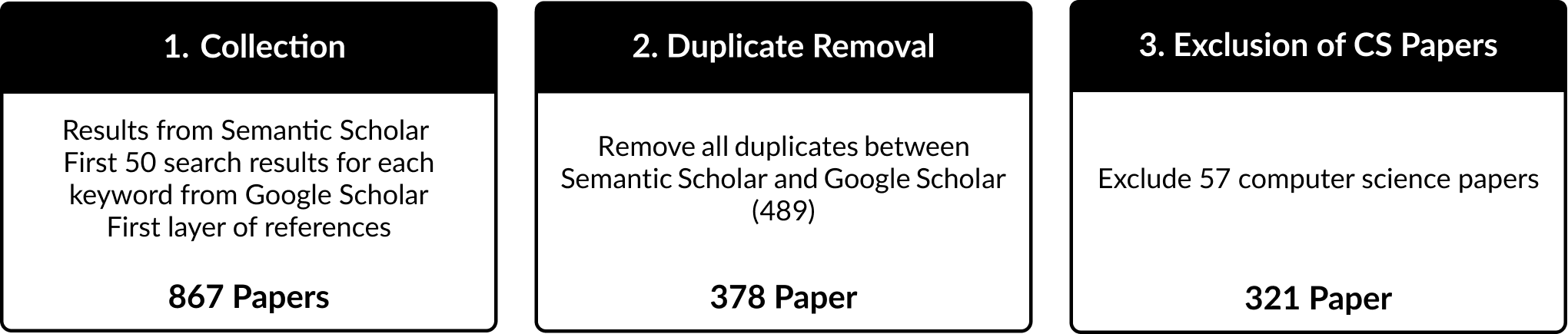
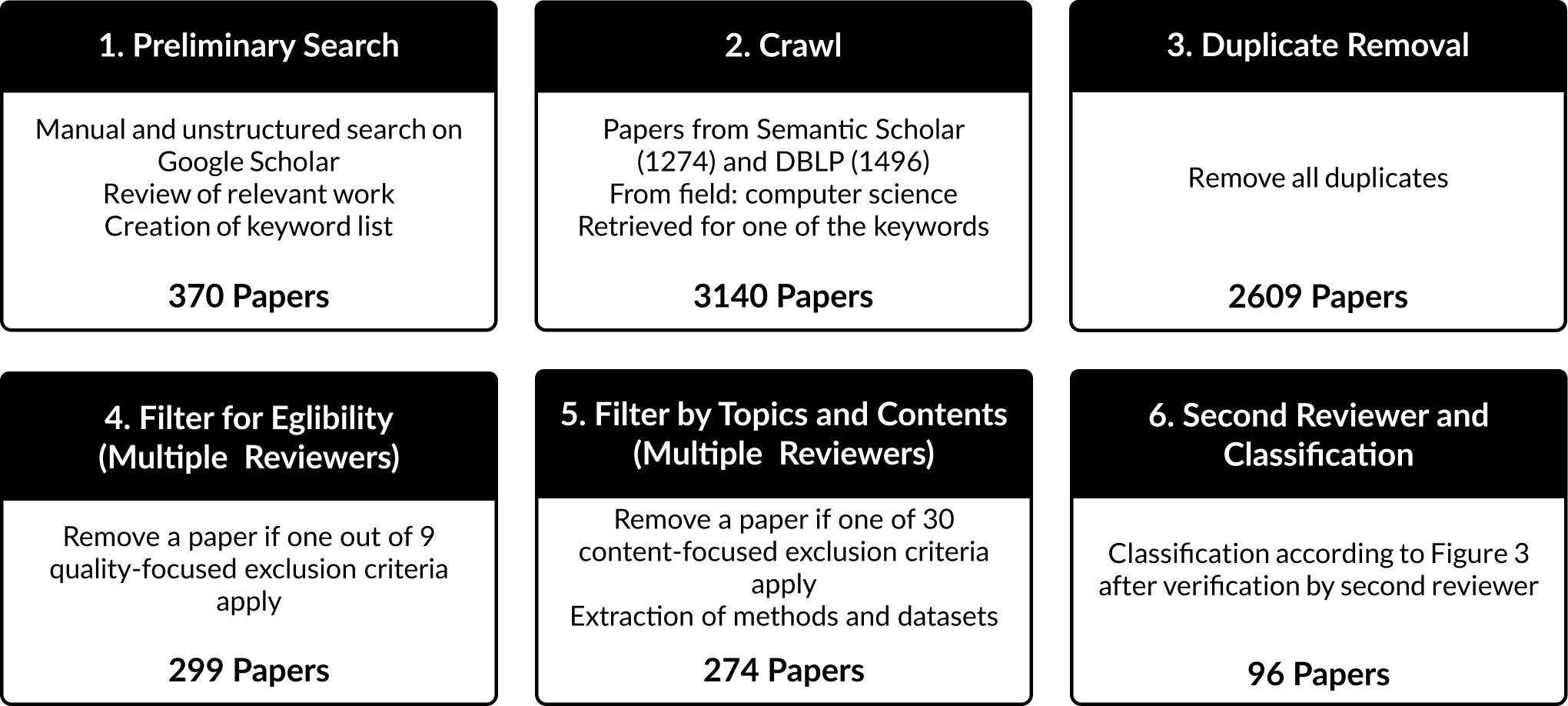
- Use automated, keyword-based literature retrieval from DBLP and Semantic Scholar to collect candidate papers.
- Apply manual screening and multi-stage selection to identify papers that use computer science methods for bias detection.
- Develop and present the Media Bias Taxonomy by consolidating bias concepts across linguistic, contextual, cognitive, and reporting levels.
- Classify computer science methods into six categories, including traditional NLP, simple ML, transformer and non-transformer ML, non-neural, and graph-based approaches.
実験結果
リサーチクエスチョン
- RQ1RQ1: What are the relationships among the various forms of bias in the literature?
- RQ2RQ2: What are the major developments in automated methods to identify media bias?
- RQ3RQ3: What are the most promising CS methods to automatically identify media bias?
- RQ4RQ4: How does social science research approach media bias, and how can it benefit CS research?
主な発見
- Media bias detection is a highly active field with transformer-based classification yielding higher accuracy and finer-grained bias detection.
- There is a lack of interdisciplinarity in existing projects and limited awareness of the full spectrum of bias types, hindering thorough evaluations.
- A need for integrating recent ML advances with reliable, diverse bias assessment strategies from other disciplines.
- The Media Bias Taxonomy links concepts from psychology, linguistics, and sociology with CS methods to support clearer evaluation and comparison.
より良い研究を、今すぐ始めましょう
論文設計から論文執筆まで、研究時間を劇的に削減しましょう。
クレジットカード登録不要
このレビューはAIが作成し、人間の編集者が確認しました。