
[論文レビュー] The more the merrier: SRG/eROSITA discovers two further galaxies showing X-ray quasi-periodic eruptions
本論文は、SRG宇宙望遠鏡搭載のeROSITA X線望遠鏡を用いて、X線準周期的噴出(QPE)を示す2つの新しい銀河、eRO-QPE3およびeRO-QPE4の発見を報告している。研究結果は、eRO-QPE3における減衰する静穏状態の放射度、QPEの中で最も長い周期と最も弱いピーク放射度、eRO-QPE4における一時的な硬めのX線成分といった新たな性質を明らかにし、QPEが極端に質量比の大きい合体に起因するというモデルを支持するとともに、その起源を理解するためにはより大きなサンプルが必要であることを示唆している。
X-ray quasi-periodic eruptions (QPEs) are a novel addition to the group of extragalactic transients. In this work, we report the discovery of two further galaxies showing QPEs, eRO-QPE3 and eRO-QPE4, with the eROSITA X-ray telescope on board the Spectrum Roentgen Gamma observatory. Among the properties in common with those of known QPEs are: the thermal-like spectral shape in eruption (up to $kT\sim110-120$ eV) and quiescence ($kT\sim50-90$ eV) and its evolution during the eruptions (with a harder rise than decay); the lack of strong canonical signatures of active nuclei (from current optical, UV, infrared and radio data); and the low-mass nature of the host galaxies ($\log M_*\approx 9-10$) and their massive central black holes ($\log M_{ m BH}\approx 5-7$). These discoveries also bring several new insights into the QPE population: i) eRO-QPE3 shows eruptions on top of a decaying quiescence flux, providing further evidence for a connection between QPEs and a preceding tidal disruption event; ii) eRO-QPE3 exhibits the longest recurrence times and faintest peak luminosity of QPEs, compared to the known QPE population, excluding a correlation between the two; iii) we find evidence, for the first time, of a transient component that is harder, albeit much fainter, than the thermal QPE spectrum in eRO-QPE4; and iv) eRO-QPE4 displays the appearance (or significant brightening) of the quiescence disk component after the detection of QPEs, supporting its short-lived nature against a preexisting active galactic nucleus. Overall, the newly discovered properties (e.g., recent origin and/or transient nature of the quiescent accretion disk; lack of correlation between eruption recurrence timescales and luminosity) are qualitatively consistent with recent models that identify QPEs as extreme mass-ratio inspirals.
研究の動機と目的
- 初期の数例にとどまらないX線準周期的噴出(QPE)源の既知の集団を拡大すること。
- 新規に検出されたQPEの物理的性質および変動パターンを調査し、形成モデルを制限すること。
- QPEが低質量銀河における潮汐破壊イベントまたは一時的降着プロセスに関連しているかどうかを検討すること。
- QPEを宿す銀河における静穏状態の降着円盤成分の役割とその進化を評価すること。
- 広範なQPE集団における周期スケールと放射度の統計的有意性を評価すること。
提案手法
- SRG宇宙望遠鏡搭載のeROSITA望遠鏡による深さと広域をカバーするX線サーベイを用い、静穏状態の銀河核における周期的X線噴出を検出する。
- XMM-Newton、NICER、Swift-XRT、SALT、ATCAを用いたフォローアップ観測により、X線光曲線およびスペクトル的性質の確認と特徴化を実施する。
- X線光曲線の分析を通じて、周期スケール、ピーク放射度、噴出時および静穏状態におけるスペクトルの進化を測定する。
- X線、可視光、紫外、赤外、電波バンドにおけるスペクトルエネルギー分布を比較し、活動銀河核(AGN)の特徴を除外し、一時的成分を特定する。
- 赤方偏移および宿主銀河の星の質量推定値を用いて、ブラックホール質量を推定し、QPE源の低質量銀河環境を評価する。
- 統計的モデリングを適用し、QPEの周期的パターンと変動形態(不規則および中間的挙動を含む)の評価を実施する。
実験結果
リサーチクエスチョン
- RQ1新たに発見されたQPE源は、既知のQPEと整合するスペクトル的および時間的性質を示しているか?
- RQ2eRO-QPE3における減衰する静穏状態の放射度の証拠から、QPEの発生以前に潮汐破壊イベントが起因した可能性があるか?
- RQ3QPEの周期スケールとピーク放射度には相関があるのか、それともeRO-QPE3が示唆するように相関がないのか?
- RQ4eRO-QPE4で観測されたように、QPE源に一時的で硬めのX線成分が確認できるか?
- RQ5QPE検出後に静穏状態のディスク成分が出現または明るくなることは、降着流の一種の一時的性質を支持するか?
主な発見
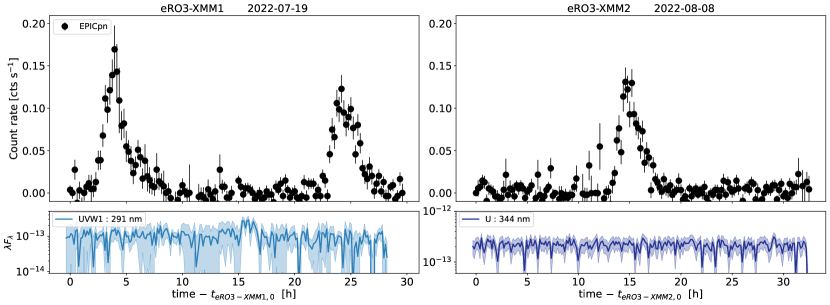
- eRO-QPE3は減衰する静穏状態の放射度を示しており、QPEの発生以前に潮汐破壊イベントが起因した強力な証拠を提供している。
- eRO-QPE3は、既知のQPEの中で最も長い周期スケール(約1.5日)と最も弱いピーク放射度(L_X ~ 1.5 × 10^42 erg s⁻¹)を示しており、周期と放射度の間に相関がないことを示唆している。
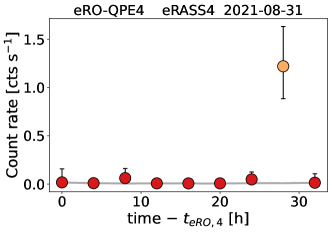
- eRO-QPE4では、噴出時にやや明るく、硬めのX線成分が観測されており、これは柔ららかな熱的スペクトルとは明確に異なり、非熱的または別個の放射メカニズムを示唆している。
- eRO-QPE4の静穏状態の降着円盤は、QPE活動の検出後に顕著に明るくなり、降着流が一時的であるという主張を支持しており、恒久的なAGNとは異なる。
- eRO-QPE4の周期的パターンは、規則的と不規則の間の中間的であるように見え、QPE挙動に厳密な二分法がないのではなく、連続的な変動の連続性を示唆している。
- 2つの新しいQPE源の発見により、サンプルサイズが拡大され、QPEが極端に質量比の大きい合体に起因するという仮説が、現在の理論的モデルと整合することを強化している。
この論文を読む
Nubintのビューアで原文を開き、読みながら気になる箇所をすぐに質問できます。
Nubintでこの論文を読むこのレビューはAIが論文の原文をもとに作成しました。引用する前に原文をご確認ください。