
[論文レビュー] The Next Generation Deep Extragalactic Exploratory Public (NGDEEP) Survey
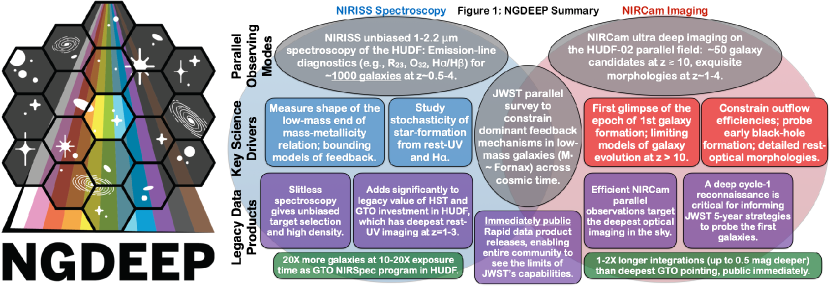
NGDEEP は JWST Cycle 1 の Treasury プログラムで、HUDF の深い NIRISS slitless 分光と HUDF-Par2 の並列 NIRCam 撮像を組み合わせ、0.5 < z < 4 にわたる低質量銀河のフィードバックを研究し、rest-UV LF を z > 12 へ押し上げる。
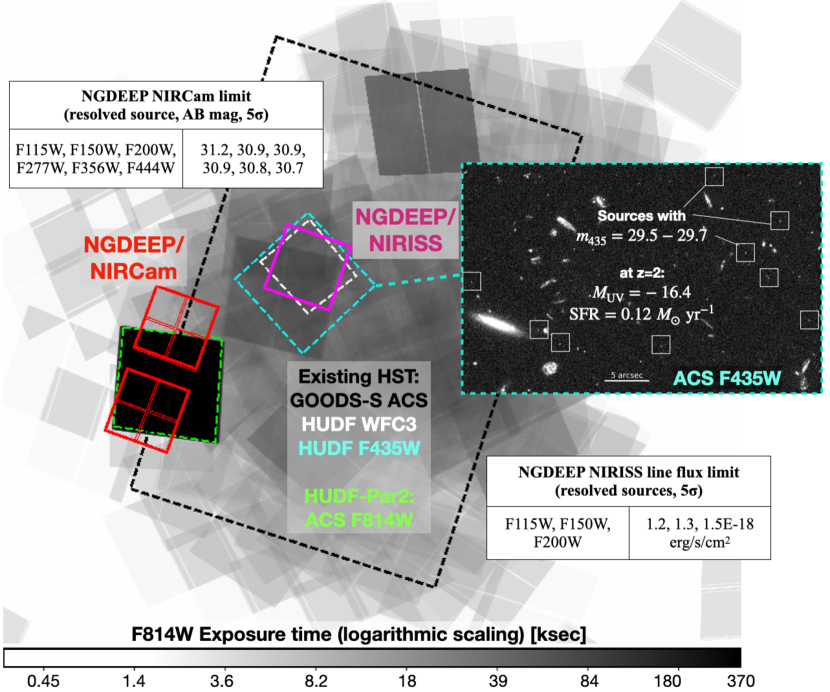
We present the Next Generation Deep Extragalactic Exploratory Public (NGDEEP) Survey, a deep slitless spectroscopic and imaging Cycle 1 JWST treasury survey designed to constrain feedback mechanisms in low-mass galaxies across cosmic time. NGDEEP targets the Hubble Ultra Deep Field (HUDF) with NIRISS slitless spectroscopy (f~1.2e-18 erg/s/cm^2, 5sigma) to measure metallicities and star-formation rates (SFRs) for low-mass galaxies through the peak of the cosmic SFR density (0.512, constraining the slope of the faint-end of the rest-ultraviolet luminosity function. NGDEEP overlaps with the deepest HST ACS optical imaging in the sky: F435W in the HUDF (m=29.6), and F814W in HUDF-Par2 (m=30), making this a premier HST+JWST Deep Field. As a treasury survey, NGDEEP data is public immediately, and we will rapidly release data products and catalogs in the spirit of previous deep field initiatives. In this paper we present the NGDEEP survey design, summarize the science goals, and detail plans for the public release of NGDEEP reduced data products.
研究の動機と目的
- 宇宙論史を通じた低質量銀河のフィードバック機構を、深いスリットレス分光から金属量とSFRを測定して制約する。
- 質量-金属量関係(MZR)の低質量端と z ~ 0.5–4 における redshift evolution を特徴づける。
- 深い NIRCam 撮像を並列フィールドで行い z > 9–15 の rest-UV 光度関数の末端を探る。
- 公開データおよび宝物データリリースを活用して、コミュニティ全体の深部 JWST 科学を実現する。
提案手法
- NGDEEP-NIS(NIRISS WFSS in HUDF)で、>1000 個の銀河に対して ~1.2–1.5 × 10^-18 erg s^-1 cm^-2 (5σ) の複数の発光線を検出可能な領域で分光を行う。
- NGDEEP-NRC(NIRCam parallel imaging in HUDF-Par2)で、六つのフィルターを介して約1–5 μm の範囲で 5σ 深さ 30.6–30.9 AB mag を達成。
- 分光系の汚染モデリングと線同定を改善するため、二つの NIRISS グリズム方位と約3 度ずれた二つの位置角を採用。
- 端から端までのシミュレーションと JWST ETC ベースの深度予測で、発光線数と連続体の限界を予測。
- 深部分野の既存実績に倣った迅速なプロダクトとカタログ公開を含む公開データリリース計画。
- JADES/MDS/binning との比較を通じて、高赤方偏移銀河選択の深さとフィールド重複を評価。
実験結果
リサーチクエスチョン
- RQ10.5 < z < 4 における質量-金属量関係(MZR)の低質量端の勾配と、それが redshift でどう進化するか?
- RQ2低質量銀河における Hα ベースの SFR は UV ベースの SFR とどう比較されるか、M* ≲ 10^9 M⊙ で z ~ 1–2 のスター形成主系列の本質的なばらつきはどれくらいか?
- RQ3z > 9–15 における rest-UV 光度関数の末端の勾配はどの程度か、初期宇宙の銀河形成とフィードバックモデルをどう制約するか?
- RQ4観測された金属量、SFR、形態は、銀河進化の理論モデルとシミュレーションにおけるフィードバック処方をどう制約するか?
- RQ5NGDEEP-NRC フィールドで z > 10–15 銀河の予想生産量はどれくらいか、これが高赤方偏移銀河形成シナリオにどう影響するか?
主な発見
| Line or Index | Number (3σ) | Number (5σ) | Redshift Range |
|---|---|---|---|
| Any line | 2266 | 1601 | |
| Ly α λ1216 | 6 | 1 | 7.22–17.09 |
| Mg II λλ2796,2804 | 40 | 19 | 2.57–6.87 |
| [O II] λλ3727,3730 | 464 | 307 | 1.68–4.90 |
| [Ne III] λ3870 | 40 | 8 | 1.58–4.68 |
| Hβ λ4863 | 289 | 162 | 1.06–3.52 |
| [O III] λ5008 | 837 | 618 | 1.00–3.39 |
| Hα λ6565 | 965 | 676 | 0.52–2.35 |
| [S II] λλ6718,6732 | 156 | 96 | 0.49–2.27 |
- NGDEEP-NIS は z ~ 0.5–4 で log(M*/M⊙) ≈ 7 付近の >350 銀河の多重線金属量を測定し、低質量 MZR の予測を検証する。
- 0.7 ≲ z ≲ 2.3 の約1000 銀河に対する Hα ベースの SFR を ≈0.1 M⊙ yr^-1 まで測定し、SFR の確率的変動と SFMS の散乱を定量化する。
- NGDEEP-NIS は 3σ–5σ の発光線を用いて >1000 銀河を検出し、R23 や Ne3O2 のような金属量診断を z ≲ 5 まで可能にする。
- NGDEEP-NRC は z > 11 の銀河を ~30–100 個発見し、z ~ 14–15 まで rest-UV 光度関数の末端を制約する。
- NGDEEP は JADES より約 0.3–0.5 mag 深く、z > 9 のドロップアウト選択と Lyα-break 研究を堅牢に行える深さを提供する。
- 全体として、NGDEEP は 金属量および SFR の制約を約0.2 dex だけ拡張し、低質量銀河の宇宙規模の進化を明らかにする。
より良い研究を、今すぐ始めましょう
論文設計から論文執筆まで、研究時間を劇的に削減しましょう。
クレジットカード登録不要
このレビューはAIが作成し、人間の編集者が確認しました。