
[論文レビュー] The reionising bubble size distribution around galaxies
本研究では、宇宙再電離期における高赤方偏移銀河および過密度周辺のイオン化バブルのサイズ分布を、大規模(1.6 Gpc³)な宇宙論的シミュレーションを用いてモデル化する。UVが明るい銀河および強い過密度は、z ≈ 7–8では大規模なイオン化バブル(>1 proper Mpc)に存在する可能性が極めて高く、一方z ≈ 8.7では低確率であることが判明した。これは、z > 8のLyα検出が、IGMの中性率を低くする、より明るい源、または強化された固有のLyα放射を要する可能性を示唆している。
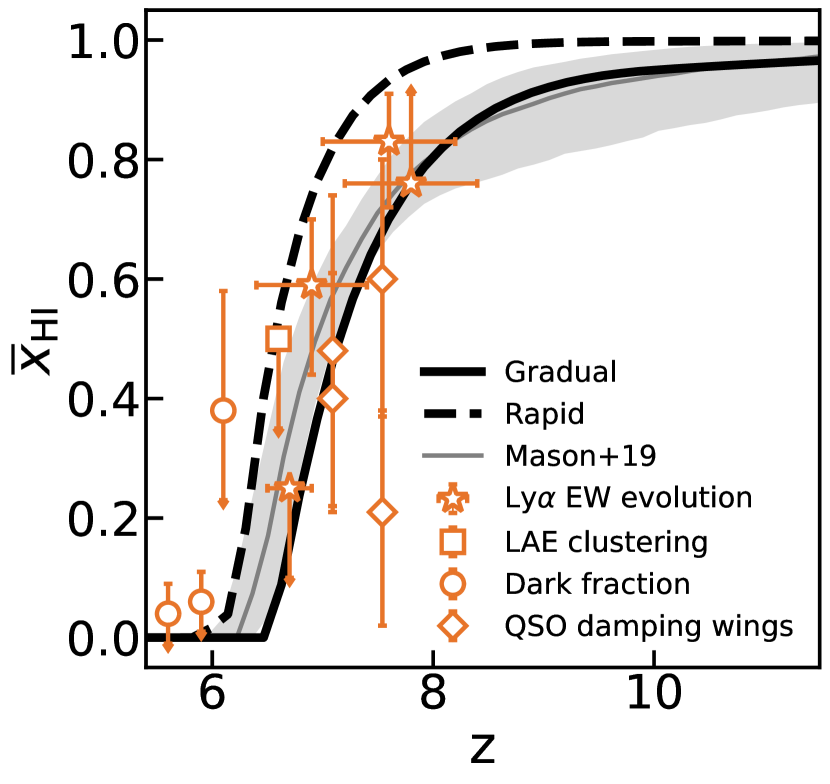
Constraining when and how reionisation began is pivotal for understanding when the first galaxies formed. Lyman-alpha (Ly$α$) emission from galaxies is currently our most promising probe of these early stages. At z>7 the majority of galaxies detected with Ly$α$ are in candidate overdensities. Here we quantify the probability of these galaxies residing in large ionised bubbles. We create (1.6 Gpc)$^3$ reionising intergalactic medium (IGM) simulations, providing sufficient volume to robustly measure bubble size distributions around UV-bright galaxies and rare overdensities. We find $M_{ m UV} \lesssim -16$ galaxies and overdensities are $\gtrsim$10-1000x more likely to trace ionised bubbles compared to randomly selected positions. The brightest galaxies and strongest overdensities have bubble size distributions with highest characteristic size and least scatter. We compare two models: gradual reionisation driven by numerous UV-faint galaxies versus more rapid reionisation by rarer brighter galaxies, producing larger bubbles at fixed neutral fraction. We demonstrate that recently observed z~7 overdensities are highly likely to trace large ionised bubbles, corroborated by their high Ly$α$ detection rates. However, the z~8.7 association of Ly$α$ emitters in EGS and GN-z11, with Ly$α$ at z=10.6, are unlikely to trace large bubbles in our fiducial model -- 11% and 7% probability of >1 proper Mpc bubbles, respectively. Ly$α$ detections at such high redshifts could be explained by: a less neutral IGM than previously expected; larger ionised regions at fixed neutral fraction; or if intrinsic Ly$α$ flux is unusually strong in these galaxies. We discuss how to test these scenarios with JWST and the prospects for using upcoming wide-area surveys to distinguish between reionisation models.
研究の動機と目的
- 宇宙再電離期における高赤方偏移銀河および過密度が大規模なイオン化バブルに存在する確率を定量化すること。
- バブルサイズ分布を用いて、多数のきわめて明るくない銀河による再電離と、まれな明るい銀河による再電離のモデルを区別すること。
- 最近の高赤方偏移Lyα検出(例:z ≈ 7–8およびz ≈ 10.6)を、イオン化バブルサイズおよびIGM中性率の観点から解釈すること。
- 近い将来のJWSTおよびEuclidの調査におけるイオン化バブルの検出可能性を予測し、再電離モデルを制約する能力を評価すること。
提案手法
- 再電離期におけるイオン化バブルサイズを、(1.6 Gpc)³の宇宙論的シミュレーションを用いて、IGMの放射輸送と源のフィードバックを含めて実施する。
- 異なる赤方偏移およびIGM中性率における、UVが明るい銀河および銀河の過密度周辺のイオン化バブルサイズを追跡する。
- 2つの再電離モデルを比較する:きわめて明るくない銀河による徐々な再電離(低脱出率)と、明るい銀河による急速な再電離(高脱出率)。
- バブルサイズ分布を用いて、固定の中性率および源の明るさにおける、1 proper Mpcを超えるバブルを有する確率を計算する。
- 基準モデルの予測に基づき、近い将来の調査(JWST COSMOS-Web、Euclid Deep、Roman Wide)におけるバブルの数密度を予測する。
- 宇宙分散および調査体積の影響が大規模なイオン化領域の検出に与える影響を分析する。

実験結果
リサーチクエスチョン
- RQ1UVが明るい銀河および過密度がz ≈ 7–8で大規模なイオン化バブル(>1 proper Mpc)に存在する確率はどの程度か?
- RQ2きわめて明るくない銀河による再電離と明るい銀河による再電離のモデルにおいて、バブルサイズ分布はどのように異なるか?
- RQ3なぜ、z ≈ 8.7(例:EGSおよびGN-z11)でのLyα検出は、基準モデル下で大規模なイオン化バブルに存在する可能性が低いのか?
- RQ4高赤方偏移Lyα検出を説明するためには、どのような条件(例:中性率の低さ、より強い固有のLyα放射、またはより明るい源)が必要か?
- RQ5EuclidやRomanのような広域調査が、イオン化バブルのサイズ分布を検出し、再電離モデルを制約できるか?
主な発見
- M_UV < -16の銀河および過密度は、ランダムな位置に比べて、大規模なイオン化バブルに存在する確率が10~1000倍高い。
- UVの明るさおよび過密度が高くなるほど、バブルサイズの特徴的スケールが増大し、ばらつきが減少する。これは、大規模な領域への強いバイアスを示している。
- z ≈ 7–8では、過密度が1 proper Mpcを超えるバブルを有する確率が40–93%以上であり、これは高いLyα検出率と整合的である。
- z ≈ 8.7では、EGSでは大規模バブル(>1 proper Mpc)に存在する確率が約11%、GN-z11では約7%にとどまり、これらの検出は非標準的状態を要する可能性が高い。
- 高赤方偏移Lyα検出は、IGM中性率をx_HI < 0.8に下げる、固定の中性率下でのより大きなバブル、または異常に強い固有のLyα放射を要する可能性がある。
- JWST COSMOS-Web調査では、x_HI < 0.9でない限り、10 cMpcを超えるバブルを検出することは難しいが、EuclidおよびRoman調査は十分な体積を有しており、宇宙分散を低く抑えてバブルサイズ分布を測定できる。
より良い研究を、今すぐ始めましょう
論文の読解から最終レビューまで、研究時間を劇的に削減しましょう。
クレジットカード登録不要
このレビューはAIが作成し、人間の編集者が確認しました。